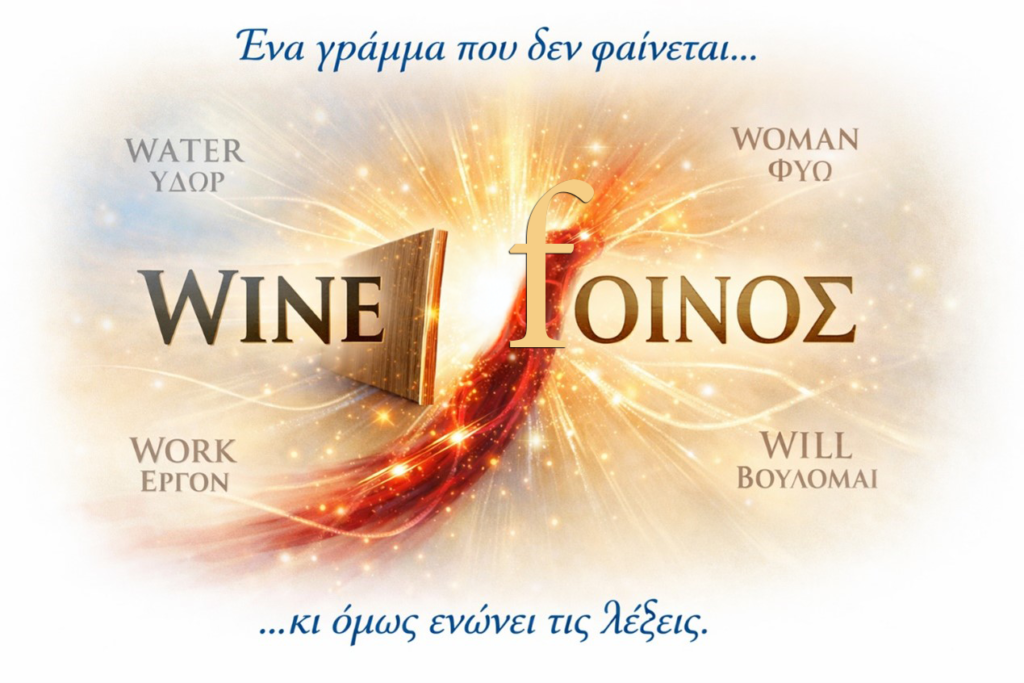
«Υπάρχει ένα γράμμα-φάντασμα που κυκλοφορεί ανάμεσα στο Work και το Έργον, στο Wine και τον Οίνο. Το λένε Δίγαμμα. Σε αυτή την ενότητα, γινόμαστε ντετέκτιβ του ήχου. Ακολουθούμε τα ίχνη που άφησε αυτό το αρχαίο γράμμα ταξιδεύοντας από την Ελλάδα στη Δύση και βρίσκουμε τους κρυφούς κρίκους που ενώνουν τις γλώσσες του κόσμου.»
Το δίγαμμα (ϝ)
Υπάρχουν γράμματα που χάθηκαν, αλλά δεν έφυγαν ποτέ.
Το δίγαμμα — ένα γράμμα που δεν το βλέπουμε πια — ζει κρυμμένο μέσα σε λέξεις, σε ήχους που άλλαξαν, σε συγγένειες που δεν φαίνονται με την πρώτη ματιά. Εκεί που κάτι «δεν κολλάει», συχνά κρύβεται αυτό.
Δεν χρειάζεται να το μάθεις σαν κανόνα.
Αρκεί να το συναντήσεις.
Σιγά σιγά θα αρχίσεις να το αναγνωρίζεις:
- σε λέξεις που μοιάζουν μεταξύ τους χωρίς να εξηγείται,
- σε ήχους που «μαλακώνουν»,
- σε μορφές που φαίνονται διαφορετικές αλλά θυμούνται κάτι κοινό.
Σου δείχνει απλώς ότι οι λέξεις έχουν παρελθόν —
και ότι αυτό το παρελθόν δεν χάθηκε.
 Αν το προσέξεις μία φορά, μετά θα αρχίσει να σου κάνει νόημα μόνο του.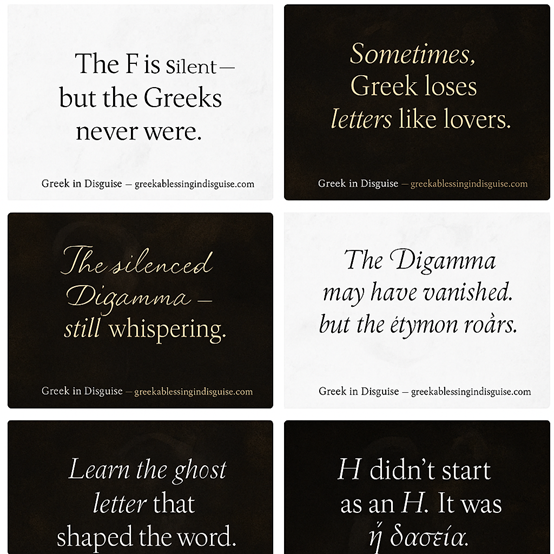
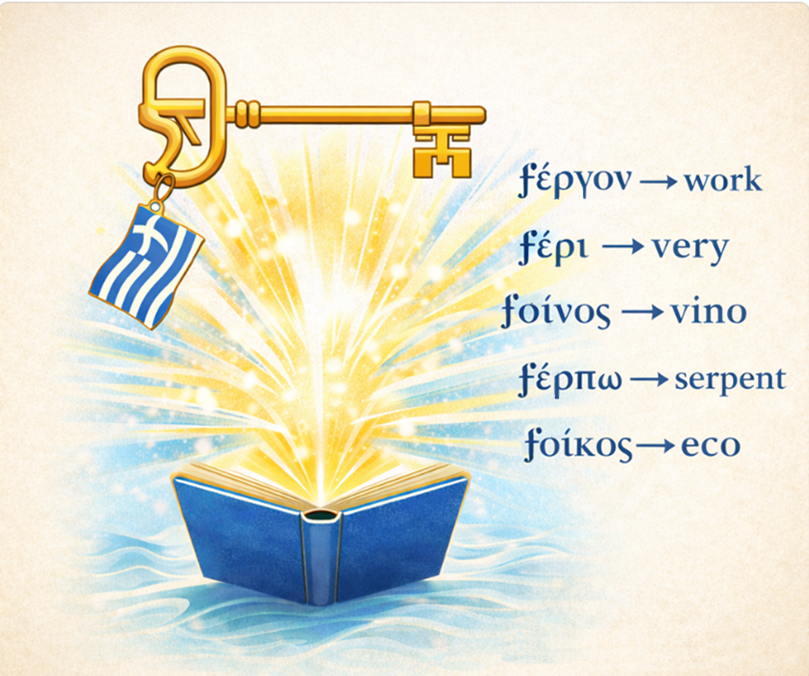
Ο ΠΑΝΔΕΚΤΗΣ ΤΩΝ ΡΙΖΩΝ: ΑΠΟ ΤΟ Α ΩΣ ΤΟ Ω
(Η Ελληνική Είσοδος με το «Φάντασμα» του Διγάμματος f και την «Ανάσα» της Δασείας ῞)
1. Αγω / Αγός < Fάγω > Ago: Η κίνηση προς τα εμπρός.
2. Αγνή < Fαγνή > Pure: Η καθαρότητα.
3. Αήρ < Fαfήρ > Air: Ο αέρας που αναπνέουμε.
4. Αιών < Αfών > Age / Aevum: Η ηλικία σου είναι ο αιώνας σου.
5. Ακούω < ΚοFέω > Écouter: Η ακοή.
6. Αλάτι / Άλς < Σάλς > Salt / Salary: Ο μισθός που πληρωνόταν σε αλάτι.
7. Αλεύρι < Fάλεfαρ > Farine: Η σύνθλιψη του καρπού.
8. Αλλάς < Αλλαfέντς > Alium: Το σκόρδο.
9. Αμοίβω/αμείβω< αμόFjω
10. Άναξ < Fάναξ > Khan: Ο ηγέτης.
11. Αξίνη < Αfξίνη > Axe: Το αιχμηρό εργαλείο.
12. Αριστερά=επί τα λαιά/λεfά>left
13. Αρμονία < Fαρμονία > Harmony: Το ταίριασμα των ήχων.
14. Αρνί < Fαρνίον > Farn: Το μικρό πρόβατο.
15. Άρρην < Fάρην > Virile: Η ανδρική δύναμη.
16. Άστυ < Fάστυ > Asty / Wasu: Η πόλη.
17. Αυγή / Ηώς < Fαfώς > Aube / Aurora: Το πρώτο φως.
18. Αυτιά < ωFάδια = ώτα.
19. Αυξάνω < Αfγ-σω > Augment: Η μεγέθυνση.
20. Βάλανος < Βαλ- > Ball: Το σφαιρικό σχήμα.
21. Βάσις < Βαίνω > Basis: Εκεί που πατάς (βαίνεις).
22. Βίος < ΒίFος > Vital / Vivid: Η ζωή σε κίνηση.
23. Βούλομαι < Fούλομαι > Will: Η θέληση.
24. Γαία / Δα < Δάfα > -gua / -land: Η γη.
25. Γαλαξίας < Γάλα > Galaxy: Ο δρόμος από γάλα της Ήρας.
26. Γλοιός < Γλοιf- > Glue: Η κολλώδης ουσία.
27. Γόνυ < Γονf- > Knee / Genu: Το γόνατο.
28. Δέα / Ευδία < ΔίFα > Day / Dies: Η φωτεινή ημέρα.
29. Δίας / Θεός < ΘεFός > Deus / Dieu: Το θείον.
30. Δις / Δύο < Δfι- / Δύfω > Bi- / Two: Η δυαδικότητα.
31. Δρόσος < Δfόσος > Dew: Η πρωινή υγρασία.
32. Έαρ < Fέσαρ > Ver / Primavera: Η άνοιξη.
33. Είδον / Ιδείν < Fιδ- > Video / Vision: Η όραση.
34. Εικόνα < Fεικ- > Icon: Αυτό που μοιάζει (Fείκω).
35. Είκελον < Fείκελον > Equal: Το όμοιο.
36. Είκοσι < Fείκατι > Vingt: Ο αριθμός.
37. Ειλύω < Fειλύω > Volvo / Wheel: Η κύλιση.
38. Είργω < Fεργ- > Orchard: Ο περιφραγμένος χώρος.
39. Εκατόν < Κεντ- > Cent: Η εκατοντάδα.
40. Εκείνος < ΧFει > He: Η κατάδειξη.
41. Ελάα / Ελιά < ΕλάFα > Oliva / Oil: Ο καρπός.
42. Έλαιον < Fελ- > Oil / Huile: Το λάδι.
43. Εμέω < Fέμεω > Vomit: Η αποβολή από το στόμα.
44. Ενέργεια < Εν + Έργον > Energy: Το έργο σε δράση.
45. Εννέα < Έννεfο > Nine: Ο αριθμός.
46. Έννυμι / Εσθής < Fεσ- > Vest: Το ρούχο.
47. Έπος < Fέπος > Vepem: Ο λόγος.
48. Επτά < Σεπτά > Seven: Η δασεία που έγινε S.
49. Έργον < Fέργον > Work: Η δράση.
50. Έρπω < Σέρπω > Serpent: Το ερπετό που σέρνεται.
51. Έσπερος < Fέσπερος > Vesper: Το βραδινό άστρο.
52. Έτερος < Fέτερος > Other: Ο άλλος.
53. Έτος < Fέτος > Veteran / Year: Ο χρόνος που πέρασε.
54. Έχω < Σέχω > Have: Η δασεία που έγινε H.
55. Έξ < Σέξ > Six / Hex: Το S που έγινε «ανάσα».
56. Ζυγός < ῞Ζυγός / Yod > Yoke / Yoga: Η ένωση/ζεύξη.
57. Ήβη < Fήβη / Jήβη > Young: Η θεά της νεότητας.
58. Ηδύς < Fηδύς > Sweet: Το γλυκό (W < F).
59. Ήλιος < Σάfέλιος > Sun / Sol: Το φως.
60. Ημείς < Σ-αμμέ > Us: Εμείς.
61. Ημί- < Σέμι > Semi-: Το μισό.
62. Ιερόν < Fερ- > Verbena: Η ιεροβοτάνη.
63. Ιον < Fίον > Violet: Το μενεξεδί χρώμα.
64. Ίππος < Fίππος > Equus: Το άλογο.
65. Ιστορία / Ίστωρ < Fιστορία > History: Η γνώση μέσα από την έρευνα.
66. Κάπρος < Βοfάρ > Boar: Το αγριογούρουνο.
67. Κλείς / Κλάις < ΚλάFις > Clavis / Key: Το κλειδί.
68. Κωφός < Κωfός > Cave: Η τρύπα/σπηλιά.
69. Λαιός < Λαf- > Left: Ο αριστερός.
70. Λεβάντα < ΛάF- > Lavender: Το λούσιμο (Lavo).
71. Λέων < ΛέFων > Lion: Ο βασιλιάς των ζώων.
72. Λουτρόν < ΛοFετρόν > Lavatory: Το πλύσιμο.
73. Μύλος < ΜύFλος > Mill: Η σύνθλιψη.
74. Ναύς < ΝαFς > Navy / Naval: Το πλοίο.
75. Νέος < ΝέFος > New / Novus: Το καινούργιο.
76. Νεύρο < Σνεf- > Nerve: Ο ιστός.
77. Νέω (κολυμπώ) < Νάfω > Swim / Nager: Η πλεύση.
78. Νήμα < Fέρfος > Fil: Η κλωστή.
79. Νύφη < Νυfός > Novia: Η νέα γυναίκα.
80.
81. Ξύλον / Ύλη < Fύλον > Xylophone / Wood: Το υλικό.
82. Οδός < Fοδός > Via / Way: Ο δρόμος.
83. Οίκος < Fοίκος > Eco- / Village: Το σπίτι.
84. Οίνος < Fοίνος > Wine / Vin: Το κρασί.
85. Όνομα < Fόνομα > Name: Η κλήση.
86. Ορίζων < Fορίζων > Horizon: Το όριο του βλέμματος.
87. Όσνος < F’οσνος > Gomar: Ο γάιδαρος.
88. Όσσα / Όψ < Fοκjα > Voice / Vox / Ocular: Η φωνή/μάτι.
89. Όχος < Fόχος > Vehicle: Το όχημα.
90. Πούς / Ποδός < Ποf- > Foot: Το πόδι (Π > F).
91. Πύελος < Πελf- > Pelvis: Η λεκάνη.
92. Πύρ < Πfύρ > Fire: Η φωτιά.
93. Ραίω < Fραίω > Vras: Η φθορά.
94. Ρέω < Fρέω > River: Η ροή.
95. Ρήμα < Fρήμα > Word: Ο λόγος.
96. Ρίζα < Fρίζα > Root: Η βάση.
97. Ρίγος < Fρίγος > Frigid: Το κρύο.
98. Ρόδον < Fρόδον > Rose: Το λουλούδι.
99. Ρυθμός < Fρυθμός > Rhythm: Η τάξη στην κίνηση.
100. Ρύμη < Fρύμη > Route: Ο δρόμος.
101. Ταύρος < Τάf-ρος > Taurus: Το ισχυρό ζώο.
102. Ταώς < Ταfώς > Pavo: Το παγώνι.
103. Τείνω / Ταναός < Τεf- > Thin: Το τεντωμένο/λεπτό.
104. Τρία < Τρίfα > Three: Ο αριθμός.
105. Τρίβω < Τριf- > Detrimental: Η τριβή.
106. Υγιεινή < ῞Υγι- > Hygiene: Η ανάσα της δασείας.
107. Υδωρ < Fυδωρ > Water: Το υγρό στοιχείο.
108. Υετός < Fυετός > Weather: Ο καιρός.
109. Υπά / Υπέρ < Σύπερ > Super / High: Το από πάνω.
110. Υπό < Σύπο > Sub / Under: Το από κάτω.
111. Ύστερος < Fύστερος > Utter: Ο έσχατος.
112. Υφαίνω < ΥφόF- > Weave: Η πλέξη.
113. Φύω / Γυνή < Fύω- > Woman: Η βλάστηση της ζωής.
114. Χθες < Fχθές > Yesterday: Η προηγούμενη μέρα.
115. Χήρα < Fίδfα > Widow: Η διαχωρισμένη.
116. Χορός / Γύρος < Fελ- > Whirl: Η περιστροφή.
117. Ψυχή / Ψύχω < Fύχ- > Soul: Η πνοή.
118. Ωόν < ΩFίον > Oeuf / Ovum: Το αυγό.
119. Ώνεια / Ωνή < Fων- > Vendo: Η πώληση.
120. Ώρα < Fορ- > Hornus: Ο χρόνος.
121. Ώψ / Όμμα < Fόπ- > Eye: Το μάτι.
«Εκεί που How the English language meets its Ancient Greek DNA through the “ghost” letter F
• AGE < Αfών > ΑΙΩΝ
o The duration of life (Age) stems from the Greek root for eternity.
• AGO < Fάγω > ΑΓΩ
o Moving forward (Ago) comes from the verb meaning to lead or drive.
• AIR < Fαfήρ > ΑΗΡ
o The air we breathe contains the double “ghost” of the digamma.
• AUGMENT < Αfγ-σω > ΑΥΞΑΝΩ
o To increase (Augment) is directly linked to the Greek root for growth.
• AURORA / AUBE < Fαfώς > ΑΥΓΗ
o The first light of dawn is the ancient Greek “Avgi”.
• AXE < Αfξίνη > ΑΞΙΝΗ
o The sharp tool that cut through centuries.
• BALL < Βαλ- > ΒΑΛΑΝΟΣ
o The spherical shape that rolls.
• BI- / TWO < Δfι- / Δύfω > ΔΙΣ / ΔΥΟ
o Duality is hidden in the root of the number two.
• CAVE < Κωfός > ΚΩΦΟΣ
o A hollow passage or hole.
• CENT < Κεντ- > ΕΚΑΤΟΝ
o The hundred that became the basis for measurements.
• CLAVIS / KEY < ΚλάFις > ΚΛΕΙΣ
o The tool that “unlocks” knowledge.
• DAY / DIES < ΔίFα > ΔΕΑ
o The bright day shining through the digamma.
• DEUS / DIEU < ΘεFός > ΔΙΑΣ / ΘΕΟΣ
o The root for the Divine.
• DEW < Δfόσος > ΔΡΟΣΟΣ
o The morning moisture that cools the earth.
• DOLPHIN < Δελφύς > ΔΕΛΦΙΣ
o Named after “delphys” (womb), identifying it as a mammal.
• ECO- / VILLAGE < Fοίκος > ΟΙΚΟΣ
o The house, the basis for both Economy and Ecology.
• ENERGY < Εν + Fέργον > ΕΝΕΡΓΕΙΑ
o Work in action.
• EQUAL < Fείκελον > ΕΙΚΕΛΟΝ
o The concept of likeness and equality.
• EYE < Fόπ- > ΩΨ / ΟΜΜΑ
o The organ of sight, preserving the archaic root.
• FARINE < Fάλεfαρ > ΑΛΕΥΡΙ
o The crushing of grain that feeds us.
• FARN < Fαρνίον > ΑΡΝΙ
o The word for the young sheep.
• FIRE < Πfύρ > ΠΥΡ
o The initial “P” shifted to the English “F”.
• FOOT < Ποf- > ΠΟΥΣ / ΠΟΔΟΣ
o The “P” became “F” and the “D” became “T”.
• GALAXY < Γάλα > ΓΑΛΑΞΙΑΣ
• From the “milky way” of Hera in Greek mythology.
• GENU / KNEE < Γονf- > ΓΟΝΥ
• The knee joint, where the Greek “G” evolved into the English “K”.
• GLUE < Γλοιf- > ΓΛΟΙΟΣ
• The sticky, viscous substance.
• -GUA / -LAND < Δάfα > ΓΑΙΑ / ΔΑ
• The very earth and the land we inhabit.
• HARMONY < Fαρμονία > ΑΡΜΟΝΙΑ
• The fitting together of sounds and elements.
• HAVE < Σέχω > ΕΧΩ
• To hold or possess; the “H” represents the ancient Greek rough breathing (῞).
• HE < ΧFει > ΕΚΕΙΝΟΣ
• The demonstrative pronoun for “that one”.
• HISTORY < Fιστορία > ΙΣΤΟΡΙΑ
• Knowledge acquired by investigation (istor).
• HORIZON < Fορίζων > ΟΡΙΖΩΝ
• The limit of our vision.
• HYGIENE < ῞Υγι- > ΥΓΙΕΙΝΗ
• Health and cleanliness; the “H” is the “breath” of the rough breathing.
• ICON < Fεικ- > ΕΙΚΟΝΑ
• An image or likeness.
• KHAN < Fάναξ > ΑΝΑΞ
• The title for a supreme leader or king.
• LAVATORY / LAVENDER < ΛοFετρόν / ΛάF- > ΛΟΥΤΡΟΝ / ΛΕΒΑΝΤΑ
• Related to washing (lavo) and the plant of cleanliness.
• LEFT < Λαf- > ΛΑΙΟΣ
• The direction of the left hand.
• LION < ΛέFων > ΛΕΩΝ
• The king of animals, whose name carries the force of the digamma.
• MILL < ΜύFλος > ΜΥΛΟΣ
• The act of crushing grain.
• NAME < Fόνομα > ΟΝΟΜΑ
• The designation by which a person or thing is known.
• NAVY / NAVAL < ΝαFς > ΝΑΥΣ
• The ship and the fleet.
• NERVE < Σνεf- > ΝΕΥΡΟ
• The fiber or tissue of the body.
• NEW / NOVUS < ΝέFος > ΝΕΟΣ
• The English “W” and Latin “V” preserve the sound of the digamma.
• NINE < Έννεfο > ΕΝΝΕΑ
• The number nine.
• NOVIA < Νυfός > ΝΥΦΗ
• The bride or young woman.
The invisible threads of the “ghost” sounds and the “breathing” mark
• OIL / OLIVA < Fελ- / ΕλάFα > ΕΛΑΙΟΝ / ΕΛΙΑ
o The liquid gold of the Mediterranean, preserving the digamma.
• OTHER < Fέτερος > ΕΤΕΡΟΣ
o The designation for the “different” or the “second”.
• PAVO < Ταfώς > ΤΑΩΣ
o The peacock, where the Greek “T” shifted to the Latin/English “P”.
• PELVIS < Πελf- > ΠΥΕΛΟΣ
o The basin-shaped structure of the body.
• PURE < Fαγνή > ΑΓΝΗ
o The concept of being clean and untainted.
• QUATRE < Τέτταρα > ΤΕΤΤΑΡΑ
o The number four; the Greek “T” corresponds to the Latin/French “Q”.
• QUI / QUALITY < Ποῖος > ΠΟΙΟΣ
o The “what kind” or the nature of things.
• RHYTHM < Fρυθμός > ΡΥΘΜΟΣ
o The flow and order of movement; the “h” is the Greek rough breathing (῞).
• RIVER < Fρέω > ΡΕΩ
o The constant flow of water.
• ROOT < Fρίζα > ΡΙΖΑ
o The base or the foundation of a plant or word.
• ROSE < Fρόδον > ΡΟΔΟΝ
o The flower of the digamma.
• ROUTE < Fρύμη > ΡΥΜΗ
o The path or the street through which we move.
• SALT / SALARY < Σάλς > ΑΛΑΤΙ / ΑΛΣ
o The “S” in English represents the Greek rough breathing (῞).
• SEMI- < Σέμι > ΗΜΙ-
o The half; the “S” is the Greek breathing mark.
• SERPENT < Σέρπω > ΕΡΠΩ
o The creature that crawls; the “S” is our rough breathing.
• SEVEN < Σεπτά > ΕΠΤΑ
o The number seven; the “S” became the Greek “breath”.
• SIX / HEX < Σέξ > ΕΞ
o The number six; the “S” is preserved in “Six” but became an “H” in “Hex”.
• SISTER < Σfέ- > ΕἷΣ / ΕΤΕΡΟΣ
o The root for one’s own kin.
o The breath of life.
· SUB / UNDER < Σύπο > ΥΠΟ
o Below or beneath; the “S” is the Greek rough breathing.
· SUN / SOL < Σάfέλιος > ΗΛΙΟΣ
o The light of the world; the initial “S” is our rough breathing.
· SUPER / HIGH < Σύπερ > ΥΠΑ / ΥΠΕΡ
o Above or beyond; the “S” is our breathing mark.
· SWEET < Fηδύς > ΗΔΥΣ
o The “W” in English is the Greek digamma.
· SWIM / NAGER < Νάfω > ΝΕΩ
o The act of moving through water.
Completing the circle of ancient sounds and modern meanings
· TAURUS < Τάf-ρος > ΤΑΥΡΟΣ
o The strong, powerful bull; the “U” preserves the digamma sound.
· THIN < Τεf- > ΤΕΙΝΩ / ΤΑΝΑΟΣ
o The concept of being stretched or slender.
· THREE < Τρίfα > ΤΡΙΑ
o The number three, rooted in the ancient digamma.
· US < Σ-αμμέ > ΗΜΕΙΣ
o The collective “we”; the English “S” reflects the Greek rough breathing (῞).
· UTTER < Fύστερος > ΥΣΤΕΡΟΣ
o The ultimate or the last; the digamma shaped the outer limit of the word.
· VENDO < Fων- > ΩΝΕΙΑ / ΩΝΗ
o To sell or trade; the Latin/English “V” is the Greek digamma.
· VER / PRIMAVERA < Fέσαρ > ΕΑΡ
o The spring, the season of “Ver”; the “V” is the Greek “F”.
· VERBENA < Fερ- > ΙΕΡΟΝ
o The sacred herb; the “V” stems from the ancient digamma.
· VESPER < Fέσπερος > ΕΣΠΕΡΟΣ
o The evening star; the Latin/English “V” is the Greek “ghost” letter.
· VEST < Fεσ- > ΕΝΝΥΜΙ / ΕΣΘΗΣ
o The garment we wear; the “V” preserves the Greek root.
· VETERAN / YEAR < Fέτος > ΕΤΟΣ
o Time passed; the “V” in Veteran and the “Y” in Year both trace back to “Etos”.
· VIA / WAY < Fοδός > ΟΔΟΣ
o The path or road we travel.
· VIDEO / VISION < Fιδ- > ΕΙΔΟΝ / ΙΔΕΙΝ
o To see; the “V” is the archaic Greek digamma of sight.
· VIOLET < Fίον > ΙΟΝ
o The color and the flower.
· VIRILE < Fάρην > ΑΡΡΗΝ
o The strength of man; the “V” is the Greek digamma.
· VITAL / VIVID < ΒίFος > ΒΙΟΣ
o Life in motion; the “V” is the Greek “F”.
· VOICE / VOX / OCULAR < Fοκjα > ΟΣΣΑ / ΟΨ
o The sound of speech and the eye of vision; all connected by the digamma.
· VOLVO / WHEEL < Fειλύω > ΕΙΛΥΩ
o The act of rolling or turning.
· VOMIT < Fέμεω > ΕΜΕΩ
o To expel; the “V” is the Greek “F”.
· WATER / WEATHER < Fυδωρ / Fυετός > ΥΔΩΡ / ΥΕΤΟΣ
o The moisture of the earth and the elements of the sky.
· WEAVE < ΥφόF- > ΥΦΑΙΝΩ
o The interlacing of threads; the “W” and “V” reflect the Greek digamma.
· WHIRL < Fελ- > ΧΟΡΟΣ / ΓΥΡΟΣ
o The circular motion; the “Wh-” captures the ancient sound.
· WIDOW < Fίδfα > ΧΗΡΑ
o The one who is separated; the “W” reflects the double digamma.
· WILL < Fούλομαι > ΒΟΥΛΟΜΑΪ
o The power of choice and desire.
· WINE / VIN < Fοίνος > ΟΙΝΟΣ
o The classic bridge where the “W” and “V” meet the Greek “F”.
· WOMAN < Fύω- > ΦΥΩ / ΓΥΝΗ
o The source of life and growth.
· WORK < Fέργον > ΕΡΓΟΝ
o Action and creation; the “W” is the living Greek digamma.
· XYLOPHONE / WOOD < Fύλον > ΞΥΛΟΝ / ΥΛΗ
o The material of the forest.
· YOKE / YOGA < ῞Ζυγός > ΖΥΓΟΣ
o The union and the bond; the “Y” reflects the Greek rough breathing and initial sound.
- The invisible threads of the “ghost” sounds and the “breathing” mark Tracing the “ghost” sounds that connect English words to their Greek origins
- How the English language meets its Ancient Greek DNA through the “ghost” letter F

