
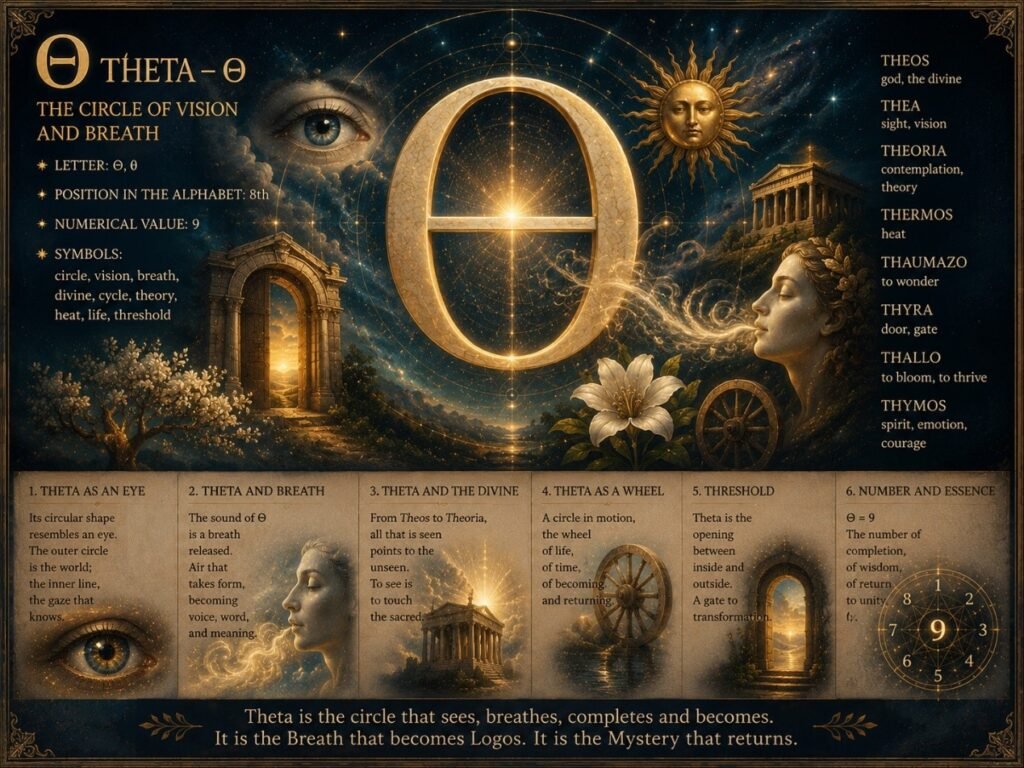
THETA (Θ, θ) — the Greek TH in English
- Sound
Theta represents the voiceless “th” sound, as in:
- think
- theatre
- theory
- method
It is not t, not d, and not f.
It is breath passing between tongue and teeth.
That matters.
Greek made breath audible.
- What Theta carries (conceptually)
Theta is linked to θέα / θεωρία:
- θέα → seeing
- θεωρώ → to observe attentively
- θεωρία → contemplation, not speculation
So in English:
- theory = a way of seeing
- theatre = a place of seeing
- theology = seeing / thinking about the divine
👉 Theta is not noise.
👉 Theta is perception with breath.
- Why English kept TH
English needed a sound it did not originally have.
Instead of flattening Θ into T or S, it chose TH —
a graphic compromise to preserve Greek precision.
That alone tells you something about Greek authority.
- Theta vs other “th” sounds
English has two “th” sounds:
Greek | English example | Sound |
Θ (theta) | think, theory | voiceless |
Δ (delta, via evolution) | this, that | voiced |
Greek separated them.
English merged them graphically but not phonetically.
Greek precision survived inside English speech.

