
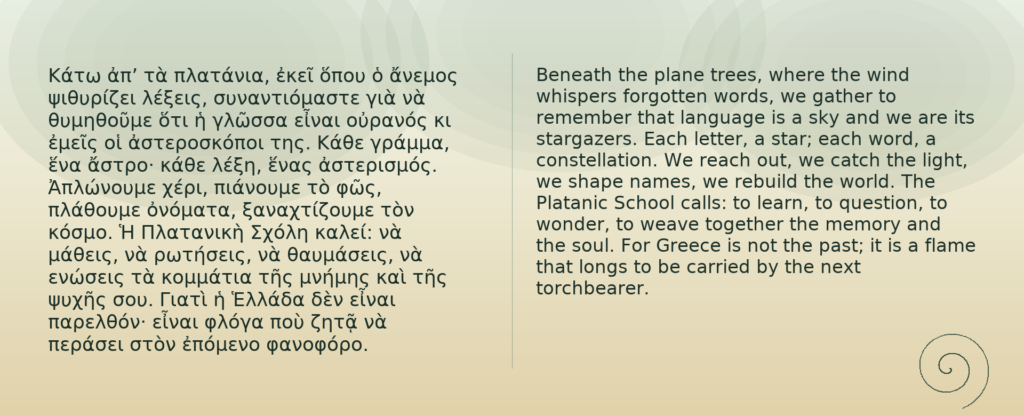
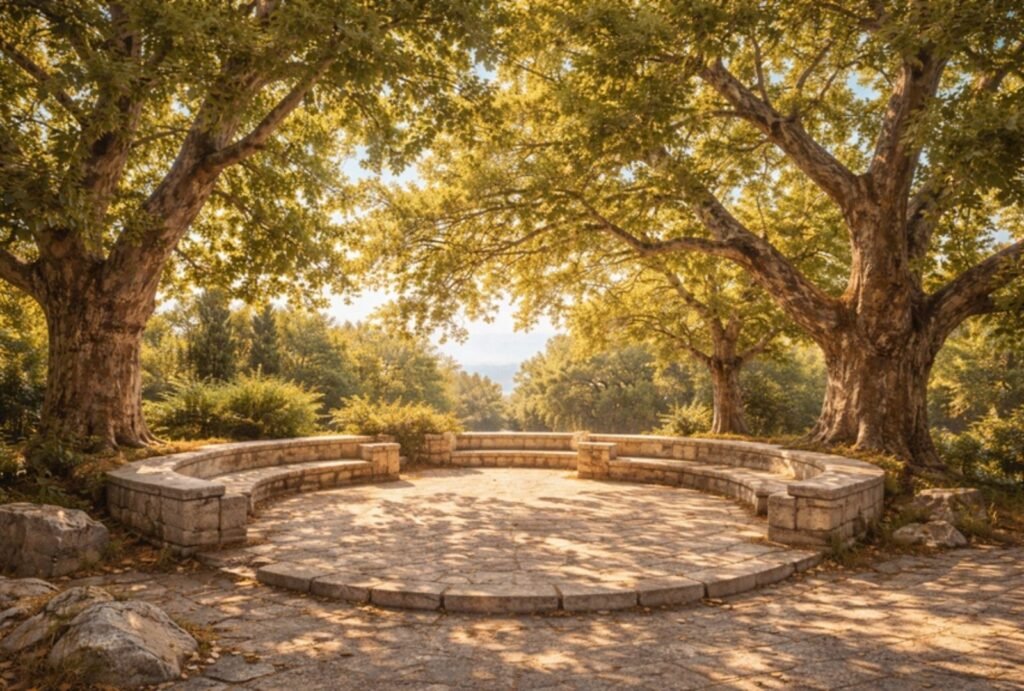
Come sit under the plane trees
You may think you don’t speak Greek.
Yet every day, you think with it.
Not as a language,
but as a way of shaping meaning.
Greek is not hidden in museums.
It lives inside words you already use —
form, rhythm, system, idea, drama, energy.
This is not a course.
It is an invitation.
To slow down.
To notice.
To rediscover how language trains the mind
to think clearly, feel precisely, and connect deeply.
Under the plane trees,
learning becomes joy again —
before it becomes analysis.
Come closer.
The words remember the way.
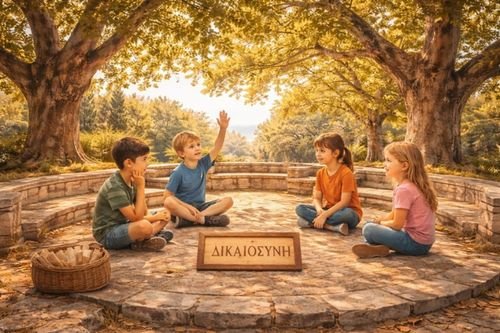
The Plane‑Tree Schole is not a classroom; it is a meeting place. Beneath the plane trees—where shade cools the mind—words return to their sources and remember why they were born. Here, we do not merely teach language; we live it. We explore roots, variations, and transformations, discovering that no word stands alone: each carries kinship, history, and music.
At the Plane‑Tree School, joy comes before analysis. First comes play, curiosity, and wonder; precision follows. Children (and adults who still know how to wonder) compose, draw, match, and dramatize. They learn that Greek rarely offers simple “synonyms,” but rather fine shades of meaning—subtle differences that reshape thought itself.
Our aim is not to display knowledge, but to cultivate a relationship: between effort and reward, memory and imagination, past and present. To learn how to listen to words—so that, when the time comes, they may speak back to us.
Come sit under the plane trees—because children understand more than we think
There is a quiet wisdom in a child’s gaze. Children do not understand less; they understand differently. They do not yet filter the world through the defenses of adults, nor do they divide it into “useful” and “useless.” They hear the tone before the explanation, they sense the meaning before the definition. Where the adult asks for proof, the child recognizes truth.
When you speak to them with vivid words, they follow you. When you give them room to play with meaning, they spread it out like a kite. They aren’t afraid of complexity; they’re afraid of being deprived of joy. That’s why they remember whatever touches their hearts: a root word that opens a path, a story that sheds light, a mistake that becomes a bridge.
At the Plataniki School, we trust in this wisdom. We speak to the children not “more simply,” but more truthfully. And they—as if they had known it all along—respond with an understanding that seeks no applause, only continuity.
Under the Plane Trees There is no rush here. The Word flows like water, whispers like the leaves, and teaches us not something new—but what we have always known
Pedagogical Note (For the Adults)
These games are NOT:
- Competitive contests (of confrontation)
- Exercises of logical display (showing off)
- Intelligence tests
They ARE:
- Exercises in intellectual humility
- Training in conceptual clarity
- Practice in the art of listening
They Cultivate:
- Critical thinking
- Emotional regulation
- The courage to revise (one’s own views)
Here, the discourse is slow and explanatory, intended for those who wish to stand in the shade of the plane tree and reflect deeply.

