

















Philoquantum book

PHILOQUANTUM
Philosophers and quantum physicists
 

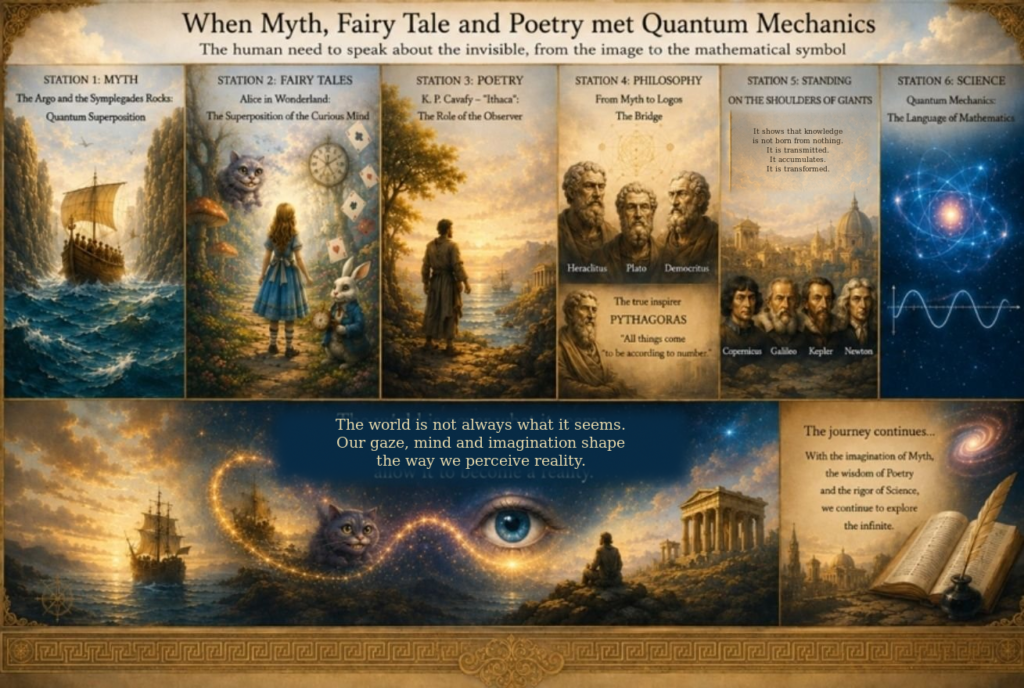
This work is not a physics textbook. Nor is it a philosophical treatise. It is a bridge. It begins with tender lessons — not to transmit knowledge, but to awaken wonder.

It continues with encounters: Ancient philosophers and quantum physicists in a dialogue that never historically happened — yet unfolds here.

Then come the faces. Brief, human biographies. To remind us that great ideas are born from individuals who doubted, struggled, and dared.

Finally, a Glossary. Not as a technical appendix, but as a map.

Quantum Physics is not merely a theory. It is a way of seeing.

Ancient Wisdom is not the past. It is memory waiting to awaken.

If this entire structure has a purpose, it is this: to remember that the world is not a machine — it is a relationship.

That the observer is not outside the universe — but within it.

And that knowledge is always a form of return.

Tender Lessons in Quantum Physics
 
PROEM

These short texts were not written to teach. They were written to remind. They require no background in physics or philosophy. Only something simple and precious: attention.

Quantum Physics revealed that the world is not what it seems. Ancient wisdom had whispered it centuries earlier: that the observer participates, that certainty is rare, that reality is born in relation.

Quantum Nuggets are brief pauses along this path. They do not need to be read in order. They only need to be allowed to find you.

For the Teens of the World and the Soul

Welcome to a journey where the infinitesimal meets the infinite. These 32 short lessons are more than just physics notes; they are tender “quantum stirrings” for those who refuse to let go of their sense of wonder. Here, science encounters philosophy, and logic dances with mystery. We invite you to view the world not as something static, but as a constant field of probability—a vibration waiting for your unique gaze to take form. Because in the quantum universe, much like in adolescence, everything is possible until the moment you decide who you truly want to be.

EPILOGUE
 

If you reached this point, you did not learn something new. You remembered something old. The world may not be a machine but a conversation. Knowledge is not conquest but participation. The question may be truer than the answer.

If any of these Nuggets made you pause for a moment, see things differently, or feel less alone in the universe, then they’ve already done their job.

The rest… you’ll remember on your own.

Ancient Greek Philosophers & Quantum Physics

Why is this book missing?
Because physicists fear poetry and poets fear mathematics. But we have Greek.
When Anaxagoras says: “Everything was in chaos, then the Mind came and brought order to it” (Everything was in chaos, then the Mind came and brought order to it), he is describing exactly the collapse of the wave function!

A Dialogue Through the Ages
 

 There is a hidden connection between the words of the philosophers and the equations of quantum physicists. In this section, we present six iconic pairs of thinkers, where ancient insight meets modern proof. From Heraclitus and Heisenberg to Democritus and Bohr, you will discover that the Universe is not made of things, but of relationships and vibrations. The Philosophers posed the questions, the Quantum scientists measured the answers, and together they compose the universal Quality of human intellect. It is a meeting beyond time, where the Zest for truth remains unchanged.

Philosophical Idea: Everything flows. Change is the only constant. The world emerges through the tension of opposites.
Quantum Theory: The uncertainty principle shows that we cannot precisely know all properties of a particle simultaneously.
Quantum Analogy: Reality is not a static object but a dynamic process of probabilities.

Heraclitus & Heisenberg: The Flux and Uncertainty

The Experiment (In simple terms): Imagine you want to measure the position of an electron. To “see” it, you must bounce “light” (a photon) off it. But the electron is so tiny and sensitive that the moment the photon touches it, its velocity and path change instantly!

The Proof: Heisenberg proved mathematically that it is impossible to know both the exact position and the exact momentum (direction/speed) of a particle at the same time. The more you “illuminate” one, the more the other “fades into the dark.”

The Connection to Heraclitus:

  • Heraclitus: “Panta Rhei” (Everything flows). You cannot step into the same river twice, for the second time, neither the river nor you are the same. Motion is the only constant.
  • Heisenberg: Reality is not a static “thing” waiting to be measured. It is a continuous interaction. The moment you try to “freeze” a moment to measure it, the flow eludes you.

The Conclusion:
“Uncertainty is not a lack of knowledge; it is the proof that the world is alive and in constant motion. Just like Heraclitus’s river, the electron refuses to stand still and be imprisoned by a single measurement.”

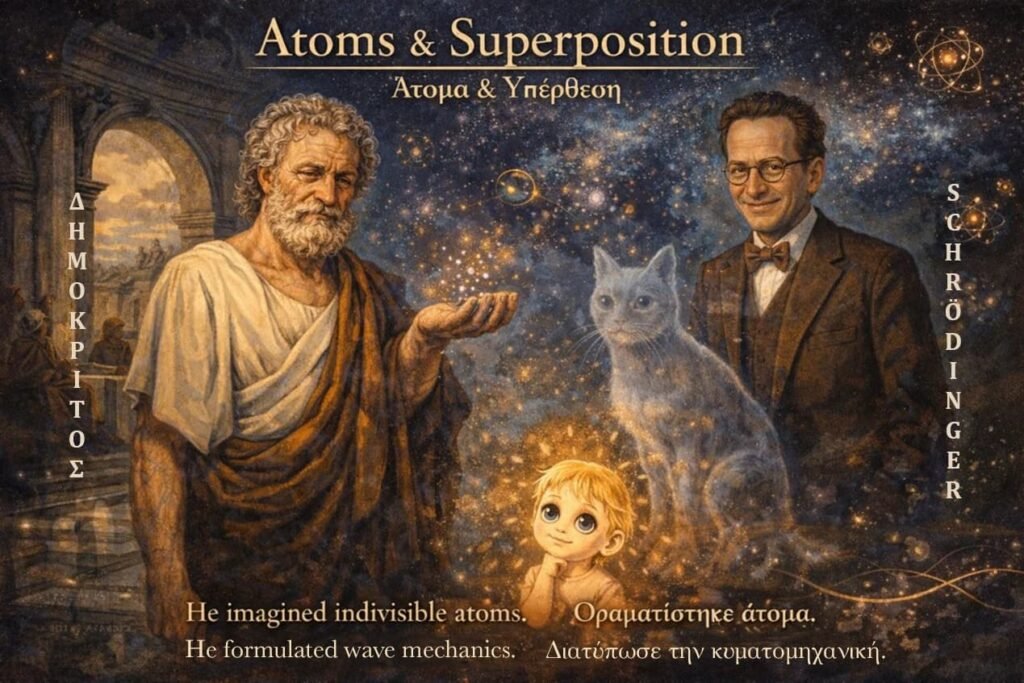
Philosophical Idea: The world consists of atoms and void.
Quantum Theory: Elementary particles are not solid “grains” of matter, but excitations of quantum fields.
Quantum Analogy: The stability of matter is an illusion; at its core, reality is composed of probability wavefunctions.

Democritus & Schrödinger: The Atom and the Superposition

The Thought Experiment: Schrödinger’s Cat The famous “Schrödinger’s Cat” never actually existed in any laboratory. It was a brilliant thought experiment (Gedankenexperiment) designed by Erwin Schrödinger—not to describe a real situation, but to highlight the absurd, almost metaphysical face of the quantum microcosm.

Imagine a cat enclosed inside an opaque box. Next to it lies a diabolical mechanism: a radiation detector and a microscopic amount of radioactive material. If even a single atom decays, the detector will register it and release a lethal poison.

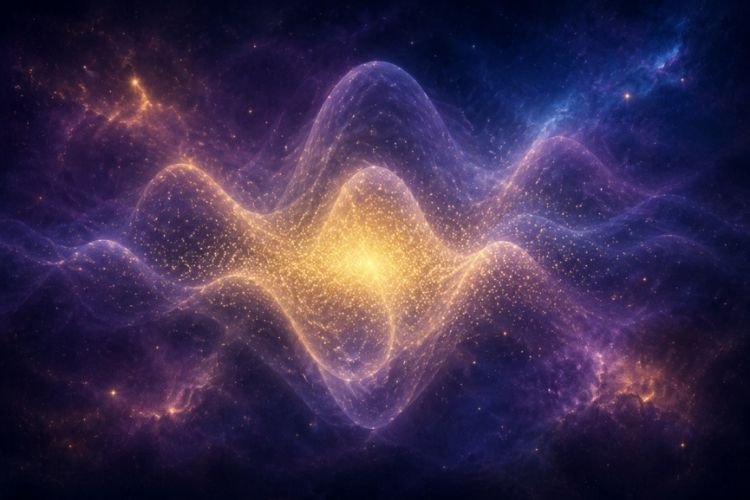
According to the laws of quantum physics, as long as the box remains hermetically sealed and no one looks inside, the atom exists in a state of superposition: it has decayed AND it has not decayed at the same time. The mathematical wavefunction encompasses both realities. Consequently, the cat inside the box is—mathematically and logically—dead AND alive at the exact same moment.

Only the moment the Observer opens the box (the act of measurement) is nature instantly forced to “choose.” The superposition collapses, the probabilities vanish, and a single, tangible reality solidifies before our eyes.

The Bridge of the Ages

  • Democritus: He was the first to strip the world of the senses, declaring that truth is hidden in “atoms” (the indivisible) and the “void.” He saw the invisible building blocks of nature, but he also intuitively sensed the deeper, mathematical logic that governs the unseen.
  • Schrödinger: Arriving 2,400 years later, he proved that Democritus’s “atoms” are not solid, hard little balls mechanically colliding in a vacuum. They are wave entities, pulses of energy dancing within a field of infinite probabilities.

Conclusion:

“Democritus gifted us the ‘particle’—the geometric constant of matter. Schrödinger breathed ‘soul’ into it—the wave of probability, which travels through infinity and materializes into fact only when the human mind decides to cast its gaze upon it.”

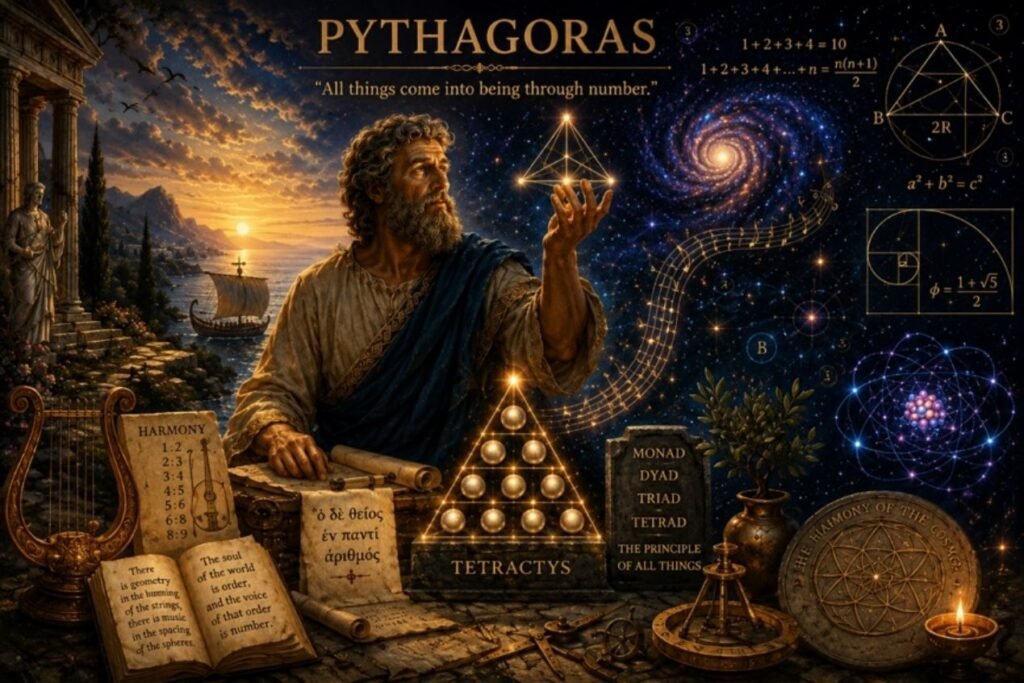
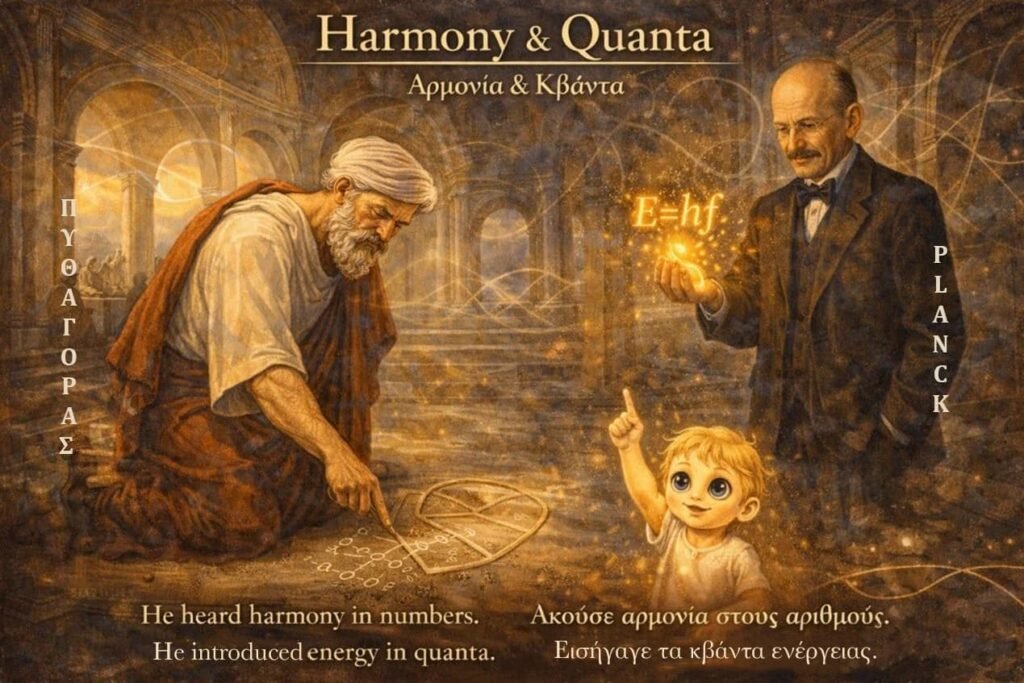
Philosophical Idea: Everything is number.
Quantum Theory: Nature is fully described through mathematical equations.
Quantum Analogy: Mathematics does not merely describe reality; it underlies it.

Pythagoras & Planck: The Harmony of Quanta

The Scientific Discovery (In simple terms):

Before Max Planck (1900), physicists believed that energy flowed continuously, like water from a tap. Planck discovered something shocking: energy is released in discrete packets, like jumping up steps on a ladder.

Imagine a ramp (continuous) versus a staircase (quantized). You cannot stand between two steps. He called these “packets” Quanta.

The Connection to Pythagoras

  • Pythagoras:
  • He discovered that musical harmony is based on whole numbers. By dividing a lyre string in precise ratios ($1/2$, $2/3$), he created the musical scale. Music is not random; it is “packets” of frequencies.
  • Planck:
  • He revealed that the Universe “plays music” with energy. Energy ($E$) is always a multiple of a constant ($h$). Just like notes on a lyre, energy has specific “frets.”

Conclusion :
“Pythagoras heard the numbers in music; Max Planck saw them in the heart of matter. The Universe is not a continuous noise, but a digital symphony played in precise notes of energy.”

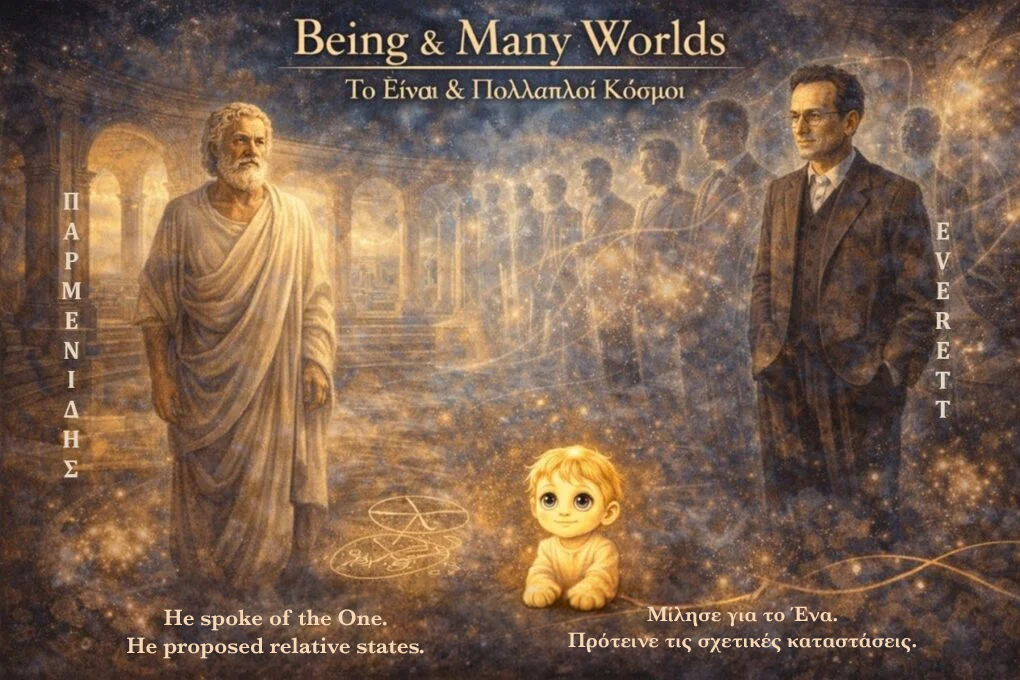
Philosophical Idea: Being is; Non-Being is not. True reality is unified and unchangeable.
Quantum Theory: The Universal Wavefunction includes all possible states of the Universe.
Quantum Analogy: Apparent changes and choices are merely manifestations of a deeper, immutable background.

Everett’s “Solution”: The Many-Worlds Theory

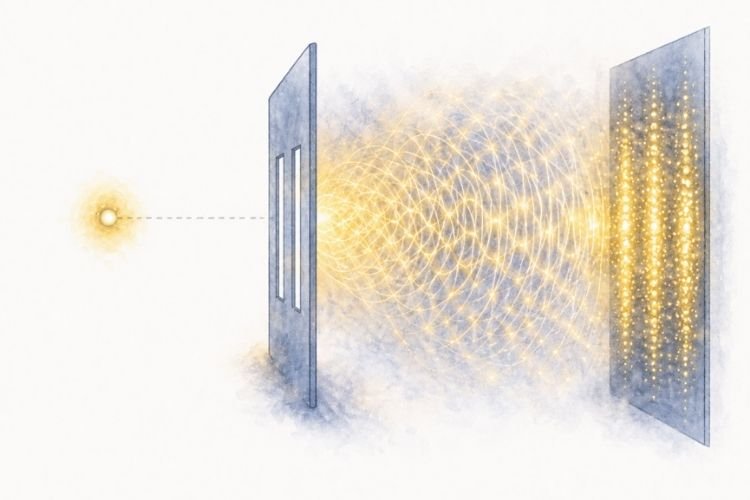
Imagine an electron heading toward two different slits. Quantum physics tells us that, as long as we do not observe it, it passes through both simultaneously. But when we turn our gaze upon it, we force it to appear in only one. Where did the other probability go?

In 1957, Hugh Everett proposed a stunning solution: The Universe never “chooses.” Instead, at the moment of measurement, reality itself branches! In one universe, the electron went right, and in another, parallel universe, it went left. Both versions are equally real; it is just that the two worlds no longer communicate with one another. Everything that can happen, is already happening somewhere.

The Connection with Parmenides:

  • Parmenides: In ancient Elea, Parmenides proclaimed that “Being” (true reality) is One, indivisible, eternal, and unmoving. Every change, birth, or decay we perceive around us is nothing but an illusion of our limited human senses.
  • Everett: Everett’s quantum theory echoes this exact idea. All infinite parallel universes coexist simultaneously within a vast, unified, and unchangeable “Universal Wavefunction.” What we perceive as the “flow of time” or as a “random choice” is merely our own limited, internal perspective as we move along one of the infinite branches of the One.

The Book Analogy:
Imagine a massive, printed book. Each of its pages represents a different development of the story, a parallel universe. We, as readers, are restricted to reading only one page at a time, experiencing the illusion of change and time. Yet, the entire book—with all its pages and all possible versions of the plot—already exists steady, solid, and unmoving right in our hands. “Change” is merely the turning of our own page.

Conclusion:
“For Parmenides, Truth is one and unmoving; for Everett, it is a vast ocean of parallel realities. And yet, at the deepest level, both agree: the world of our senses is but a sm all, fragmentary branch of a unified, eternal, and indivisible Wholeness.”

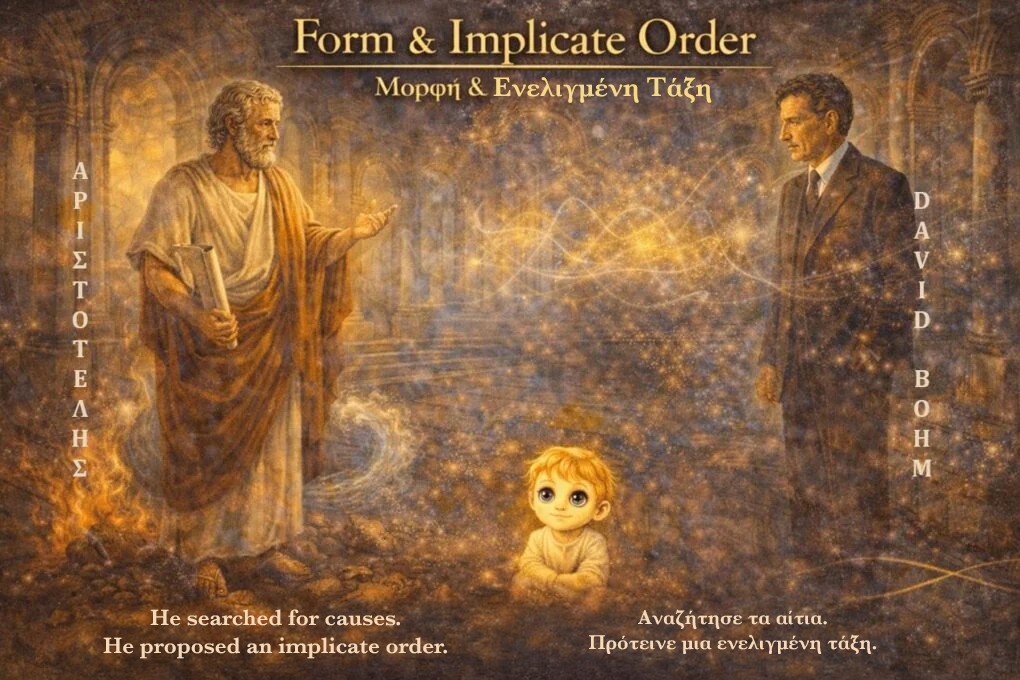
Philosophical Idea: Potentiality and actuality.
Quantum Theory: A system exists in superposition until it is measured.
Quantum Analogy: Reality moves from possibility to actuality through measurement.

Aristotle & David Bohm: Wholeness and the Implicate Order

The Scientific Theory (In simple terms): David Bohm proposed that the physical world we perceive (particles, objects) is the “Explicate Order.” However, beneath it lies the “Implicate Order,” where everything is interconnected.

The Hologram Analogy: Imagine a hologram: if you shatter it into a thousand pieces, each tiny fragment still contains the entire original image. The Experiment (Quantum Entanglement): When two particles become “entangled,” they communicate instantaneously, regardless of distance. This happens because, in reality, they are not two separate things but parts of a single Wholeness manifesting in two locations.

The Connection to Aristotle:

  • Aristotle: He spoke of “Entelechy.” Everything carries within itself its ultimate purpose and completion. A seed already contains the information of the entire tree. For Aristotle, the Whole precedes the part.
  • Bohm: Το σύμπαν είναι ένα αδιαίρετο όλο. Κάθε «μέρος» (ένας άνθρωπος, ένα αστέρι, ένα άτομο) περιέχει μέσα του την πληροφορία για ολόκληρο το σύμπαν.

Conclusion:
“Ο Αριστοτέλης είδε τη ζωή ως μια οργανωμένη ολότητα. Ο David Bohm απέδειξε πως η ύλη είναι σαν ένα ολόγραμμα: όσο κι αν την τεμαχίσεις, η καρδιά της περιέχει πάντα το Σύνολο.» “Aristotle viewed life as an organized wholeness. David Bohm proved that matter is like a hologram: no matter how much you fragment it, its heart always contains the Whole.”

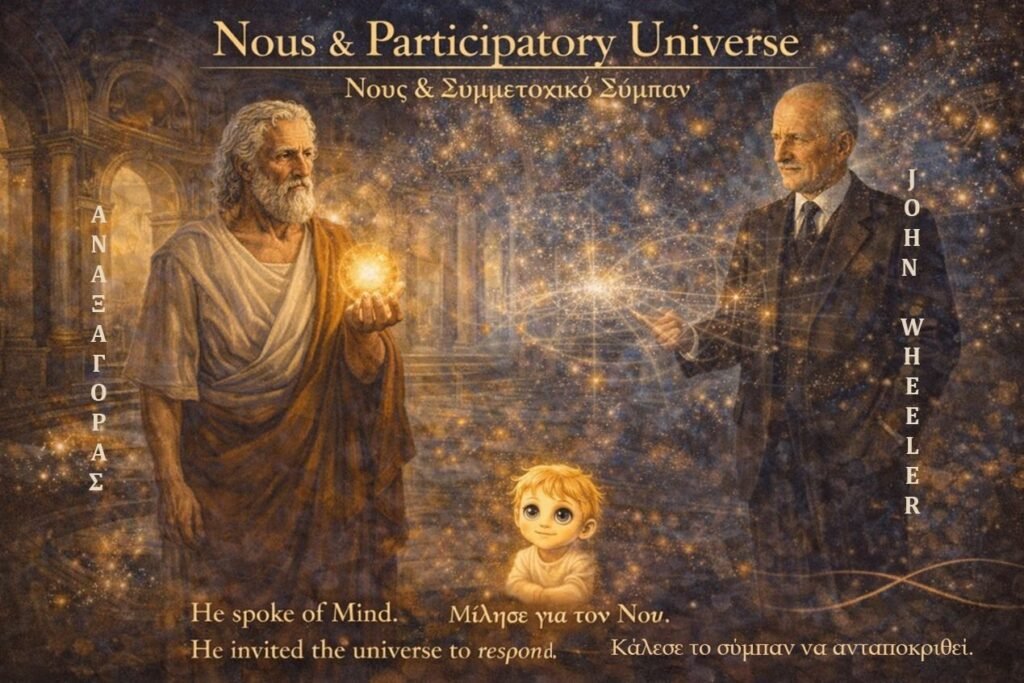
Philosophical Idea: Nous ordered all things.
Quantum Theory: The role of the observer affects the outcome of a quantum phenomenon.
Quantum Analogy: Consciousness is not external to reality; it participates in it.

Anaxagoras & John Wheeler: The Participatory Universe

The Delayed Choice Experiment (In simple terms): Imagine a particle (photon) reaching a fork in the road. As long as we don’t observe it, it travels through both paths simultaneously, like a wave.

The Choice: Wheeler asked: “What happens if I let the particle pass the fork and then, at the very last microsecond, I decide how to measure it?” The Shock: The particle seemed to “know” our future decision! If we decided to view it as a particle, it had already “chosen” a single path. If we decided to see it as a wave, it had already traveled through both. The Conclusion: Our decision in the present influenced what the particle did in the past.

The Connection to Anaxagoras:

  • Anaxagoras: He taught that “All things were together, then Mind came and set them in order.” Everything was a chaotic blur of possibilities until Mind (Nous) intervened to organize them.
  • Wheeler: He proposed the “Participatory Universe.” The cosmos does not exist “out there” independently of us. It requires an observer (a Mind) to “crystallize” into a definite form.

Conclusion:
“Για τον Αναξαγόρα και τον Wheeler, ο άνθρωπος δεν είναι ένας απλός θεατής, αλλά ο συν-δημιουργός της πραγματικότητας. Το σύμπαν περιμένει τη δική μας ματιά για να αποφασίσει τι θα είναι.» “For Anaxagoras and Wheeler, a human is not a mere spectator, but a co-creator of reality. The universe waits for our gaze to decide what it will become.”

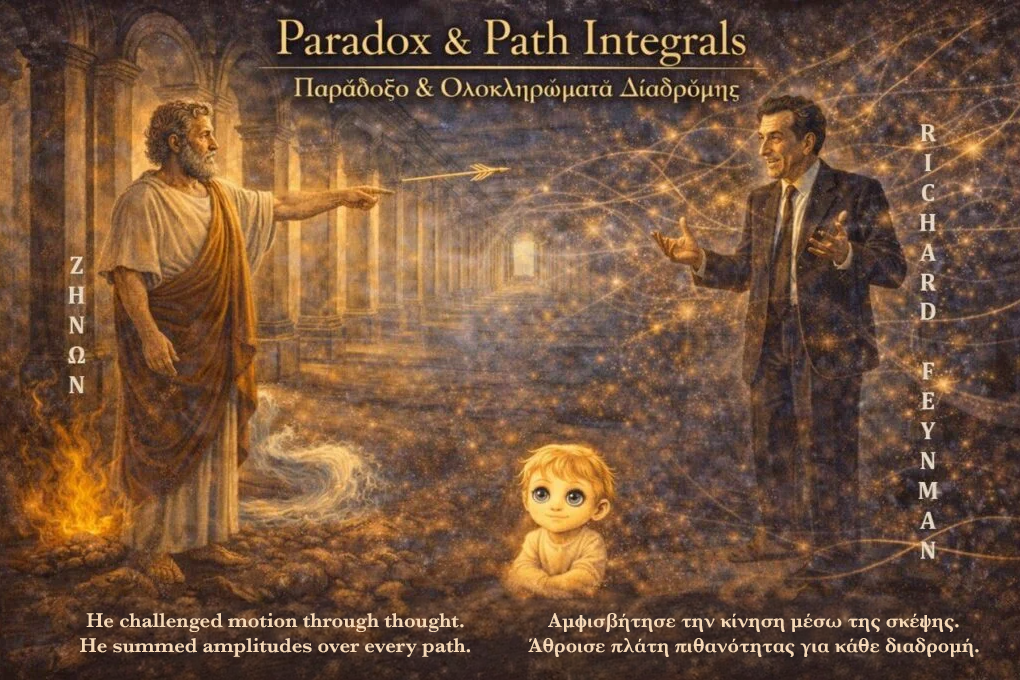
Philosophical Idea: Motion and multiplicity are illusory; the mind becomes trapped in the paradoxes of the infinite divisibility of space and time.
Quantum Theory: The particle does not follow a single trajectory, but rather the sum of all possible alternative paths in spacetime (Path Integrals).
Quantum Analogy: In reality, motion is not a static straight line, but a living “sum over histories” that compose the present.

Paradox & Path Integrals

The Experiment (In simple terms): Richard Feynman, the most “rock ‘n’ roll” physicist in history, proposed something that sounds like madness: When a particle moves from point A to point B, it doesn’t choose a single straight line. Instead, it takes every possible path simultaneously! It travels via China, circles the Moon, passes through your kitchen, and finally reaches its target. In the end, all these infinite “crazy” paths cancel each other out, and what remains for us to see is only the most direct and shortest route.

The Connection to Zeno:

  • Zeno: Through the paradox of Achilles and the tortoise, he argued that motion is “broken” into infinite points. If you must cross infinite intervals, you will never reach your destination.
  • Feynman: He responded that motion is not a single, isolated path, but a “Sum over Histories.” Achilles reaches the tortoise because the universe “calculates” all those infinite quantum paths at the same time.

Conclusion:
“Zeno showed us that the mind can get trapped in infinity. Feynman set us free, proving that motion is not a line, but a dance of all possibilities culminating in the ‘here and now”

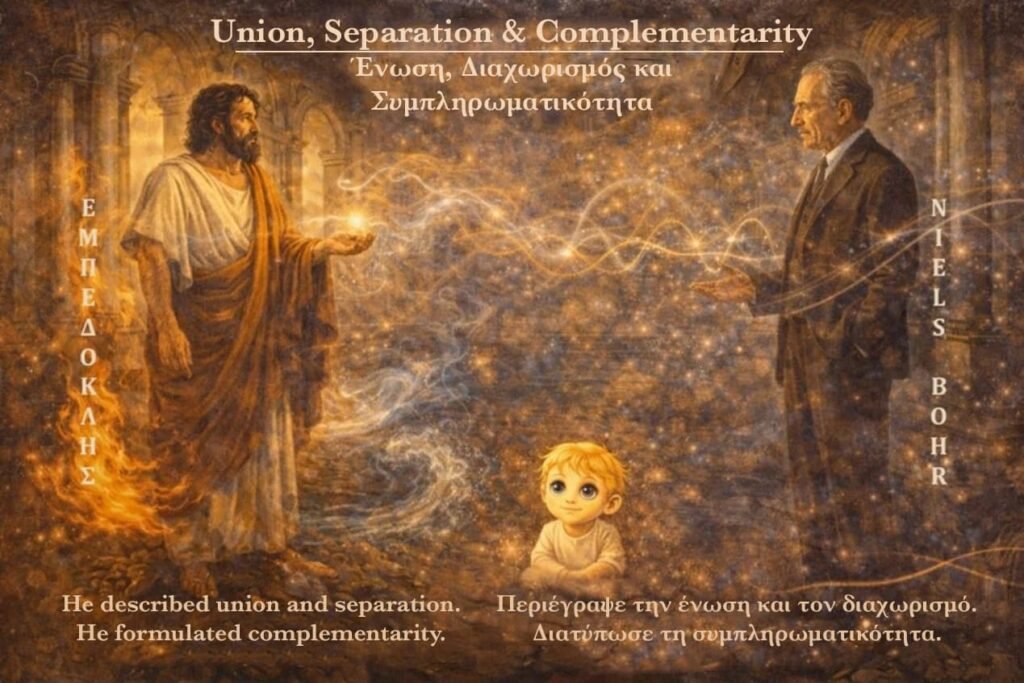
Philosophical Idea: The Universe is governed by the eternal struggle of two cosmic forces, Love (Philotes / attraction) and Strife (Neikos / separation), which compose and decompose the elements of nature.
Quantum Theory: Matter and radiation are governed by complementarity and fundamental interactions, where particles are continuously created and destroyed through field excitations.
Quantum Analogy: Reality is not a static substance but a dynamic relationship; a cosmic dance between coherence and differentiation, where stability is born from the absolute balance of opposites.

Forces & Complementarity

Quantum Bridge — Empedocles & Modern Physics

Empedocles spoke of four “roots” moved by two forces:
Philotes (union) and Neikos (separation).

Modern physics does not speak of Earth, Water, Air and Fire.
It speaks of fields, particles, and interactions.

Yet something quietly echoes.

In quantum field theory:

  • Nothing appears from absolute nothingness.
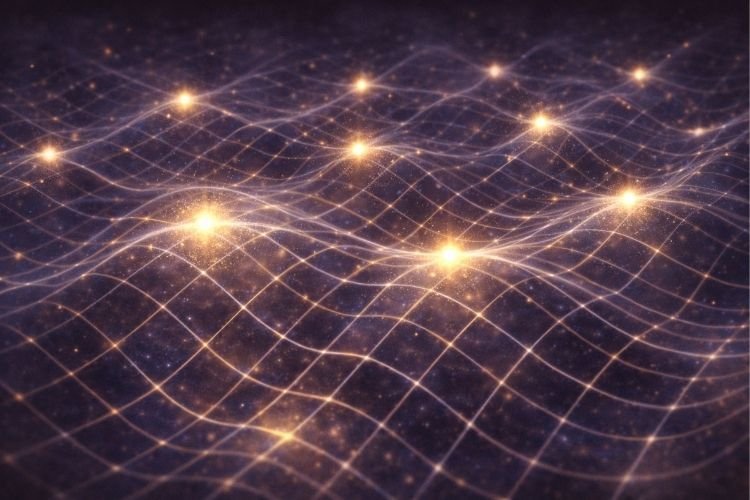
    • What we call “particles” are excitations of underlying fields.
    • Matter is not static substance — it is dynamic relationship.

Empedocles said:

Nothing is born from nothing.
Nothing is lost into nothing.
There is mixing and separation.

Quantum physics says:

Energy transforms.
States change.
Systems oscillate between coherence and differentiation.

Too much uniformity → no structure.
Too much fragmentation → no stability.

Life — and matter — exist in balance.


The Grand Convergence These eight dualities and parallels are by no means a random conceptual or linguistic coincidence. They stand as absolute proof that human consciousness, when operating with purity and intellectual freedom, encounters the exact same truth through different pathways. Where the Ancient Greek thinkers utilized the instrument of pure Logos, intuition, and philosophical observation, the Quantum Physicists of the 20th and 21st centuries arrived by means of mathematical experimentation and laboratory verification.

Matter is not a hard, isolated object, but a perpetual probability awaiting the observer in order to manifest. The Universe is not a cold machine, but a living conversation, a unified Whole. Quantum Physics did not, in reality, discover a new world; it merely provided contemporary mathematical form to the profound concepts that had already been born under the Greek sky.

The Protagonists of Thought
 

Behind every grand idea, behind every revolutionary equation, there always lies a human face — a soul that dared to question the obvious, to look beyond the darkness of its era, and to risk its own comfort for the sake of truth. In this section, we do not merely list dry encyclopedic biographies. Instead, we present the brief, deeply human portraits of the protagonists of this eternal dialogue.

Ten Ancient Greek Philosophers who sowed the seeds of reason and wonder, meet conceptually nine Quantum Physicists who broke the barrier of the microcosm. Individuals with passions, musical sensitivities, exiles, and profound doubts, who nonetheless shared the exact same Phronema: a refusal to accept the world as something static. Let us walk among the faces that changed the way the Universe perceives itself.

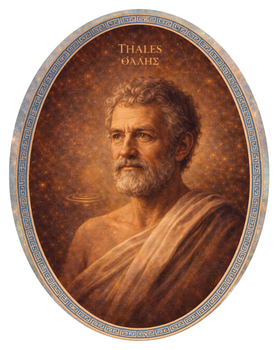
Thales

ΘΑΛΗΣ / THALES

(c. 624–546 BCE, Μίλητος / Miletus)

Considered the first natural philosopher. It is said he once fell into a well while observing the stars — searching for the origin of the cosmos. He believed everything arises from a single underlying element: water. Practical, yet visionary.
Thales

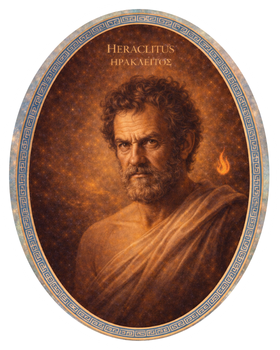
ΗΡΑΚΛΕΙΤΟΣ / HERACLITUS

(c. 535–475 BCE, Έφεσος / Ephesus)

Known as “the obscure.” He spoke in riddles and avoided crowds. He believed conflict is the harmony of the world. He saw reality as fire in perpetual transformation.
Thales

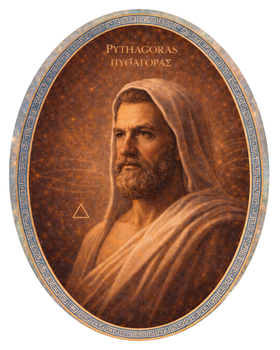
ΠΥΘΑΓΟΡΑΣ / PYTHAGORAS

(c. 570–495 BCE, Σάμος / Samos)

Mystic and mathematician. Founded a disciplined philosophical community. Believed in the transmigration of the soul. Saw the cosmos as musical harmony.
Thales

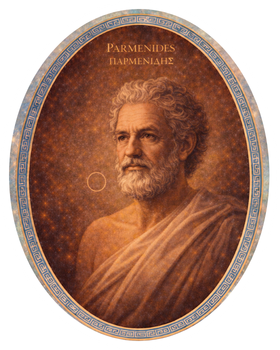
ΠΑΡΜΕΝΙΔΗΣ / PARMENIDES

(c. 515 BCE, Ελέα / Elea)

A philosopher-poet. Wrote in verse about Being. Believed change is illusion. Calm, rigorous, contemplative.
Thales

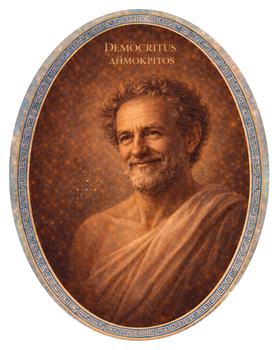
ΔΗΜΟΚΡΙΤΟΣ / DEMOCRITUS

(c. 460–370 BCE, Άβδηρα / Abdera)

Known as “the laughing philosopher.” Proposed that everything consists of atoms and void. Advocated joy as a philosophical attitude. Remarkably optimistic for his time.
Thales

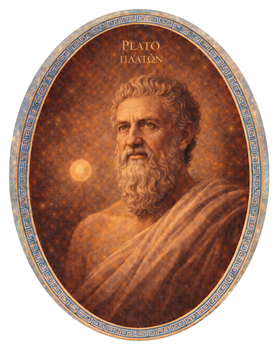
ΠΛΑΤΩΝ / PLATO

(c. 427–347 BCE, Αθήνα / Athens)

Student of Socrates and teacher of Aristotle. Founded the Academy — the first organized school of philosophy. Believed the visible world is a shadow of deeper Forms. Saw knowledge as recollection of the soul.
Thales

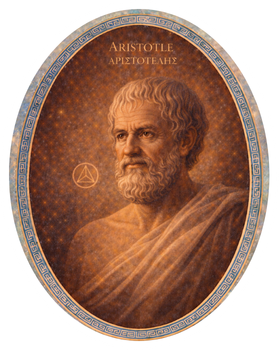
ΑΡΙΣΤΟΤΕΛΗΣ / ARISTOTLE

(384–322 BCE, Στάγειρα / Stagira)

Student of Plato, yet thinker in his own direction. Observer of nature and systematic mind. Classified, recorded, analyzed. Believed knowledge begins with experience.
Thales

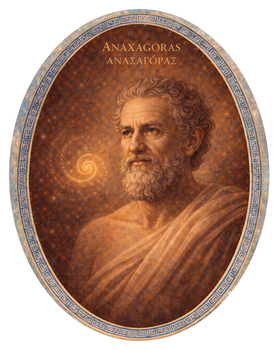
ΑΝΑΞΑΓΟΡΑΣ / ANAXAGORAS

(c. 500–428 BCE, Κλαζομενές / Clazomenae)

Introduced Nous (Mind) as a cosmic principle. Believed that “everything is in everything.” Was exiled from Athens for his ideas. Calm yet daring thinker of order within chaos.
Thales

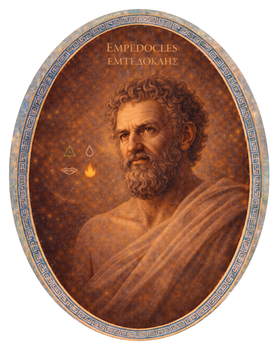
ΕΜΠΕΔΟΚΛΗΣ / EMPEDOCLES

(c. 494–434 BCE, Ακράγας / Acragas)

Poet and mystic philosopher. Spoke of four elements and two cosmic forces. Legend says he vanished into a volcano. Saw the world as a cycle of unity and separation.
Thales

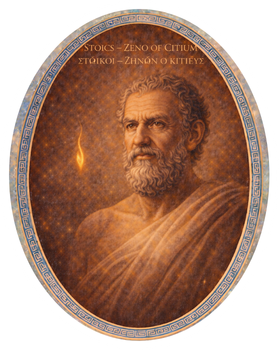
ΣΤΩΙΚΟΙ – ΖΗΝΩΝ Ο ΚΙΤΙΕΥΣ / STOICS – ZENO OF CITIUM

(c. 334–262 BCE, Κίτιον / Citium)

Founder of the Stoic school. Taught that one must live according to Logos. Saw the universe as a rational, unified organism. Sought inner serenity amidst external turbulence.

Thales

ΠΛΩΤΙΝΟΣ / PLOTINUS

(c. 204–270 CE, Λυκόπολις / Lycopolis, Egypt)

Central figure of Neoplatonism. Taught that all emanates from The One. Avoided portraits — he did not wish his image to bind him. Sought union with the Absolute.
Thales

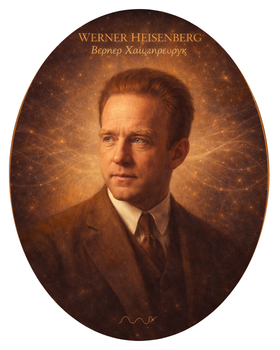
WERNER HEISENBERG

1901 - 1976, Founder of Quantum Mechanics

Son of a professor of Ancient Greek, he grew up immersed in language and conceptual precision. Deeply loved Ancient Greek thought — he considered it his greatest intellectual training. He loved music and played the piano passionately, seeing mathematics as harmony. At 23 he formulated the Uncertainty Principle, yet remained philosophically.
Thales

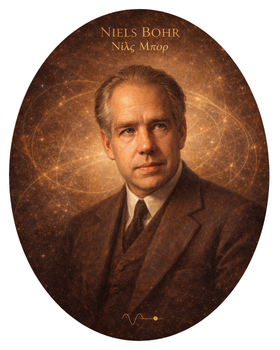
NIELS BOHR

1885 - 1962, Denmark

Introduced the Principle of Complementarity. Believed truth may possess dual aspects. Bridged rigorous science with philosophical reflection. Calm, almost fatherly, yet intellectually intense. At his Copenhagen Institute the “Copenhagen Interpretation” was born. His key word was “complementarity.” He believed opposites do not cancel each other — they complete each other.
Thales

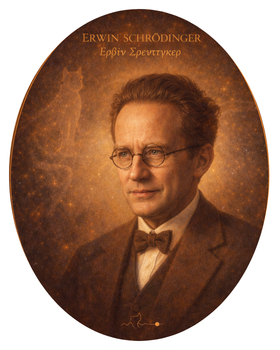
ERWIN SCHRÖDINGER

1887 - 1961, Austria

Romantic and philosophically inclined, deeply influenced by Eastern thought. His “cat” was not a joke — it was a protest against interpretational paradox. He saw science as a metaphysical adventure. He believed in a deep unity of consciousness. Formulated the wave equation of quantum mechanics. Imagined the famous cat in superposition. Studied Vedanta and classical metaphysics.
Thales

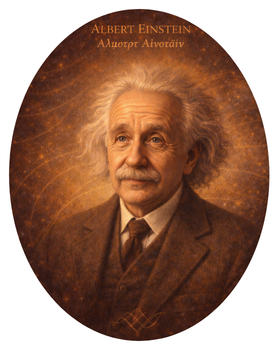
ALBERT EINSTEIN

1879 - 1955, Germany – United States

Redefined space and time. Never fully accepted quantum randomness. Sought deeper harmony beyond probability. Not a “quantum” physicist in spirit — but its greatest challenger. He loved determinism and resisted randomness. “God does not play dice,” he famously said. Yet without his photoelectric effect, quantum theory would not have begun.
Thales

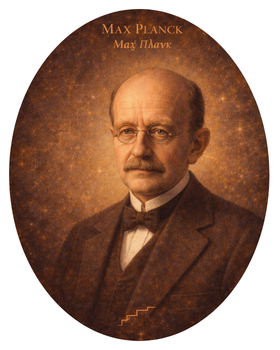
MAX PLANCK

1858 - 1947, Germany

Introduced the concept of the energy quantum. A man of discipline and inner resilience. Reserved, conservative, reluctant revolutionary. He did not intend to overturn physics — he did it accidentally. Introduced the “quantum” as a mathematical trick. Unknowingly opened the door to a new worldview.
Thales

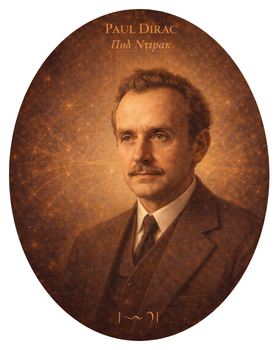
PAUL DIRAC

1902 - 1984, United Kingdom

Unified quantum mechanics with relativity. Reserved, almost ascetic. Believed mathematical beauty is a sign of truth. Predicted antimatter before it was observed. Spoke little — his equations spoke profoundly.
Thales

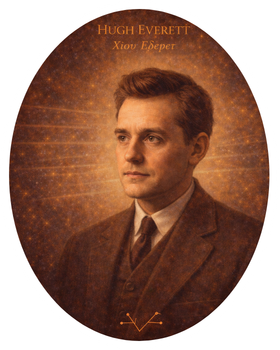
HUGH EVERETT III

1930 - 1982, United States

Proposed the Many Worlds Interpretation. Suggested every possibility becomes real. His idea gained recognition decades later.
Thales

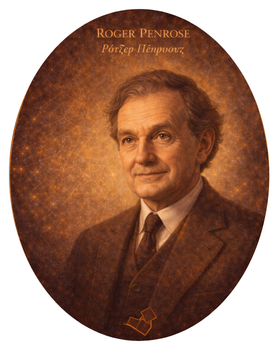
ROGER PENROSE

1931 - , United Kingdom

Explored the geometry of the universe and black holes. Mathematical thinker with philosophical depth. Argues consciousness cannot be fully algorithmic. Co-developed quantum consciousness theory with Hameroff. Restless, bold, exploratory.
Thales

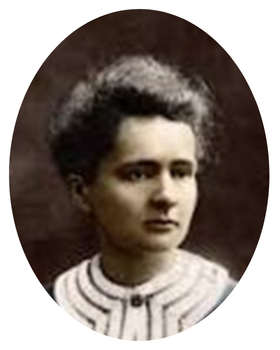
MARIE CURIE

1867 - 1934, Poland – France

Pioneer of radioactivity. Twice Nobel laureate. Dedicated her life to science and service. Proved the Atom is Not Indivisible: At the end of the 19th century, scientists believed the atom was a solid, unchanging, indivisible object. Marie Curie’s research into radioactivity (a term she coined) showed that radiation is an intrinsic property of the atom, originating from within it.
Epilogue – After the Characters
 

People come and go.
The questions remain.
And perhaps this is the deepest thread that unites philosophers and scientists: not certainty,
but the courage to keep searching.

The universe does not reveal itself all at once. It opens up to those who persist in looking at it with wonder.

Glossary

This Glossary was not written to explain everything. It was written to illuminate words.

In Quantum Physics, words are not mere descriptions; they are gateways.

Superposition · Entanglement · Vacuum · Coherence

Each sounds technical. Yet each hides a way of seeing the world.

You may read this as a dictionary. Or you may open it at random.

These terms do not demand full comprehension. They invite presence.

Understanding arrives quietly. As memory does.

QUANTUM GLOSSARY (A–E)

A
Action (Δράση)
In physics, “action” is a quantity that summarizes how a system evolves in time.
Nature seems to “choose” the path that minimizes action.
This principle connects motion, energy, and time in one elegant formulation.
It suggests that the universe does not move randomly but follows deep optimization rules.
Amplitude (Πλάτος κύματος)
A quantum amplitude is not a probability itself, but something that produces probability when squared.
It can interfere positively or negatively with other amplitudes.
Reality at the quantum level behaves more like overlapping waves than solid objects.
B
Bell’s Theorem (Θεώρημα Bell)
Bell proved mathematically that no local hidden-variable theory can explain quantum correlations.
Experiments confirmed him.
This means reality is either non-local or fundamentally different from classical expectations.
C
Collapse of the Wavefunction (Κατάρρευση της Κυματοσυνάρτησης)
Before measurement, a quantum system exists in superposition.
After measurement, it “collapses” into one definite state.
This is not fully understood — and remains one of the deepest mysteries in physics.
Coherence (Συνοχή)
Quantum coherence means phases between wave states remain aligned.
It allows interference and quantum effects to exist.
Without coherence, quantum systems behave classically.
D
Decoherence (Αποσυνοχή)
Decoherence occurs when a quantum system interacts with its environment.
The superposition effectively disappears.
It explains why we do not see quantum effects at everyday scales.
Duality (Δυϊκότητα)
Quantum objects behave both as particles and waves.
They are not one or the other — they are both depending on how we observe them.
E
Entanglement (Κβαντική Εμπλοκή)
Two particles can become linked in such a way that measuring one instantly affects the other — regardless of distance.
Einstein called it “spooky action at a distance.”
It suggests reality is deeply interconnected.
Energy Quantization (Κβαντοποίηση Ενέργειας)
Energy does not flow continuously at microscopic levels.
It exists in discrete packets called quanta.
This discovery began quantum theory.

QUANTUM GLOSSARY (F–L)

F
Field (Quantum Field) (Κβαντικό Πεδίο)
A quantum field is the most fundamental description of reality in modern physics.
Particles are not tiny solid objects; they are excitations of underlying fields.
Every type of particle corresponds to its own field permeating all space.
Fluctuation (Quantum Fluctuation) (Κβαντική Διακύμανση)
Even in a perfect vacuum, energy fluctuates due to uncertainty principles.
These temporary fluctuations can create particle–antiparticle pairs.
The vacuum is not empty but dynamically active.
H
Heisenberg Uncertainty Principle (Αρχή Απροσδιοριστίας Heisenberg)
It is impossible to know both position and momentum of a particle with absolute precision at the same time.
This is not a limitation of instruments, but a property of nature itself.
Hidden Variables (Κρυμμένες Μεταβλητές)
A proposed explanation suggesting quantum randomness is due to unseen underlying parameters.
Bell’s Theorem strongly limits such theories.
I
Interference (Συμβολή Κυμάτων)
Quantum waves can reinforce or cancel each other.
This interference produces patterns that reveal the wave-like nature of matter.
Information (Πληροφορία)
In modern physics, information is fundamental.
Some theories suggest that reality itself may be information-based.
The principle “information is never lost” is central in black hole physics.
L
Locality (Τοπικότητα)
The idea that objects are only influenced by their immediate surroundings.
Quantum entanglement challenges this classical assumption.
Least Action Principle (Αρχή της Ελάχιστης Δράσης)
Nature evolves along paths that minimize (or extremize) action.
This principle unifies mechanics, optics, and quantum theory.

QUANTUM GLOSSARY (M–S)

M
Many-Worlds Interpretation (Ερμηνεία Πολλών Κόσμων)
Proposed by Hugh Everett, this interpretation suggests that all possible outcomes of a quantum event actually occur — but in different branches of reality.
There is no collapse; instead, reality continuously branches.
Measurement (Κβαντική Μέτρηση)
Measurement is the interaction that forces a quantum system into a definite state.
It marks the transition from possibility to actuality.
The exact nature of measurement remains philosophically and physically debated.
Momentum (Ορμή)
Momentum describes motion.
In quantum physics, it cannot be simultaneously determined with position with perfect precision (Uncertainty Principle).
N
Non-Locality (Μη Τοπικότητα)
Quantum systems can exhibit correlations that transcend spatial separation.
Entangled particles behave as a unified system even across vast distances.
O
Observer Effect (Φαινόμενο του Παρατηρητή)
The act of observation affects the system being observed.
In quantum physics, this is not psychological — it is physical interaction at the microscopic level.
P
Pauli Exclusion Principle (Αρχή Αποκλεισμού του Pauli)
No two identical fermions can occupy the same quantum state simultaneously.
This principle explains the structure of atoms and the stability of matter.
Photon (Φωτόνιο)
The quantum of light.
It behaves both as a wave and as a particle and carries electromagnetic energy.
Probability Wave (Κυματοσυνάρτηση Πιθανότητας)
A mathematical description of all possible states of a quantum system.
Its square gives measurable probabilities.
Q
Quantum (Κβάντο)
The smallest discrete unit of a physical quantity.
Energy, for example, is emitted and absorbed in quanta.
Quantum Coherence (Κβαντική Συνοχή)
A state in which quantum phases remain correlated.
Essential for interference and quantum computing.
Quantum Field (Κβαντικό Πεδίο)
The fundamental entity underlying particles.
Particles are excitations of these fields.
Quantum Jump (Κβαντικό Άλμα)
A sudden transition between discrete energy levels.
No continuous path exists between the two states.
Quantum Tunneling (Κβαντική Σήραγγα)
A particle can pass through a barrier it classically should not overcome.
This occurs due to wave behavior.
R
Relativity (Σχετικότητα)
Einstein’s theory describing space, time, and gravity.
While not quantum theory, its unification with quantum physics remains one of the greatest challenges.
S
Superposition (Υπέρθεση)
A quantum system can exist in multiple states simultaneously until measured.
It is a foundational concept of quantum theory.
Symmetry (Συμμετρία)
Symmetries govern physical laws.
Modern physics is deeply built upon symmetry principles.

FULL GLOSSARY – ENGLISH (A–Z)

M
Many Worlds Interpretation (Ερμηνεία Πολλών Κόσμων)
An interpretation of quantum mechanics proposing that all possible outcomes of a quantum event actually occur in branching parallel universes.
→ Every quantum choice generates a new branch of reality.
Measurement Problem (Πρόβλημα Μέτρησης)
The unresolved question of how and why a quantum system transitions from superposition to a single observed outcome.
→ What exactly causes collapse?
N
Nonlocality (Μη-Τοπικότητα)
The phenomenon where entangled particles influence each other instantly across distance, without any visible signal passing between them.
→ Reality is not confined to classical spatial limits.
O
Observer Effect (Φαινόμενο Παρατηρητή)
The act of measurement changes the state of a quantum system.
→ Observation is participation.
P
Pauli Exclusion Principle (Αρχή Αποκλεισμού του Pauli)
No two identical fermions (like electrons) can occupy the same quantum state simultaneously.
→ This principle explains the structure of atoms and matter.
Photon (Φωτόνιο)
The quantum of light; behaves as both wave and particle.
→ Carrier of electromagnetic energy.
Planck Constant (Σταθερά του Planck)
A fundamental constant (h) that sets the scale of quantum effects.
→ The “unit” of quantum action.
Probability Amplitude (Πλάτος Πιθανότητας)
A complex mathematical quantity whose square gives the probability of a quantum event.
→ Reality emerges from probability patterns.
Q
Quantum (Κβάντο)
The smallest discrete unit of energy in a physical system.
Quantum Coherence (Κβαντική Συνοχή)
The property that allows quantum systems to maintain phase relationships between states.
→ Essential for quantum computing.
Quantum Computing (Κβαντικός Υπολογισμός)
A computing model using qubits and superposition instead of classical bits.
Quantum Field (Κβαντικό Πεδίο)
The fundamental entity in quantum field theory; particles are excitations of fields.
Quantum Leap (Κβαντικό Άλμα)
A discrete transition between energy levels.
Quantum Vacuum (Κβαντικό Κενό)
The lowest energy state of a quantum field, not empty but filled with fluctuations.
R
Relativity (Σχετικότητα)
Einstein’s theory describing gravity as curvature of spacetime.
(Though not quantum, it frames modern physics.)
S
Schrödinger’s Cat (Η Γάτα του Schrödinger)
A thought experiment illustrating superposition and measurement paradox.
Spin (Σπιν / Κβαντικός Στροφορμή)
An intrinsic quantum property of particles, not literal spinning.
Superposition (Υπέρθεση)
The ability of a quantum system to exist in multiple states simultaneously.
T
Time Symmetry (Συμμετρία Χρόνου)
Some quantum equations work identically forward and backward in time.
Tunneling (Κβαντική Σήραγγα)
The ability of a particle to pass through a barrier it classically shouldn’t.
U
Uncertainty Principle (Αρχή Απροσδιοριστίας)
You cannot simultaneously know position and momentum with perfect precision.
Unified Field (Ενοποιημένο Πεδίο)
A theoretical framework aiming to unify all fundamental forces.
W
Wave Function (Κυματοσυνάρτηση)
A mathematical description of a quantum system’s state.
Wave–Particle Duality (Κυματοσωματιδιακή Δυϊκότητα)
Quantum objects behave as both waves and particles.
The Return to the Source
 

The journey of Philoquantum reaches its conclusion, yet in truth, within the quantum realm, every end is merely the starting point of a new superposition, a new probability. We began with tender lessons for the adolescents of the soul, crossed the bridges of philosophical parallels, gazed into the eyes of sages and physicists, and mapped out the definitions within our glossary. If this book succeeds in leaving a lasting imprint upon you, it is not the mark of a new knowledge, but that of a profound remembrance.

We did not compose these lines to prove anything in a dry, academic sense. We wrote them to remind you that the Greek language—the very cradle of Logos—and the timeless concepts it gifted to the world, possess the ultimate power to decipher the infinite. By discovering these bridges, you realize that you are not just a passive traveler in existence.

As you close this book, keep your Phronema high. Do not look upon the world as a pre-fabricated, alien machine. You are the observer. You, through your thought and your word, give form to the Universe.

Farewell, lovers of wonder. The journey toward the Light never ceases.