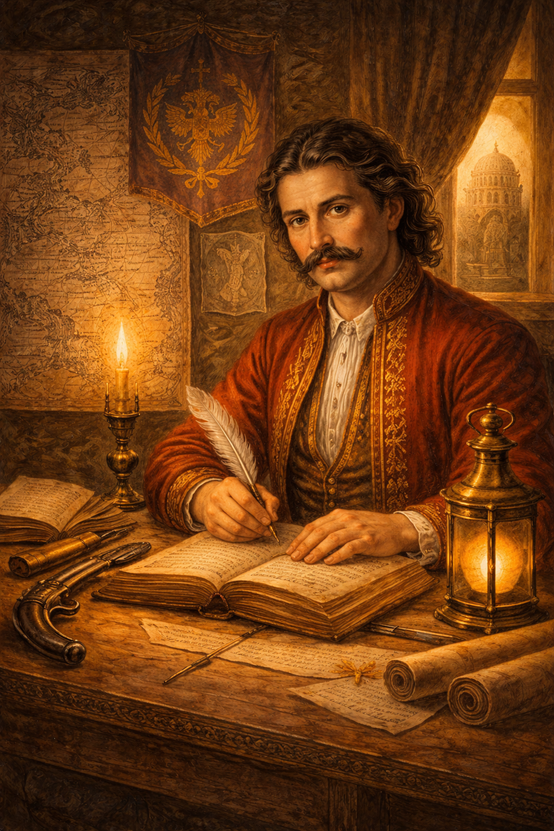
Rigas Feraios
The man who traced freedom before it existed
Ρήγας Φεραίος did not merely dream of freedom — he designed it.
Before a single cannon was fired, he spread maps, words, and ideas across the table of History.
His Charter of Greece is not geography; it is a political act.
A silent cry that says:
“See who you are. See where you stand. And remember.”
For Rigas, language was not ornament — it was a weapon.
His songs, his proclamations, his Thourios spoke to people who had not yet learned to call themselves citizens.
Yet through his words, they learned to stand upright —
to recognize themselves not as subjects, but as human beings with judgment, responsibility, and voice.
His map unites lands, peoples, and memories.
It does not divide — it includes.
It does not mark borders of power, but boundaries of consciousness.
That is why he was feared more than armies:
because he understood that when the mind changes, the body follows.
Rigas did not live to see freedom born.
But he gave it a map, a language, and a rhythm.
And these — unlike empires — do not die.
Beyond the Thourios: the vision of Rigas
Rigas did not envision merely a revolt.
He envisioned a new way of being a citizen.
A. Word
For Rigas, freedom begins with the word:
- he translated and spread Enlightenment texts,
- he wrote constitutions and declarations of rights,
- he spoke in a language people could understand.
The word was not rhetoric.
It was consciousness.
B. Map
His Charter of Greece is not just a map.
It is:
- a lesson in history,
- a lesson in politics,
- a lesson in self-knowledge.
Through names, symbols, and images,
he invites the viewer to see the land as a unified cultural body.
C. Action
His vision was not narrowly nationalistic, but democratic and inclusive:
- freedom for all Balkan peoples,
- equality before the law,
- religious tolerance,
- active citizens — not passive subjects.
This is why his work was dangerous.
It did not threaten only a regime —
it threatened the habit of submission.
Rigas = word + map + action

