Divisions — and the Quiet Power of What Came Before
Every age believes it stands at a crossroads. We speak of old and new, tradition and progress, past and future — as if they were enemies locked in a permanent struggle. Yet most of these divisions are false. They are habits of speech, not necessities of thought.
The power of the past is not nostalgia. It is structure. It is the skeleton that allows movement. Without it, what we call “innovation” collapses into improvisation without memory.
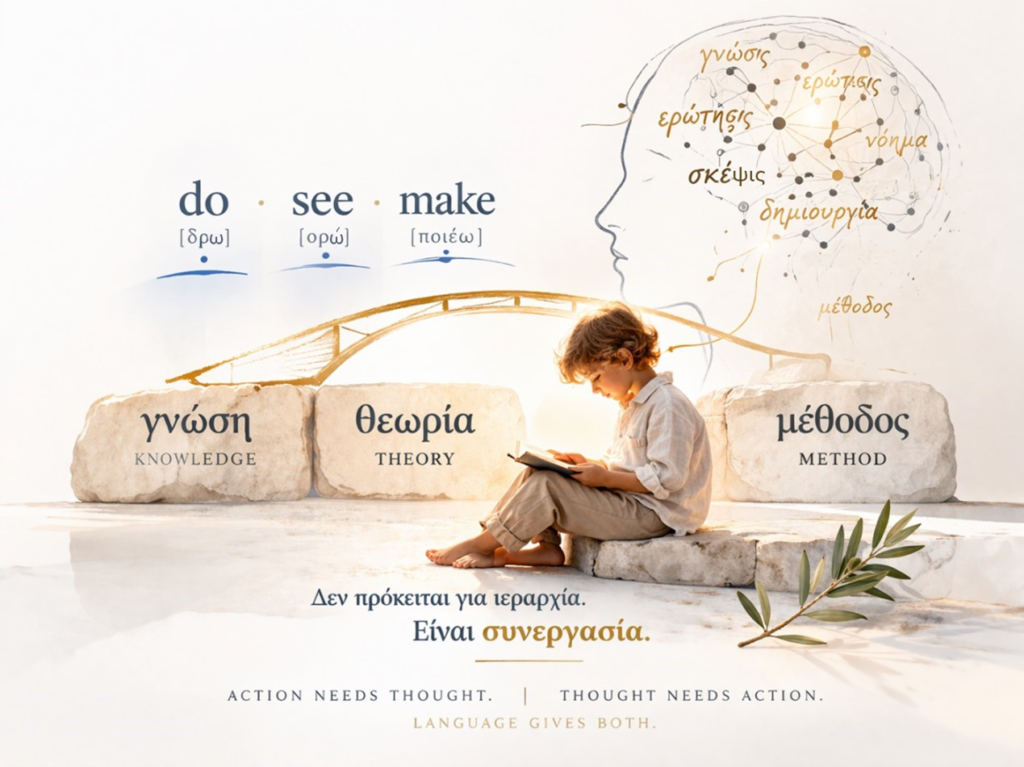
Greek thought understood this early. It did not oppose old and new; it wove them. The word archē means both “beginning” and “principle.” What comes first is not discarded — it continues to operate quietly underneath.
What we call division (dichotomy) often arises when language loses precision:
- reason is separated from imagination,
- science from poetry,
- analysis from joy,
- learning from desire.
But these were never separate in their origin.
The Platonic tradition reminds us that thinking is not linear but relational. Aristotle shows us that clarity is not simplification but right distinction. Empedocles teaches balance between forces, not victory of one over the other.
In this sense, the past does not command us. It supports us.
What we propose here is not a return backward, but a grounding:
- to think with roots,
- to speak with awareness,
- to learn without fear of depth.
This is why the Plane‑Tree Schole begins where others think it ends. Not with conclusions — but with first principles quietly remembered.
(The rest follows.)

