
THE ORIGIN OF THE GREEK LANGUAGE: Oral and Written Traditio

The view advanced in the 18th century that the Greek language belongs to the Indo-European family of languages, as well as the view that the Greek alphabet is of Phoenician–Semitic origin, have constituted subjects of intense and continuing debate and dispute up to the present day.
These are two issues that should not leave any Greek indifferent, for the language of our cultural heritage — the Greek language, both oral and written — is inextricably linked with the identity, continuity, survival, and future of Hellenism. It is therefore a matter that concerns us all.
Certainly, it concerns the present speaker as well, given my long-standing involvement in education and my related writings, through which I have criticized legislative interventions in our language — interventions presented under the misleading title of “Educational Reforms.”
Given that these two issues are interdisciplinary in nature, involving multiple scientific fields, my present effort is to present authoritative views from linguists, archaeologists, historians, anthropologists, and paleontologists, in order to shed more light on these two complex and still insufficiently clarified matters, also taking into account recent findings and developments in archaeogenetics (DNA) and population genetics — developments that have overturned or confirmed earlier hypotheses.
ΑARISTOTLE: “TO HELLENIZEIN ESTIN TO ORTHŌS ONOMAZEIN”
(“To speak Greek is to name things correctly”) In Plato’s Cratylus, a dialogue on the correctness of names, with interlocutors Hermogenes, the philosopher-mathematician Cratylus (founder of a philosophical school in the 5th century BC), and Socrates, we find the beginnings of Comparative Linguistics — with regard to foreign names — as well as the beginnings of the comparative method in relation to Greek dialects (Aeolic, Doric, Ionic, Attic, etc.). There we also find the foundations of Etymology, concerning how the correct naming of things is determined — whether by nature (phýsei) or by convention (nómōi).
According to the view of natural correctness (as expressed by Cratylus), there exists an intrinsic correspondence between the name (word) and its conceptual content — that is, between signifier and signified. According to the conventional view, naming is arbitrary and based on agreement. Plato states (Cratylus 435–436):
Plato states (Cratylus 435–436):
Dionysius of Halicarnassus (1st century BC), in his work On the Arrangement of Words, considers Plato the founder of Etymology, writing: “The discourse on etymology was first introduced by Plato, in many places, but especially in the Cratylus.” Aristotle emphasizes the semantic function of language: “Speech, if it does not make something clear, will not accomplish its function.” (Rhetoric, Book III) He then extols the Greek language with the phrase:
“To speak Greek is to name correctly.” (Rhetoric, III, 4, 1407)
NOBEL LAUREATE HEISENBERG ON ANCIENT GREEK
In modern times, the German philosopher and physicist Werner Heisenberg (Nobel Prize 1932) stated:
“My training in Ancient Greek was the most important intellectual exercise of my life. In this language there exists the fullest correspondence between the word and its conceptual content.”
Whether the first alphabet (more precisely, writing system) was Semitic-Phoenician in origin, and whether the Phoenicians — a branch of the Semitic peoples distinguished in navigation and trade — received it from the Hebrews and transmitted it to the Greeks, has been the subject of extensive debate and dispute.
Related questions requiring examination include: When did Phoenician migrants settle in Phoenicia? What are the earliest inscriptions or written texts of Phoenician civilization?
Regarding the prevailing view that the Greek alphabet derives from “Phoenician letters” — essentially from a Phoenician syllabary — it is worth noting that supporters of this position have relied primarily on the well-known statement of Herodotus:
“The Phoenicians … brought to the Greeks various teachings and indeed letters, which, as it seems to me, the Greeks did not previously possess.” Herodotus thus expresses himself with reservation (“as it seems to me”) and refers generally to “letters,” not to the letters of a specific writing system.
DIODORUS SICULUS: “The Phoenicians took them from others”
Diodorus Siculus (Book V, 74), however, does not agree with Herodotus’ view. He clarifies that the so-called “Phoenician letters” were not an invention of the Phoenicians but rather an adaptation of other letters — namely Greek-Cretan ones — stating:
“They say that the Phoenicians did not invent them from the beginning, but merely altered the forms of the letters.”
WERE THERE PHOENICIAN INSCRIPTIONS?
It has been noted that the Phoenicians, according to various historical sources, settled in Phoenicia (modern Lebanon and parts of Syria), mingling with the indigenous Canaanites between 1200 and 1100 BC.
WAS THERE GREEK WRITING DURING THE TROJAN WAR?
Based on historical data, inscriptions, and numerous references in known ancient Greek texts, it has been accepted by the international scholarly community that Greek (alphabetic) writing may have existed prior to the time of the Trojan War. (Not referring here to Linear A or Linear B, nor to the earlier Cretan hieroglyphic writing system.)
In the Iliad, Homer refers to Bellerophon: “having written baneful signs on a folded tablet.” Similarly, later sources (Porphyry, Suda) attribute written composition to Homer himself.
Apollodorus (as cited by Mistriotis) recounts that during the Trojan War, Oeax wrote news of his brother Palamedes’ death upon a rudder. Furthermore, the scientific announcement by Greek researchers Stavros Papamarinopoulos and collaborators (Academy Proceedings, 2017) dated the end of the Trojan War prior to 1200 BC. If writing indeed existed before 1200 BC, then the assertion that the Greeks received their writing system from the Phoenicians becomes subject to serious reconsideration.
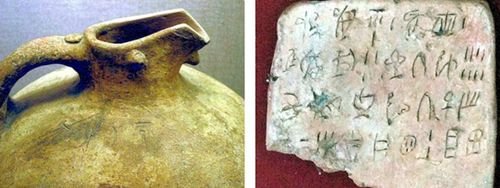
Reference is made to the position of Sir Arthur Evans, the excavator of Knossos, who maintained that the Phoenicians did not invent writing but adopted and adapted earlier Aegean scripts. Evans’ research into Cretan scripts — including Cretan hieroglyphic writing and Linear A — demonstrated the existence of advanced writing systems in the Aegean long before the traditionally accepted date of the appearance of the Phoenician alphabet. The Cretan script, according to Evans, constitutes an indigenous development of the Aegean world and not a derivative of Semitic systems.
LINEAR A AND LINEAR B
The discovery and decipherment of Linear B by Michael Ventris proved conclusively that the Mycenaean civilization (14th–13th century BC) used a written form of the Greek language. This fact is of decisive importance, as it demonstrates that the Greek language was written several centuries before the conventional dating of the so-called “Phoenician transmission” of the alphabet to Greece. If Greek was already written in the Mycenaean era, the question arises: Did the Greeks truly lack writing prior to contact with the Phoenicians? Or did they possess earlier writing systems that later evolved or were replaced? Linear A, though not yet deciphered, is generally considered pre-Greek (Minoan). However, its structural complexity and chronological priority in the Aegean world indicate that writing traditions in the Greek sphere were ancient and highly developed.
THE QUESTION OF PRIORITY
If writing existed in the Aegean prior to 1200 BC, and if the Mycenaean Greeks used Linear B to record their language centuries before the 8th century BC (the conventional date for the adoption of the Phoenician alphabet), then the theory that the Greeks “received” writing wholesale from the Phoenicians becomes problematic. The issue is not whether there was contact between Greeks and Phoenicians — such contact is historically well attested. The issue concerns:
- priority,
- originality,
- and the direction of influence.
Was there simple borrowing? Or was there adaptation of pre-existing Greek writing traditions into a new alphabetic system?
THE BROADER CONTEXT
The question of the origin of the Greek language — oral and written — cannot be examined in isolation. It must take into account:
- archaeological findings,
- comparative linguistics,
- historical testimonies,
- genetic research,
- and cultural continuity.
Recent developments in archaeogenetics and population genetics have reopened discussions concerning ancient population movements and cultural transmissions, overturning or confirming earlier hypotheses. The debate remains open.
THE ORIGIN OF THE GREEK LANGUAGE: ORAL AND WRITTEN TRADITION
(Continuation of Antonios Kounadis’ lecture) According to Sir Arthur Evans, “the script of Crete is the mother of the Phoenician [script],” while René Dussaud states: “The Phoenicians had received their alphabet at a very early stage from the Greeks, who had formed it from Cretan-Mycenaean writing.” (See also: Georgiev, Problems of the Minoan Language, Sofia, 1953.)
PHOENICIAN WITHOUT VOWELS…
Phoenician is not an alphabet, but a “syllabary,” without vowels: it has 22 consonants and lacks the consonants Ξ, Φ, Ψ of the Greek alphabet. Moreover, according to the TLG (Thesaurus Linguae Graecae) Center of the University of Irvine, the Cretan historian Dosiadis (author of the local history of Crete) reports that the alphabet was invented by the Cretans.
WHERE DOES THE LETTER “ALPHA” COME FROM?
Plutarch (Quaestiones, 737) considers naïve the view that the letter “alpha” is Phoenician, derived from “aleph,” the name given to the ox (considered first among necessities). According to the Great Etymological Lexicon, the letter “alpha” derives from the verb alphō (= “I find”), because “it was the first of the other letters to be discovered.”
THE PRESENT ALPHABET IS IONIAN
Each city-state or region in the archaic Greek world had its own alphabet (with small variations from those of other cities). The Greek alphabet in use today is the prevailing Ionic one, with 24 letters, since 403 BC, during the archonship of Euclides. The Corinthian alphabet also has 24 letters; the Cretan has 21; that of Miletus has 24; the Chalcidian has 25— from which the modern Latin alphabet arose, following adaptation by the inhabitants of Latium in Italy (who, it appears, received it from Greeks of Cumae). From the Greek alphabet also derived the Etruscan, the Cyrillic, the ancient Phrygian, the alphabet of Lycia, the Lydian, the Armenian, the Coptic, the Gothic, and others.
VERY ANCIENT GREEK WRITING SYSTEMS
There are many sources concerning the beginnings of Greek writing, among them:
1. The Dispilio Tablet (Kastoria). The tablet of Dispilio in Kastoria, brought to light in 1993 by Professor G. Chourmouziadis, which archaeometrists both from the “Democritus” Research Center and from abroad dated to 5250 BC.
2. “The Sherd on the Islet of Gioura (Sporades)” A sherd found by archaeologist Adam Sampson, bearing Greek writing on a potsherd, dated to 5500 BC.
“The Sherd from the Pilikata Area of Ithaca” Dated to 2700 BC (Stavros Museum of Ithaca), on which symbolic shapes are engraved, similar to those of Linear scripts A and B.
4. THE HOMERIC EPICS WERE TRANSMITTED IN WRITING
A reasonable question arises: how could thousands of verses of the Homeric epics be preserved and transmitted for many centuries unchanged, with remarkable accuracy? For this reason, Mistriotis, in his work History of the Homeric Epics (Sakellarios Press, Athens 1903, 2nd edition), states: “The polymorphism and the instability in the lengthening and shortening of vowels cannot be attributed to the absence of writing.”
5. Professor Gilbert Highet states that a poem such as the Iliad could not have been transmitted without writing (The Classical Tradition, MIET editions), while the well-known author Horst Blanck (Papadima editions, p. 148) affirms: “Today a large part of philologists inclines toward the hypothesis that the composition of the Homeric Epics had already made necessary the written fixation of the text… the rhapsodes carried with them their written manuscript copy.” Also, the French Hellenist Jacqueline de Romilly states categorically: “Homer and writing coexist.” (Why Greece?, “Asty” editions, p. 28.) The dactylic hexameter of the Homeric epics is based on prosody (long and short vowels, double consonants, diphthongs, etc.). The view that the Phoenicians lent certain consonants and that the Greeks immediately wrote the Epics with correct orthography lacks strong arguments, as the Suda (or Souidas) Lexicon notes (see: “Phoenice, city”).
6. WILLIAM DURANT: THE PHOENICIANS RECEIVED IT FROM THE GREEKS
Notable is the statement by the American historian/philosopher William Durant, author of a global history of civilization: “The Phoenicians were not the inventors of the alphabet; they merely circulated it from place to place. They took it from the Cretans and carried it to Tyre, Sidon, Byblos, and other Mediterranean cities. They were the ‘peddlers’ and not the inventors of the alphabet.”
7. The archaeologist and epigrapher Apostolos Arvanitopoulos declared: “The alphabet was conceived and implemented by the Ancient Greeks… and they bestowed it upon all humanity as a common possession.” There are sufficient testimonies in texts of ancient historians and writers (later than Homer’s era) which support that there existed a written Greek language (different from Linear B) around 1200 BC, that is, prior to the Phoenician–Semitic syllabary.
8. GILBERT MURRAY: GREEK IS THE MOST PERFECT LANGUAGE
Concerning this language of incomparable perfection— which we ourselves have mistreated, while for foreign Hellenists and linguists it remains an object of admiration and study— one may cite the statement of the distinguished Oxford Hellenist Gilbert Murray: “[…] a thought can be expressed with ease and grace in Greek, whereas it becomes difficult and heavy in Latin, English, French, German. Greek is the most perfect language, because it expresses the thoughts of more perfect human beings.”
9. The distinguished Spanish Hellenist and linguist Professor F. R. Adrados, a foreign member of the Academy of Athens, has repeatedly stated that Western European languages are semi-Greek or crypto-Greek.
10. THE INVENTOR OF ACCENTS AND BREATHINGS
It is also worth noting that Aristophanes of Byzantium (2nd century BC) is considered the first to have devised and applied accents and breathings.
11. THE PHAISTOS DISCΥ
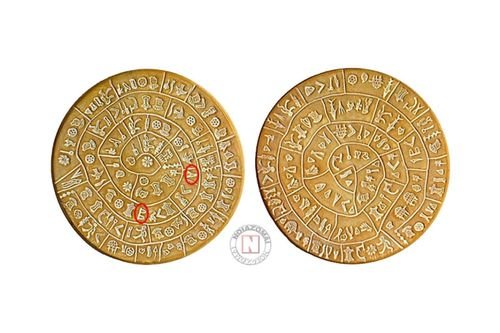
On the “Phaistos Disc,” dated before 1200 BC (found in Crete and still undeciphered), the letters B, G, L, Y appear clearly “printed.”
12. CLAY DOCUMENTS (2ND MILLENNIUM BC)
Michael Ventris and John Chadwick were the first to argue that the tablets “of baked clay, from the second millennium BC, found at Pylos, Knossos, Mycenae, and other places, contained Greek documents originating from the ancient Mycenaean kingdoms.”
13. MYCENAEAN GREEK
Mycenaean, as F. R. Adrados recently emphasized (following others), was Greek, written with the aid of an ancient syllabic script that was later forgotten.
14.OSVALD PANAGL: A PRIMITIVE VARIANT OF ANCIENT GREEK
In a lecture at the Academy of Athens (8–10 March 2013), the distinguished Austrian linguist and Mycenologist Osvald Panagl stated that the above tablets (from Knossos, Pylos, Mycenae) were written in a primordial variant of Ancient Greek, 500 years older than the linguistic idiom of the Homeric epics. Consequently, their dating goes back to around 1300 BC.
15. IKLAINA (MESSENIA): LINEAR B (1450–1400 BC)
16. Ο Αρχαιολόγος Μ. Κοσμόπουλος στην Ίκλαινα Μεσσηνίας με Γραμμική Β΄ του 1450 π.Χ. (ιστοσελίδα ανασκαφής iklaina.wordpress.com)
At Iklaina in Messenia (14 km from Pylos), archaeologist Michael Cosmopoulos, professor at the University of Missouri (director of excavations since 1998), found “among rubble and refuse” the oldest clay tablet of Linear B known to date, dated between 1450 and 1400 BC, as he informed me in a relevant letter. (Excavation website reference is noted in the original: iklaina.wordpress.com)

