
Quantum Nugget #28 — The Soul of the Photon
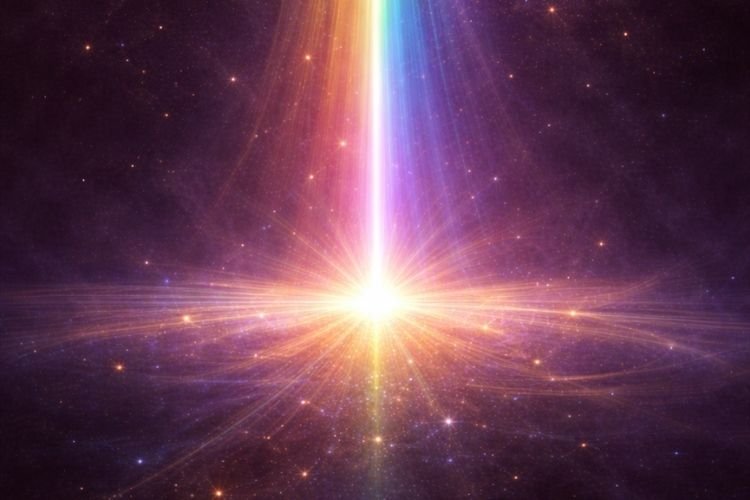
A Poetic Question About the Nature of Light
Terms of the Day:
Photon — Quantum of Light — Electromagnetic Field
If a photon had a “soul,” what would it be?
Its radiance?
Its speed?
The colour it carries?
Its ceaseless journey through the world?
Physics does not attribute a soul, consciousness or inner experience to a photon.
It can, however, reveal the fundamental properties that make a photon what it is.
And those properties are so strange that they almost invite poetry to approach them.
What Is a Photon?
A photon is a quantum of the electromagnetic field: the smallest discrete excitation of a particular mode of that field.
It is not a tiny glowing ball.
Depending upon the experiment, light displays:
- Wave-like properties, such as interference and diffraction.
- Particle-like properties, such as the discrete absorption and emission of energy.
A photon is not “really a wave” on one occasion and “really a particle” on another. It is a quantum object that cannot be fully contained within either classical picture.
Energy and Colour
The energy of a photon is given by:
E = hν
where h is Planck’s constant and ν is the frequency of the light.
The higher the frequency, the greater the photon’s energy.
Within the visible spectrum, different frequencies correspond to different colours.
A violet photon carries more energy than a red photon.
Brightness, however, does not depend only upon the energy of each photon.
It is also related to how many photons reach a surface within a given time.
Colour is one thing.
Light intensity is another.
Momentum Without Rest Mass
A photon has no rest mass, yet it carries both energy and momentum.
For a photon in a vacuum:
E = pc
and
p = h/λ
where p is momentum and λ is wavelength.
Light can therefore exert pressure and transfer momentum to material objects.
Although it may feel immaterial to us, light can genuinely push matter.
Constant Speed
In a vacuum, light travels at:
c = 299,792,458 m/s
All inertial observers measure the same local speed of light in a vacuum, regardless of the motion of the source.
This is a foundation of Special Relativity.
We cannot, however, construct a valid reference frame travelling alongside a photon.
The popular statement “time stops for the photon” must therefore not be interpreted as though we knew what a photon “experiences.”
A photon possesses no clock, viewpoint or experience.
Polarisation: The Orientation of Light
A photon also carries polarisation information.
Polarisation is related to the orientation of the electromagnetic field and may be measured in different bases.
An individual photon can exist in a superposition of polarisation states.
When measured, one of the allowed outcomes appears according to the probabilities predicted by its quantum state.
Polarisation is used today in optics, communications and quantum technologies.
Emitted and Absorbed
A photon may be emitted when an atom or another physical system loses energy.
It may be absorbed when it transfers its energy to another system.
In an ordinary detection, the photon does not simply arrive to have its picture taken.
It interacts with matter and is often absorbed, leaving a measurable electrical or energetic signal behind.
We know that it arrived from the trace it leaves.
Messenger of Electromagnetism
In Quantum Field Theory, the photon is the carrier of the electromagnetic interaction.
Visible light, radio waves, microwaves, infrared and ultraviolet radiation, X-rays and gamma rays all belong to the same electromagnetic spectrum.
They do not differ in whether they consist of photons.
They differ in frequency and energy.
The Poetic Bridge
Human beings associated light with knowledge, revelation, truth and life long before they knew of the photon.
Physics does not prove these symbolic meanings.
It does, however, reveal a reality that makes them even more wondrous:
Whenever we observe a distant star, photons bring us information about matter that may lie thousands or millions of light-years away.
Light does not understand the message it carries.
Yet through light, the distant becomes visible.
Keep This in Mind:
The photon does not possess a soul in the human
sense.
It possesses a quantum identity: energy, momentum,
polarisation and an inseparable relationship with
the electromagnetic field.
If poetry wishes to call it a messenger, physics need not object.
It will merely add:
A messenger without intention — but with a measurable message.
Visual note: The multicoloured beam symbolises the electromagnetic spectrum and the transmission of light. A photon is not a luminous sphere travelling along a predetermined cosmic line.
Scientific references: A photon is an elementary excitation of the quantised electromagnetic field and has energy E = hν. It has no rest mass, carries momentum and propagates through a vacuum at speed c. No valid inertial rest frame exists for a photon; we therefore attribute neither experience nor a personal perception of time to it. NIST — What Is a Photon? · CERN — Quantum Fields and Photons · Einstein Online — The Speed of Light

