02 — Empedocles of Acragas
Akragas (Sicily) · 490–430 BC
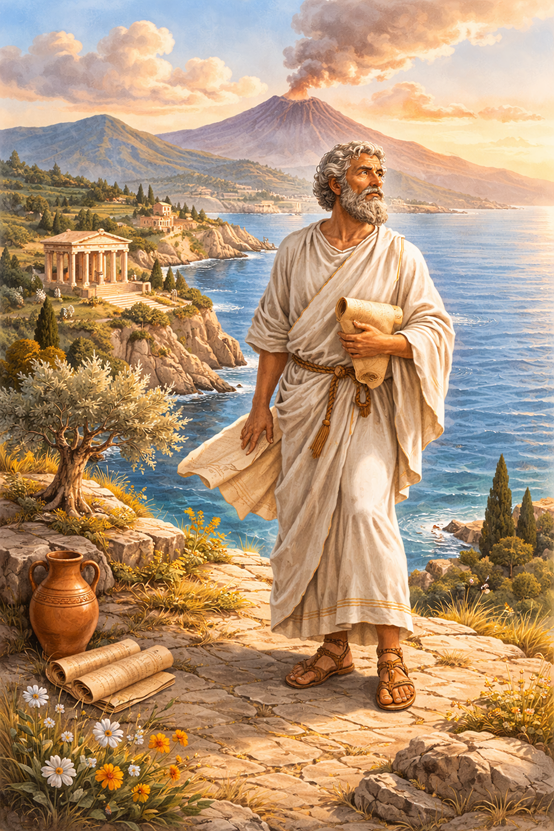
Who He Was
Empedocles was not only a philosopher.
He was a poet, a physician, and a thinker.
He refused to separate nature from soul.
The Central Idea

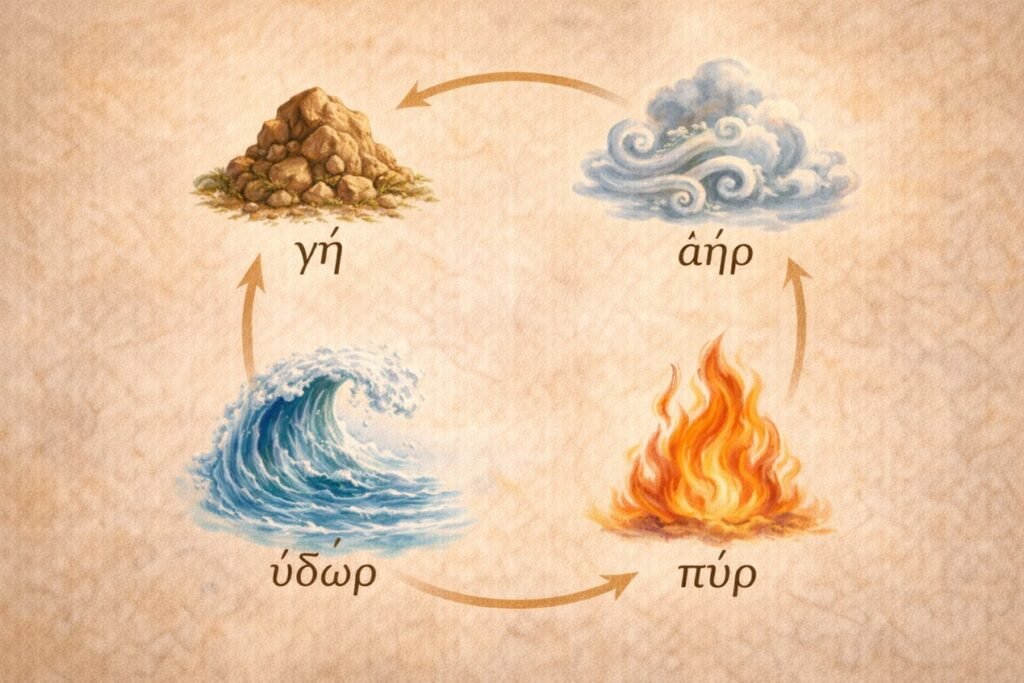
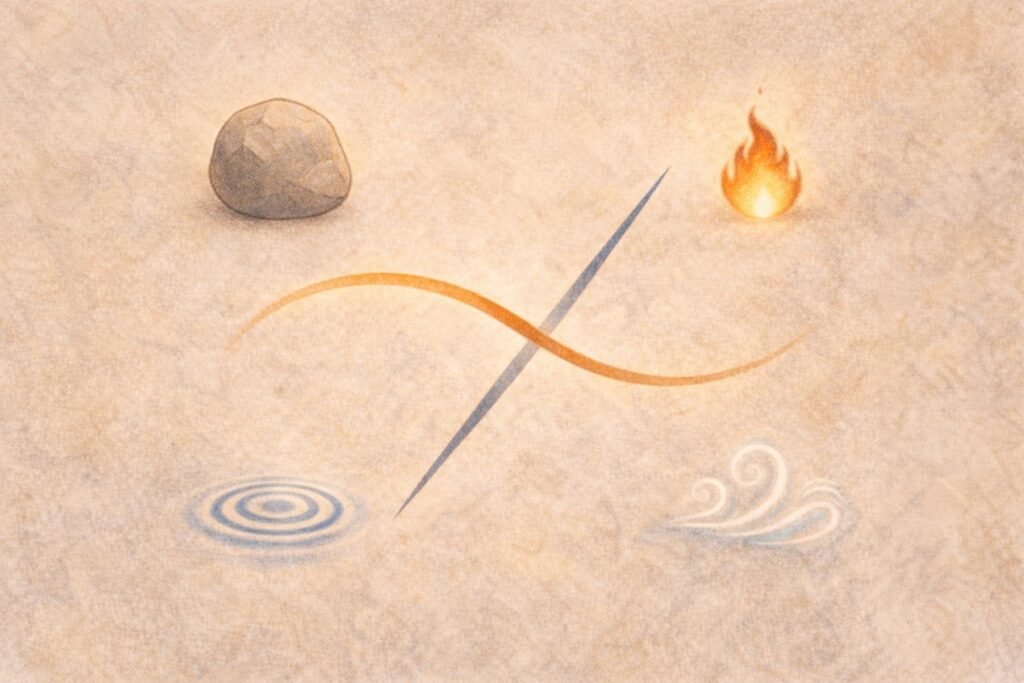
Everything that exists is composed of four roots:
- 🌍 Earth
• 💧 Water
• 🌬️ Air
• 🔥 Fire
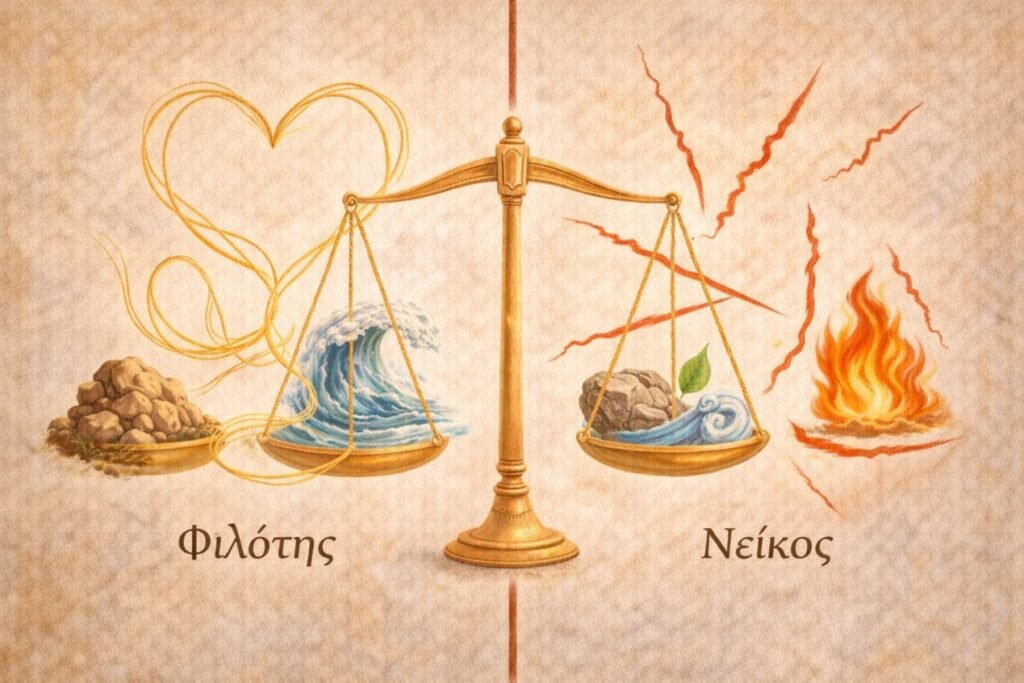
And everything moves through two forces:
- 💞 Philotes — that which unites
• ⚔️ Neikos — that which separates
Nothing is born from nothing.
Nothing disappears into nothing.
There is mixture.
There is separation.
Why He Still Matters
Empedocles thinks systemically before the word “system” exists.
Harmony is not stillness.
It is dynamic balance.
- Too much Philotes → everything merges and loses form.
• Too much Neikos → everything fragments and dissolves.
Life happens in between.
A Quiet Question
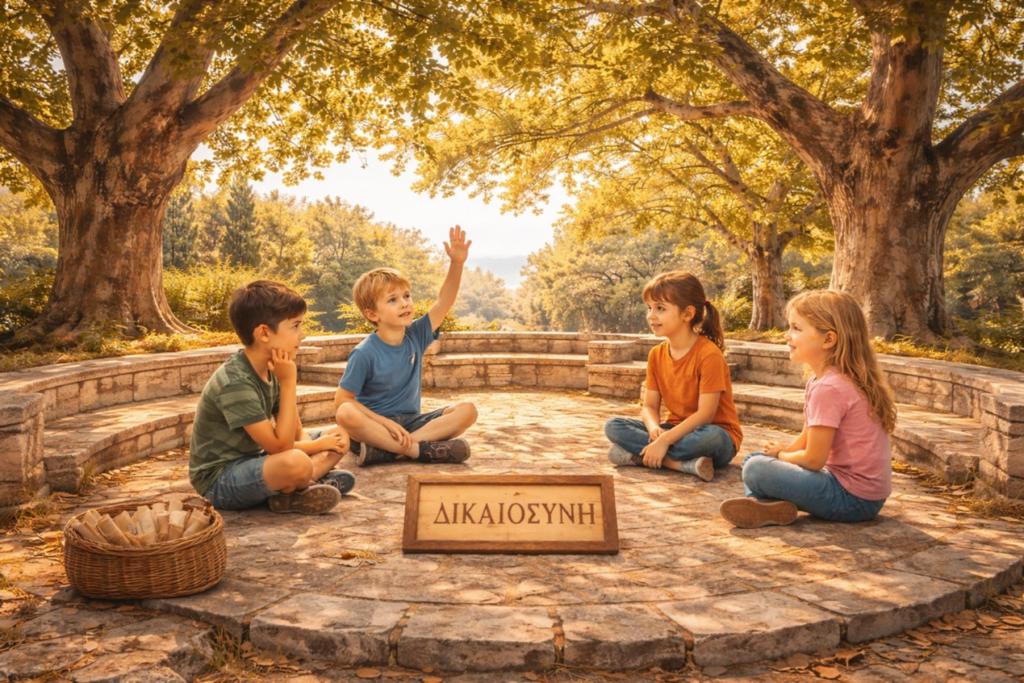
Where in your life is there need
for less conflict
and more rebalancing?
(We do not answer. We hold it.)
Pedagogical Note (For the Adults)
These games are NOT:
- Competitive contests (of confrontation)
- Exercises of logical display (showing off)
- Intelligence tests
They ARE:
- Exercises in intellectual humility
- Training in conceptual clarity
- Practice in the art of listening
They Cultivate:
- Critical thinking
- Emotional regulation
- The courage to revise (one’s own views)
🌿 PLATANIAN GAMES — Empedocles
🎲 Game 02-1-1
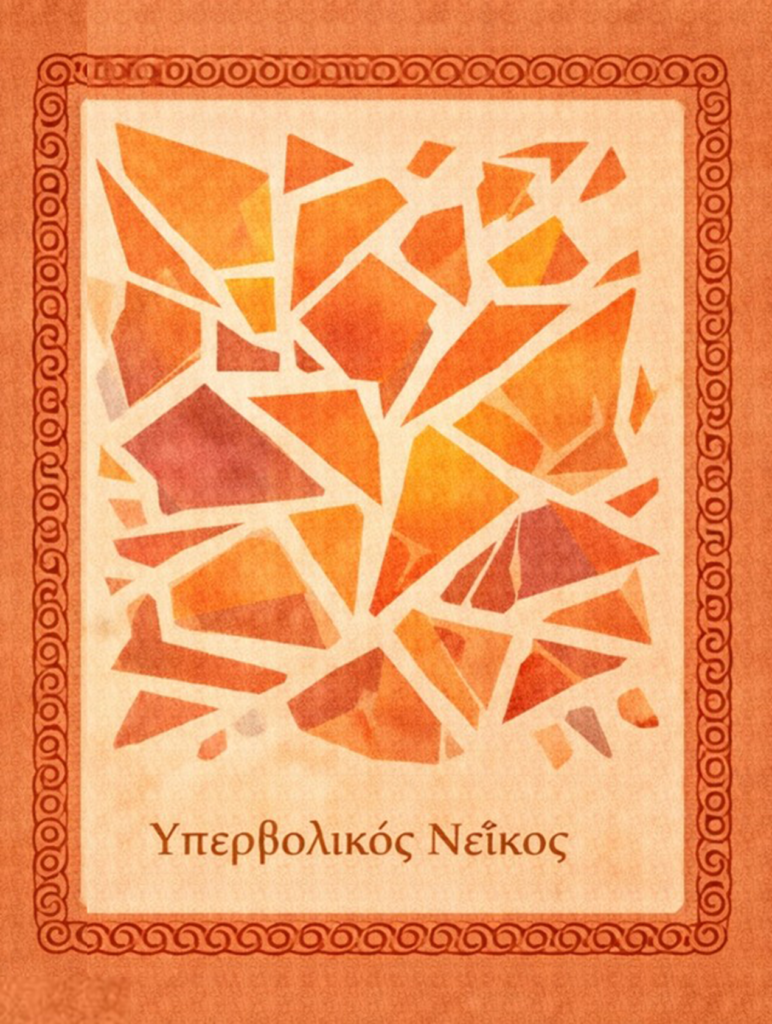
PHILOTES & NEIKOS — The Game of Forces
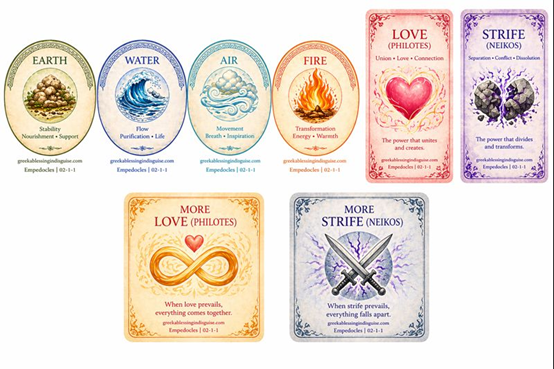
🟦 Materials
- 4 Element Cards: 🌍 Earth | 💧 Water | 🌬️ Air | 🔥 Fire
• 2 Force Cards:
💞 PHILOTES (union, love, composition)
⚔️ NEIKOS (distinction, tension, separation)
🟩 How It’s Played (simple — wise — childlike)
- The children draw 2 elements.
- They draw 1 force (Philotes or Neikos).
- Question (no right or wrong answer):
If it is PHILOTES:
“What new thing might be born if these unite?”
If it is NEIKOS:
“What happens if these separate? What is lost?”
- The child:
• draws
• narrates
• or dramatizes
🟨 The Hidden Pedagogical Miracle
Without realizing it, children:
- learn balance
• understand that
neither absolute union is life
nor absolute conflict
• practice systemic thinking
👉 This is not taught. It is cultivated.
🟣 Bonus (for older children & teens)
Add two new cards:
- “More Philotes”
• “More Neikos”
Ask:
“When does the thing break?”
This is not a philosophy lesson.
It is a life lesson disguised as a game 🌱
CARDS FOR THE GAME
🎲 Game 02-2-1 — “Excess”
This is another level.
Not a skill game — a balance game.
It does not ask for knowledge.
It does not ask for the correct answer.
It asks for inner weighing.
Ideal for:
• older children
• teenagers
• adults who “think they no longer play”
Scenarios:
- Everyone always agrees.
• Everyone constantly clashes.
Question:
Is this balance — or excess?
When Does the World Break?
(We do not answer quickly.)
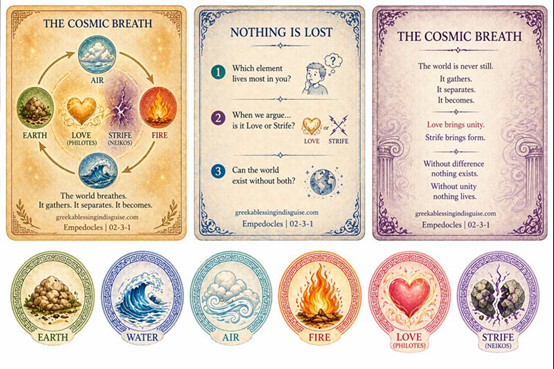
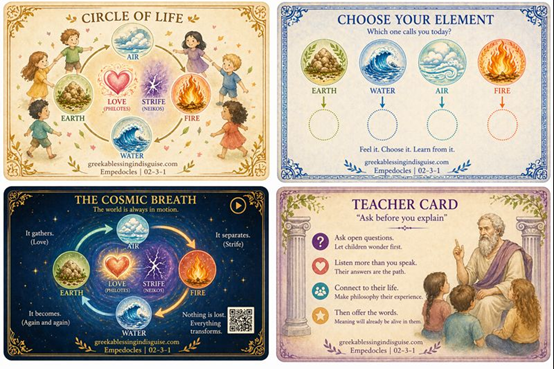
🎲 Game 02-3-1 — “Nothing Is Lost”
Structure (for children)
- Show the four elements.
- Ask: “Which element does your body have the most of?”
- Then: “When we quarrel, is that Philotes or Neikos?”
- Final question: “Can there be a world without both?”
- The Cosmic Breath
For Empedocles, the world is not created once.
It contracts.
It dissolves.
It contracts again.
Philotes brings unity.
Neikos brings distinction.
Without distinction there is no form.
Without unity there is no life.
CARDS FOR EMPEDOCLES GAME 02-3-1
- Why It Belongs in the Platanian School
All our work moves between:
- Analysis ↔ Synthesis
• Past ↔ Present
• Play ↔ Precision
• Root ↔ Derivative
This is Empedoclean rhythm.
We do not merge everything into shapeless mass.
We do not fragment everything into dust.
We learn when to distinguish
and when to connect.
- Small Exercise — “Find the Philotes”
Give two seemingly opposite words:
- tradition / progress
• joy / effort
• root / blossom
Ask:
Where is the force that holds them together?
We do not seek the “correct” answer.
We seek relationship.
Quantum Bridge — Empedocles & Modern Physics
Empedocles spoke of four “roots” moved by two forces:
Philotes (union) and Neikos (separation).
Modern physics does not speak of Earth, Water, Air and Fire.
It speaks of fields, particles, and interactions.
Yet something quietly echoes.
In quantum field theory:
- Nothing appears from absolute nothingness.
• What we call “particles” are excitations of underlying fields.
• Matter is not static substance — it is dynamic relationship.
Empedocles said:
Nothing is born from nothing.
Nothing is lost into nothing.
There is mixing and separation.
Quantum physics says:
Energy transforms.
States change.
Systems oscillate between coherence and differentiation.
Too much uniformity → no structure.
Too much fragmentation → no stability.
Life — and matter — exist in balance.
🌿 A Platanian Insight
Philotes resembles coherence.
Neikos resembles differentiation.
A universe of only fusion would collapse into sameness.
A universe of only separation would dissolve into noise.
Character is formed the same way.
Between attachment and autonomy.
Between unity and distinction.
Between “we” and “I”.
This is not physics replacing philosophy.
This is resonance.
Empedocles intuited rhythm.
Physics describes it mathematically.
Quantum Bridge: Empedocles & Modern Physics
- The Roots and the Forces: Empedocles spoke of four “roots” (elements) moved by two forces: Philia (Love/Union) and Neikos (Strife/Division).
- The Modern Resonance: Modern physics doesn’t speak of earth, water, air, and fire. It speaks of fields, particles, and interactions. Yet, a quiet resonance persists.
- In Quantum Field Theory: • Nothing emerges from absolute zero. • “Particles” are excitations of underlying fields. • Matter is not a static substance—it is a dynamic relationship.
- Empedocles said: Nothing is born from nothing. Nothing is lost to nothing. There is only mixing and separation.
- Quantum Physics says: Energy is transformed. States are altered. Systems oscillate between coherence and differentiation.
- The Balance of Life: Too much uniformity → no structure. Too much fragmentation → no stability. Life—like matter—exists in the balance.
🌿 Philosophical Reflection
- Philia resembles Coherence.
- Neikos resembles Differentiation.
- A universe of only union would collapse into an undifferentiated mass.
- A universe of only division would dissolve into chaos.
- Personality is formed the same way: between connection and autonomy; between “we” and “I”.
- Physics does not replace philosophy. It is an echoing rhythm. Empedocles sensed the rhythm; physics describes it mathematically.
The Quantum Match: Werner Heisenberg
Why Heisenberg?
- Uncertainty Principle: The limits of knowledge.
- Dynamics over Statics: Reality is not solid; it is rhythmic.
- The Observer and the Observed: They are inextricably linked.
Common Ground: Empedocles says: Mixing – Separation Heisenberg says: Probabilities – States Reality is not a solid object. It is a rhythm.
Alternative Match: Niels Bohr
For the Principle of Complementarity. The unity of opposites—just like Philia and Neikos.
“Just as a quantum particle ‘dances’ among all possibilities until it finds its place, so do the roots of Empedocles ‘dance’ between union and separation.”
Why Empedocles Belongs in Greek a Blessing in Disguise (GBD)
Because he reminds us — without preaching — that:
- science and poetry were never enemies,
• matter carries memory,
• thought can be beautiful without becoming obscure.

