PROLOGUE
Two Rivers Open the Same Story
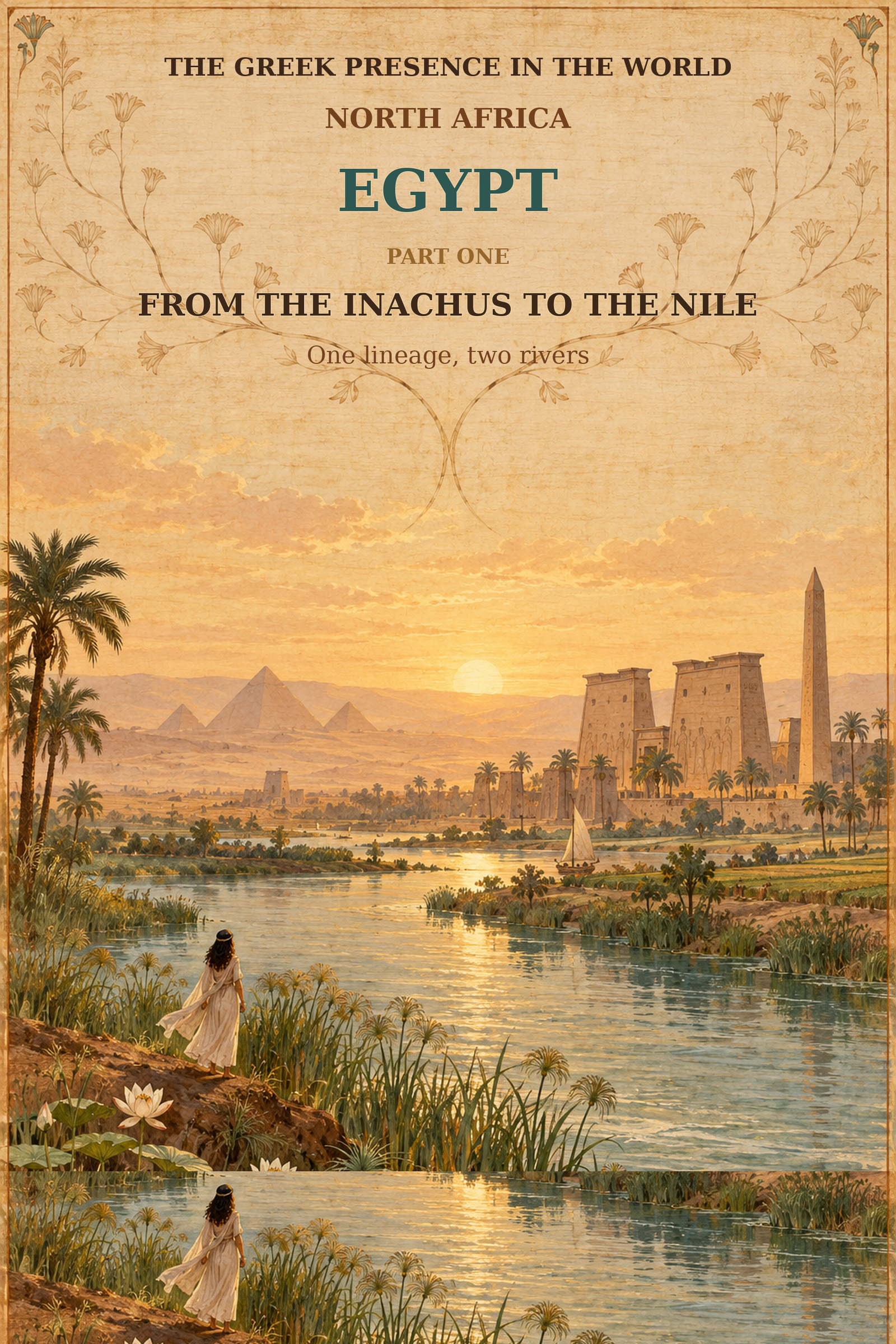
Ancient tradition did not place Greece and Egypt in two separate worlds. It linked them through genealogies, journeys and rivers. Inachus flowed through Argos. The Nile crossed Egypt. Yet in the memory preserved by the ancient narratives, both rivers belonged to the same great family of waters.
Io descended from Inachus. Her path would carry her far from her homeland, until her steps finally came to rest on the banks of the Nile. There, her wandering ended and a new lineage began.
To follow this lineage, we need not burden our memory with a multitude of names. We shall watch it grow as we would a tree: one trunk, a few clear branches and, each time, a road continuing onwards.
One lineage. Two rivers. And between them, a journey that became a genealogy.
CHAPTER 1
One Lineage Two Rivers
Long before Io first saw Egypt, the story had already linked her homeland to the Nile. Inachus and the Nile appear in the ancient genealogical traditions as sons of Oceanus and Tethys. One became the river of Argos; the other, the great artery of Egypt.
Io belonged to the line of Inachus. When she reached the Nile, therefore, she did not find herself outside the world of her own lineage. The river that welcomed her was a distant kinsman of the river she had left behind.
The First Small Family Tree in Our Book
CHAPTER 2
Io Reaches the Nile
Io had crossed seas and lands. Her journey belongs to another, greater narrative; here we pause at the moment when her road ceases to be a flight. In Egypt her wandering ends, Io regains her human form and bears Epaphus, the son of Zeus.
Epaphus does not remain merely the child of the wandering Io. He grows up, becomes king of Egypt and marries Memphis, daughter of the Nile. Through this marriage the two lines are bound even more closely: the lineage that began with Inachus is joined to the very family of the Egyptian river.
Epaphus and Memphis have a daughter, Libya. Her name spreads across the land of North Africa, and our narrative now takes root firmly in Africa.
Io arrived persecuted. Epaphus grew to be a king. Flight became a root.
From Io to Belus and Agenor
CHAPTER 3
The Lineage Takes Root in Africa
Libya was united with Poseidon and had twin sons, Belus and Agenor. For a while the two brothers belong within the same picture. Then their paths divide.
Agenor makes his way towards Phoenicia. From his line will spring figures who fill other great narratives. We shall mention his branch so that the tree remains complete, but we shall not follow it step by step.
Belus remains in Egypt and reigns there. He marries Anchinoe, daughter of the Nile, and has twin sons: Aegyptus and Danaus. Another generation is joined to the river, and another branching is about to begin.
Agenor's road continues… Our narrative remains on the banks of the Nile.
CHAPTER 4
The Two Sons of Belus
Aegyptus and Danaus came into the world together, but they were not destined to follow the same road. Belus established Aegyptus in Arabia and Danaus in Libya. Aegyptus advanced into the land of the Melampodes, conquered it and, according to tradition, gave it his name.
Thus the name of a person became the name of a land. The card that follows does not interrupt the story; it holds this moment open for a little while, allowing the reader to watch the name pass from the man to the country.
The years passed. Aegyptus had fifty sons and Danaus fifty daughters. Two great families grew on opposite sides of a difference that would soon become a conflict.
CHAPTER 5
The Roads Divide
Danaus feared that the sons of Aegyptus would turn against him. On Athena's advice he built a ship with fifty oars, took his fifty daughters aboard and left Libya behind. He stopped at Rhodes and then continued towards Argos.
He was not, however, travelling to a land without ties to his lineage. He was returning to the country of his distant ancestress, Io. There King Gelanor handed over his rule, and the inhabitants were named Danaans after him.
Danaus thus returns the lineage of Io to Argos. The movement completes a great circle: Inachus, Io, the Nile, and Argos once more. But our own story does not board his ship. It stands upon the shore and watches it sail away.
THE BRIDGE TO PART TWO
Agenor followed his road towards the East. Danaus took the sea route to Argos. Their branches continue into other stories, and we shall meet them again when the time comes.
We remain here. Before us flows the Nile: the river that welcomed Io, was joined twice to her descendants and gave life to the country in which her lineage reigned.
Now the figures step aside for a while, and the land itself comes to the foreground. We shall follow the river, learn its names, discover the earth it waters and the cities that rose upon its banks.
Their road continues… Our narrative remains on the banks of the Nile.
PART TWO
THE RIVER THAT BECAME A COUNTRY
SOURCES FOR PART ONE
Hesiod, Theogony 337 ff. — The rivers as children of Oceanus and Tethys, among them the Nile.
Apollodorus, Library 2.1.1 and 2.1.3–5 — Inachus, Io, Epaphus, Memphis, Libya, Belus, Agenor, Aegyptus and Danaus.
Aeschylus, Prometheus Bound 846 ff. — Io's journey to the Nile and the birth of Epaphus.
Aeschylus, The Suppliants — The memory of Io and the return of the Danaids to Argos.
Diodorus Siculus, Historical Library, Book I — The Greek traditions connected with Egypt and the ancient memory of the two lands.

