
Mythology Is Not Fairy Tales · Cycle 1 · Episode 3 — A Hundred Eyes, One Flute
Mythology Is Not Fairy Tales
Season 1 · Io — the girl who became a map
Episode 3
A Hundred Eyes,
One Flute
The mightiest weapon on Olympus was not the thunderbolt.
It was a lullaby.
The Hero-Jailer
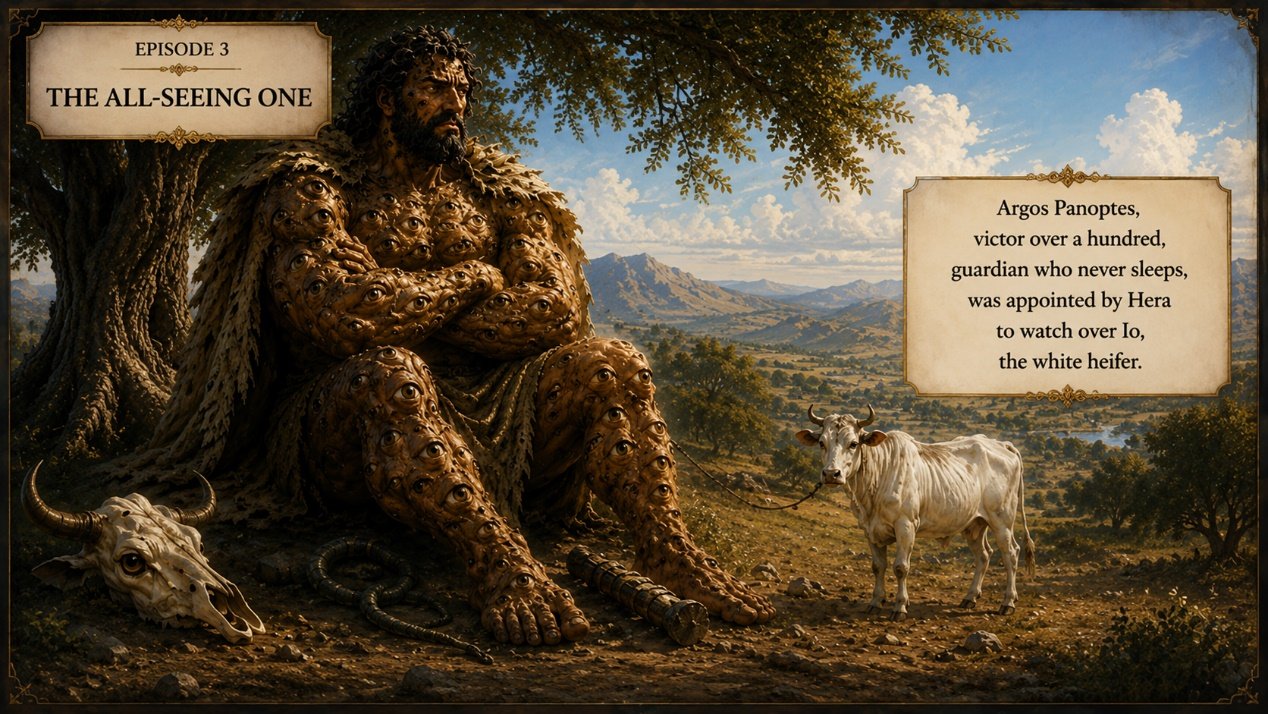
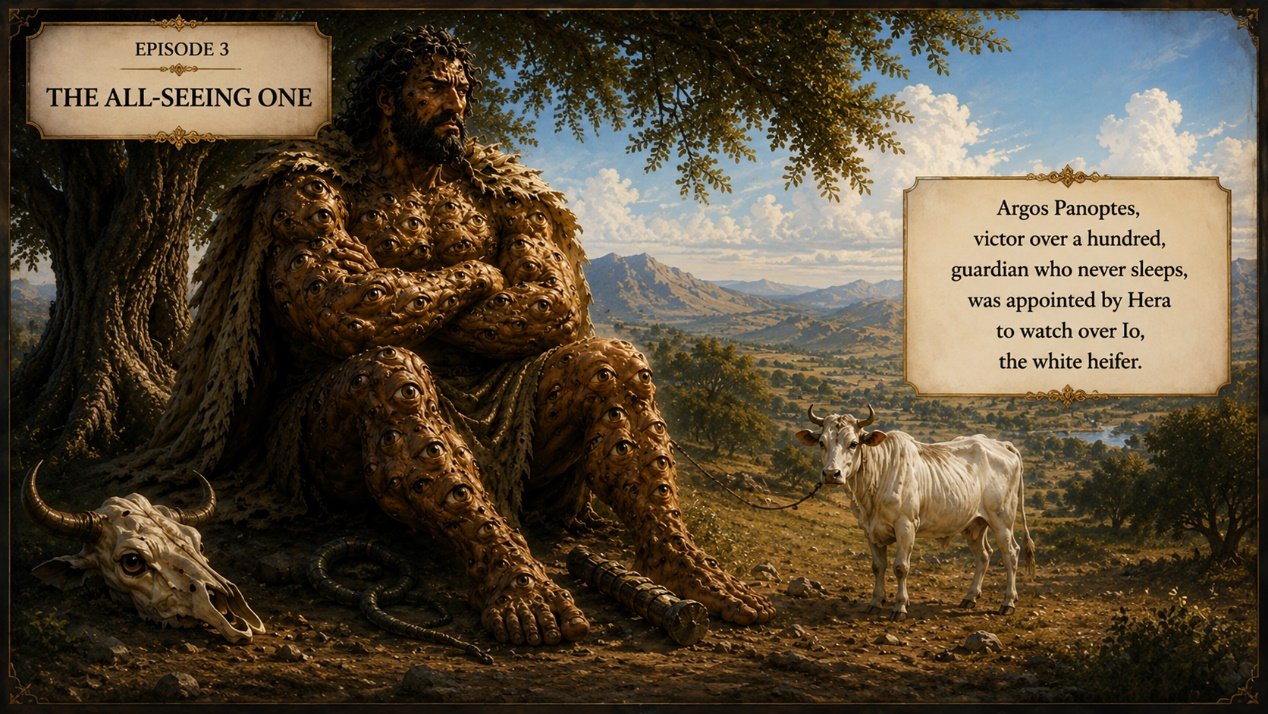
To measure the escape, you must first meet the jailer. Argus Panoptes was no stock monster. He was the superhero of his age: the one who strangled the bull that ravaged Arcadia and wore its hide as a cloak; who rid the land of the Satyr that rustled the herds; who found Echidna — the serpent-woman who swallowed travellers — and finished her in her sleep.1 Note the irony; myth adores it: the hero who killed the monster in its sleep will die of sleep.
This was Hera's choice of jailer. And Zeus, high on Olympus, kept looking at the white heifer tied to the olive tree — looking at what he had caused and dared not touch. At last he could bear it no longer. He called his son Hermes — the fastest, the slyest, the only god who could steal a thing and be applauded for it — and gave him two words: “Steal her.”2
How do you sneak up on someone who has no back?
But you do not steal from Panoptes. Come from any side — he sees you. Choose any hour — half his eyes are open, waiting. Hermes understood at once: winged sandals were useless here. So he did what the truly great do: he set down everything that made him a god.
The Goatherd
He took the uphill road whistling.
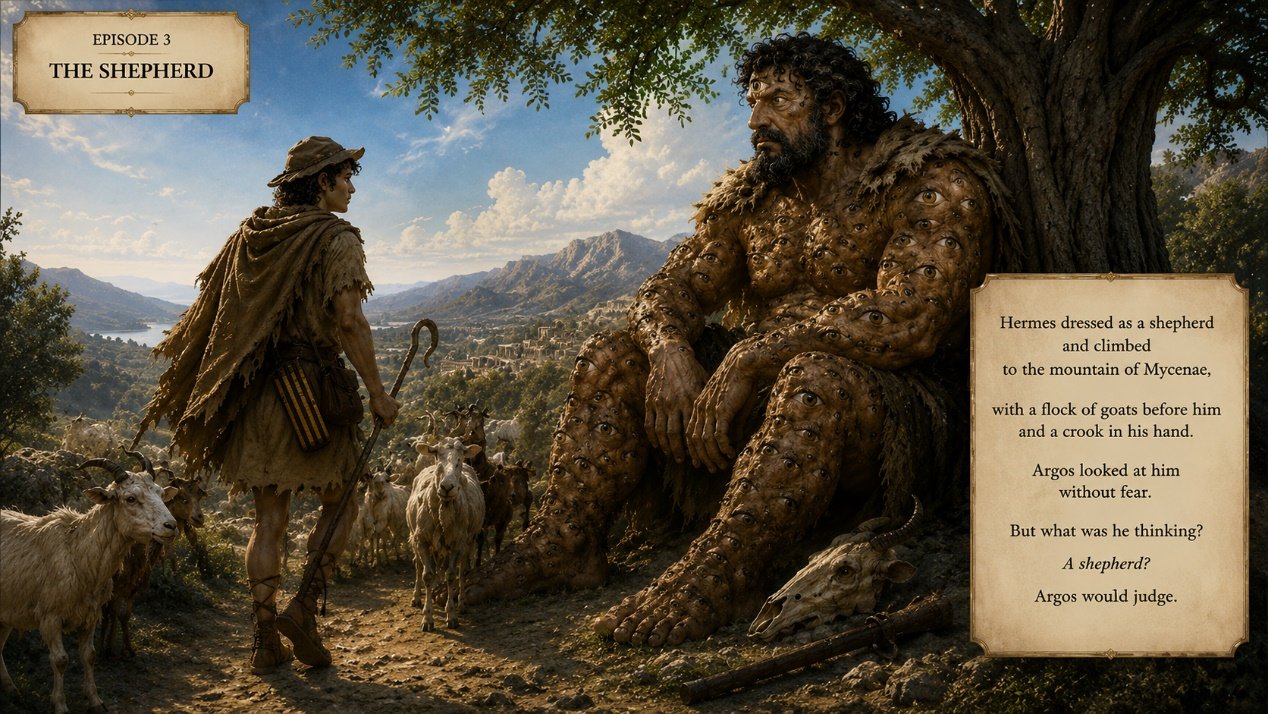
He hid the wings, left the herald's staff, dressed as a goatherd. And he took the uphill road to Mycenae whistling, a scatter of goats ahead of him and, tucked in his belt, a syrinx — the shepherd's pipe of seven reeds.3
Argus saw him from afar — Argus saw everything from afar. But what was there to fear? A goatherd with dusty feet? He let him approach. And the shepherd sat down on a rock across from him, with the deference of the small before the famous, and began to play.
The Lullaby
No eye can resist a good story told softly.
He played no marches. He played what shepherds play when the sun leans west: slow, sweet tunes that rise and fall like a sleeper's breathing. And between the tunes, stories — for Hermes knew the great secret: no eye can resist a good story told softly.
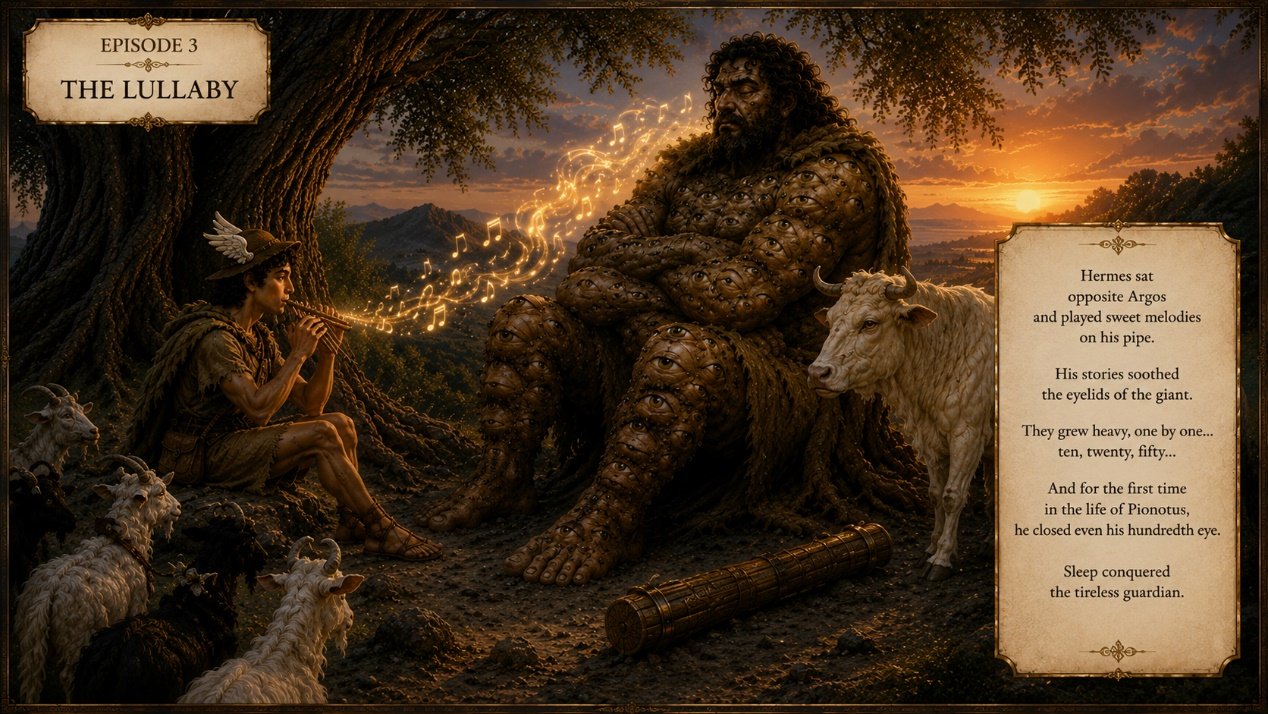
The gentle siege lasted hours. Twenty eyelids grow heavy... forty... Argus fights it — he is a jailer, he knows his duty — but the melody circles and returns, the afternoon turns gold, the shepherd's voice grows softer still...3 And at some point, for the first time in the life of Panoptes, the unthinkable happened: the hundredth eyelid drooped.
The myth does not hide the price: Hermes did not merely lull him. He lifted a stone and ended the watchman where he sat — abruptly, shepherd-style, for good.4 The Greek gods are not fairy-tale creatures; that is precisely why their stories refuse to fade. From that day Hermes carries the deed in his name: Argeiphontes, slayer of Argus — an epithet so old that Homer already uses it on autopilot, like a surname.5
The hero who killed the monster in its sleep
was conquered by sleep.
The Eyes That Never Close
Hera made memory visible.
Hera did not weep as mortals weep. She did something more regal: she gathered, one by one, the hundred eyes of her faithful watchman and sowed them across the tail of her favourite bird. Look at a peacock today — any peacock, in any park on earth. Those hundred “eyes” fanning open in the sun are Argus's memorial: eyes that never sleep again, because they never close again.6 The bird you glimpsed on the temple ledge back in Episode 1? Now you know why its tail was still plain.
Then Hera sent her final gift. Not a guard this time; guards can be sung to sleep. Something tiny, winged, almost invisible — an oistros: the gadfly with the white-hot sting. A thing that does not sleep, does not negotiate, does not listen to flutes. At the first stab the white heifer leapt as if lightning had touched her — and began to run.7
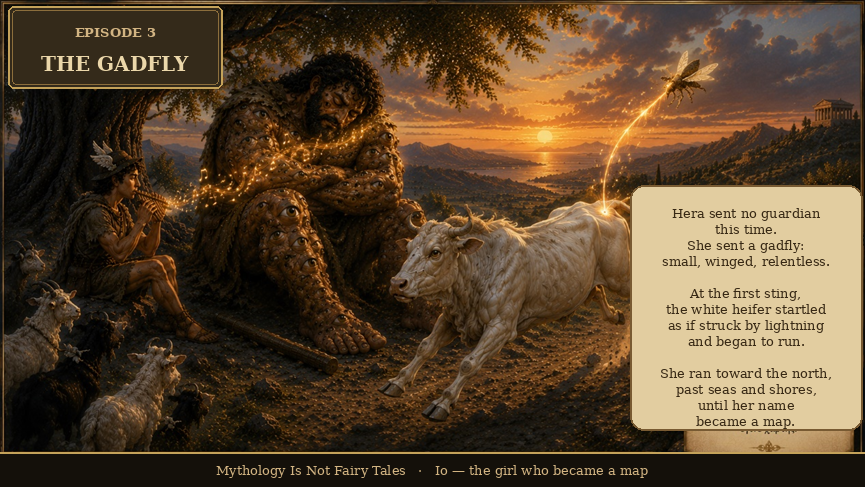
She ran north, out of the plain, out of the world she knew. And she would not stop — oh, she would not stop — until two seas and one crossing between two continents had taken her name.
Greek in Disguise
Words That Travel
Panopticon
In 1791 the philosopher Jeremy Bentham designed a prison where one unseen guard watches everyone, and named it the Panopticon — pan + opsis, “all-seeing,” lifted straight from our giant's title. The word is now the international shorthand for the age of cameras and surveillance. Every debate about being watched happens in the shadow of Argus. [A]
Syringe
The shepherd's pipe — the syrinx of hollow reeds — lent its name to every hollow little tube after it: which is why the doctor's needle is called a syringe to this day. The instrument that put Panoptes to sleep is the distant ancestor of the instrument that pricks you at the clinic. [A]
Argeiphontes
“Slayer of Argus,” as the ancients understood it — though linguists still argue over the epithet's first root. We keep it as Homer kept it: a riddle with a certificate of antiquity. [B]

The Journey Continues
The road ahead of her:
north, unknown.
