GLOBAL ETYMOLOGICAL MAP: THE [A] LIST
Suffixes & Roots / Επιθήματα & Ρίζες
- -STAN (e.g., Kurdistan): < Stion (ancient gr. στίον = pebble, small stone). According to George W. Lemon (1783), the word Stone originates from Stion. It is linked to the megalithic heritage of sites like Stonehenge.
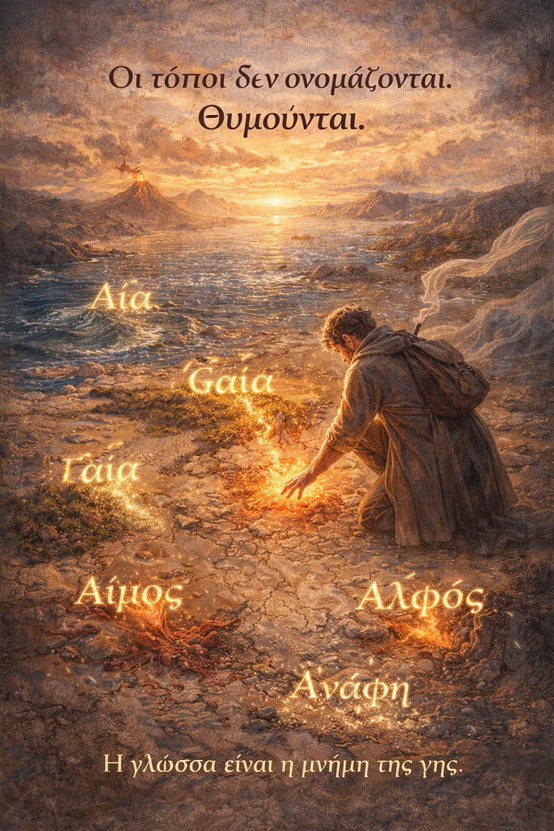
- -GUA (e.g., Nicaragua, Antigua, Paraguay, Uruguay): < GAIA (ancient gr. γαία = earth/land).
- Nicaragua: The Land of Victory (Niki + Gaia).
- Uruguay: The Land of Ares (Uru ~ Ares + Gaia).
- -LAND (e.g., Ireland): < Las / Laos / LAVAS (ancient gr. λᾶς = stone/rock). The foundation of the earth.
- AIA: (The island of Circe) < aia = gaia = earth. It survives in ancient toponyms such as Poteidaia, Nikaia, and Phokaia.
Alphabetical Place Names
- Adriatic Sea: Named after the hero Adrias, son of Ionios.
- Aegean Sea: < Aegeus < aix-aigos (goat). Metaphorically, aiges refers to leaping waves. < aisso (to move rapidly).
- Aegina: Named after the nymph Aegina, daughter of the River God Asopus. Zeus fell in love with her and carried her to the island of Oinone, which was subsequently renamed in her honor.
- Agistri: Ancient Kekryphaleia. Modern name means “Hook,” as it is “hooked” to Aegina.
- Aia: (The island of Circe) < aia = gaia = earth.
- Aidipsos (Αιδηψός): < Aidoion (genitals) + apto (to touch/fasten). The place where Pyrrha took thermal baths to become fertile.
- Aidoion: < aideomai (to feel awe/respect). The “venerable part” where life begins.
- Alonissos: < als (sea) + nissos (island). Ancient Ikos.
- Alps: < ALPHOS (Ancient Gr. ἀλφός = white), due to the snow.
- America (Αμερική): Named after Amerigo Vespucci. However, Plutarch (in “On the Face which Appears in the Orb of the Moon”) mentions a “Great Continent” beyond Ogygia, inhabited by Greeks who honored Hercules.
- Amorgos: < amorge (a plant used for transparent robes).
- Amphissa: < amphi + isa (equal on both sides), regarding oracular revelation.
- Anafi (Ανάφη): < Anephani (it appeared/emerged). It appeared to the Argonauts during a storm, who then built a temple to Apollo there
- Andes: < andano (to please/delight). Andes (Άνδεις): < andano (to please/to delight). Those which provide pleasure.
- Andros (Άνδρος): Named after the hero or seer Andros (or Andreas), to whom Rhadamanthus—the most just man on earth—gifted the island.
- Arcadia: Etymologically linked to the ship Argo (Ark-adia).
- Argos: < Ar- < Var / Sar (Sirius). The “shining city.”
- Astypalaia (Αστυπάλαια): Means the “Ancient City” (Asty + Palaia); it served as a naval station in antiquity.
- Attica: < Atta (father). The “Land of the Fathers.”
- Boreas / North: < F + oros (wind from the mountains).
- Brauron: Signifies “Splendid/Radiant.”
- Calabria, Italy (Καλαβρία): < kale (beautiful) + bria (Thracian for polis / city). The “Beautiful City.”
- Cappadocia (Καππαδοκία): < KAPPA (Doric for hippos / horse) + DECHOMAI (to receive/welcome). The land that “welcomes the horses.” Etymologically linked to the vast plains famous for their equine tradition.
- Ceuta, Spain (Θέουτα): < Theou + ta/da/ga (The Land of God).
- Chile (Χιλή): < Phyle (gr. φυλή = tribe/outpost, from phyo -to grow- and phylasso -to guard).
- China (Κίνα): Derived from the ancient Indian KINA < SIN (Sinope / Sines / Kines). A name that travelled through the ancient trade routes.
- Chios (Χίος): From Chione (daughter of Poseidon). It is said that snow (chioni) fell at her birth, making the soil fertile.
- Cholargos (Χολαργός): < chole (bile/anger) + argos (idle). People who are mild-tempered, “without bile.”
- Cork, Ireland (Κορκ): < erkos (wall/enclosure). The fortified place.
- Crete (Κρήτη): < Krata (powerful, strong, sovereign). Linked to the word kratos (power/state).
- Damascus (Δαμασκός): Linked to the myth of the giant Askos who fought Dionysus. < deo (to bind) or Dermaskos < derma (skin/hide), from which Hermes crafted a vessel.
- Danaans (Δαναοί): < DA/GA (Earth) + NAF (to inhabit/dwell, root of naos/temple). The “Inhabitants of the Earth.”
- Danae (Δανάη): < DAN (water/moisture/dew, as in Danube) or < DA (earth) + NAEI (where one dwells).
- Earth: < enerthe(n) (deep within)..
- Elche, Spain: Derived from ancient Helike. Euboea (Εύβοια): The land of “fine cattle” (eu + bous). Ancient coins depicted the cow as its sacred symbol.
- Epidaurus: Literally “acting upon the breeze” (dra epi tis ayras).
- Epirus (Ήπειρος): < a + perao (without end/infinite). Named by the Corfiots to describe the vast mainland. Home to the Selloi priests of Dodona, who slept on the ground to draw prophetic power.
- Euboea: The land of “fine cattle” (eu + bous).
- Europe (Ευρώπη): < europos (wide) + ops (eye/vision). She who opens the “wide vision” (insight) into the realms perceived by the mind before incarnation.
- Gaia (Γαία): < ga-ge < gignomai (to be born/to become). The source of all existence.
- Galapagos (Γκαλαπάγκος): < gala (milk) + pagos (ice/rock). Referring to the stark white rocks of the islands.
- Gaza (Γάζα): < ga (Doric for Earth) + za. The Land of Zeus.
- Giza (Γκίζα): < gi (earth) + za (Zeus). The Land of Zeus.
- Gue (Γούε): A variant of Gaia (Earth).
- Haemus / Balkan Mountains (Αίμος): Named after the haema (blood) of Typhon, which stained the mountains when Zeus struck him with thunderbolts.
- Hellas / Greece (Ελλάς): < selas (light/brightness) or EL (Sun/God) + LAS (stone/people).
- Hesperia / The West (Εσπερία): < Fesperia-Vesp-OUESP. Through the transformation of “p” to “tau”, we derive OU-EST > WEST.
- Hera: < era (earth) or anagram of aer (air). Hera (Ήρα): < era (archaic word for earth) or an anagram of aer (air).
- Himalayas (Ιμαλάια): Linked to the Doric SAM (Sun/High).
- Ikaria: Named after Icarus, who fell into the sea there.
- Ithaca: < ithys (straight/long). Root of ichthys (fish) and ithageneia (nativity).
- Japan (Ιαπωνία): FAP-SAP/FI. If “P” becomes “B”: SAV/SIV. Linked to SAV/SAF = Light/Sun.
- Jericho (Ιεριχώ): Meaning the “Sacred Echo” (Iera Echo).
- Kefalonia (Κεφαλονιά): Named after the hero Kephalos, an Athenian leader and son of Dionysus. Note: The correct orthography in Greek uses a single “l” (Λ).
- Kissavos (Κίσσαβος): < kissa (spiritual ecstasy/contact with the divine, as in Dionysus’ kissos / ivy) + boos (the sacred ox of the earth). Signifying “divine birth upon the earth.”
- Knossos (Κνωσός): < gno-kno. Root of the English know, the French connaitre, and the Latin recognosco. Linked to the sacred mantras konx (to know) and om (to see).
- Kos (Κως): < Kofos. Signifying a “hollow” island or an island with caves (cave).
- Kythera (Κύθηρα): < keutho (to hide). The island where Aphrodite was born in secret.
- Lacedaemon: < Lakon + daemon or Lakos + Daemon (Lake of the Gods).
- Lake (Λίμνη): < LAKOS / lakis (a rift, chasm, or gorge). Where the earth opens to hold water.
- Laconia (Λακωνία): < las (stone) + konos (cone). The word Laos (people) originates from the Greek root las (the people of the stone).
- Larissa (Λάρισα): Signifies the “Pelasgian Acropolises.” < las + airo (to raise stone walls). The leader of the Pelasgian wall-builders was Laertes > lars (leader/ruler), the root of the English title Lord.
- Lefkada (Λευκάδα): Recorded by Homer; derived from leukas (white), referring to the island’s “white earth” (limestone cliffs).
- Lemnos (Λήμνος): Two interpretations:
- < leibo (to pour/flow), the land of many waters (limne / lake).
- < leion pedion (rich plain), the granary of the Aegean. The word leion (wealth) survives in the word lestes (bandit)—the one who steals wealth.
- Lisbon (Λισσαβώνα): Legend attributes the city’s foundation to Odysseus (Ulysses). Ancient names found in archaeological records include Ulissipo or Olissipo.
- Lusitania / Portugal (Λουζιτανία): Named after Lusus, the general and companion of Dionysus-Zagreus.
- Madrid (Μαδρίτη): < MADRE (Mother) < CYBELE. The Phrygian deity Cybele (Matar Kubileya) is the Mother of Mountains and creative forces. Pindar addresses her as “Cybele, Mother of Gods.” In Madrid’s Plaza de Cibeles, the city celebrates its triumphs under her gaze.
- Meander (Μαίανδρος): < maia (midwife) + aner (man/force) = that which “midwifes” the active force. Its motion (pause-forward-back-forward) embodies the Orphic Law of the Triad: Abiding – Proceeding – Returning.
- Malta (Μάλτα): < Melite < meli (honey). The land of sweetness.
- Mare (Sea): < myrein (to flow) < MYR-MAR. A linguistic shift similar to the Vella < Vel-Val-Vyl transition.
- Milos (Μήλος): Named after the hero Milos, a friend of Adonis. He was the first to teach the shearing of sheep, hence in Homeric epics, melos signifies sheep.
- Moai (Easter Island): < HOMOIA (ancient gr. ὅμοια = similar/statues). A reference found in Plato’s Laws.
- Monaco (Μόνακο): < Hercules Monoikos (Hercules “Living Alone”). Dedicated to the solitary strength of the hero.
- Naxos (Νάξος): Ancient name “Dia” (the greatest of the Cyclades). Renamed after the hero Naxos, son of Endymion. Also interpreted as Nous (Mind) + axon (axis/worthy).
- Naupactus (Ναύπακτος): < naus (ship) + pegnymi (to build/construct).
- Nile (Νείλος): < nea ilys (new silt/mud). Formerly called Aigyptos. Roots: NEF-NEI-NAF-NAI.
- Nicaragua: The Land of Victory (Niki + Gaia).
- Nestos (Νέστος): < nefo/nafo (to flow/to be navigable). Ogygia: The island of Calypso; a primordial place.
- Netherlands (Κάτω Χώρες): < nadir (lowest point) + land (< las = stone/earth).
- Ogygia: The island of Calypso; a primordial place.
- Ossa (Όσσα): < divine fame/rumor. Derived from the verb opto (to see/to perceive).
- Olympus (Όλυμπος): < Ololampis topos. The “Wholly Radiant Place,” where the Noes (the pure minds/light) dwell.
- Pacific Ocean (Ειρηνικός): < pegnymi (to solidify/fasten) > paktosis (consolidation of peace) > pagos > PAX (peace).
- Paradise (Παράδεισος): < para + deisa (moisture/collection of herbs). A lush, cool, and irrigated garden.
- Paris (Παρίσι): Founded by Celtic and Galatian tribes; historically linked to the myth of the hero Paris.
- Parnassus (Παρνασσός): < Par- (radiant region) + nassos (shrine/dwelling).
- Paros (Πάρος): Signifies the “shore/coastline.”
- Paxoi (Παξοί): < pathos (passion). Legend says Poseidon struck Corfu with his trident to create a secluded nest for his love for Amphitrite.
- Peloponnese (Πελοπόννησος): Ancient name “Apia” (surrounded by water). Named after Apis (son of Phoroneus), who later became Serapis in Egypt.
- Peru (Περού): < Epirus (The “Mainland” continent).
- Phaistos (Φαιστός): < phaos (light).
- Phaeacians (Φαίακες): < phaos + akos (cure/remedy). Those who find the remedy for their soul when bathed in the “noetic light.”
- Phthia (Φθία): < phthino (to wane/diminish). The region where the waters receded.
- Piraeus / Perama (Πειραιεύς): < peiro (to pierce/cross through). Root of the English Port.
- Samos (Σάμος): < SEM / SOM (height/elevation). < semeion (sign/high tomb).
- Scotland (Σκωτία): < skotos (darkness) + las (stone/land).
- Serifos (Σέριφος): < ser (serifon, a sea plant). Denotes an island rich in healing flora and minerals.
- Sirius (Σείριος): The place where “daemons by relation” are hatched. The Mind passes through here to receive its awakening mission for Earth (the one entering Plato’s Cave).
- Skiahos (Σκιάθος): < skia (shadow). Referring to the dense forests or the shadow cast by Mt. Athos.
- Souli (Σούλι): < sol (sun) / ouros (guardian).
- Sounion (Σούνιον): < STHYN (healthy, intact, salvific).
- Stonehenge: < stone (gr. stion = pebble) + henge (gr. ancho = to hang/fasten).
- Taygetus (Ταΰγετος): < taes (high) + ge (earth) = High Land. Or he who tageuei (rules/commands) the land.
- Tarsus (Ταρσός): < tersomai
- to dry up). The first land to dry after the Great Flood. Root of terra and toast. Tempe (Τέμπη): < temno (to cut). Where the mountains were severed to drain the Thessalian plain (the era of Deucalion).
- Thrace (Θράκη): Named after the hero Thrax. Linked to the Kabeirian mysteries and the early fire-walking traditions (Anastenaria).
- Thessaly: < thesis + alos (position by the sea).
- Ogygia (Ωγυγία): The island of Calypso; the primordial place (possibly Greenland or Gibraltar).
- Uruguay: The Land of Ares (Uru ~ Ares + Gaia).
- Vlach (Βλάχος): < blacha / bliche / BLYCHAOMAI (ancient gr. βληχάομαι = to bleat like a sheep). Referring to the pastoral life of the shepherds.
- Zakynthos (Ζάκυνθος): Named after Zakynthos, son of Dardanos from Troy, who settled there after the Trojan expedition.

