PREFACE
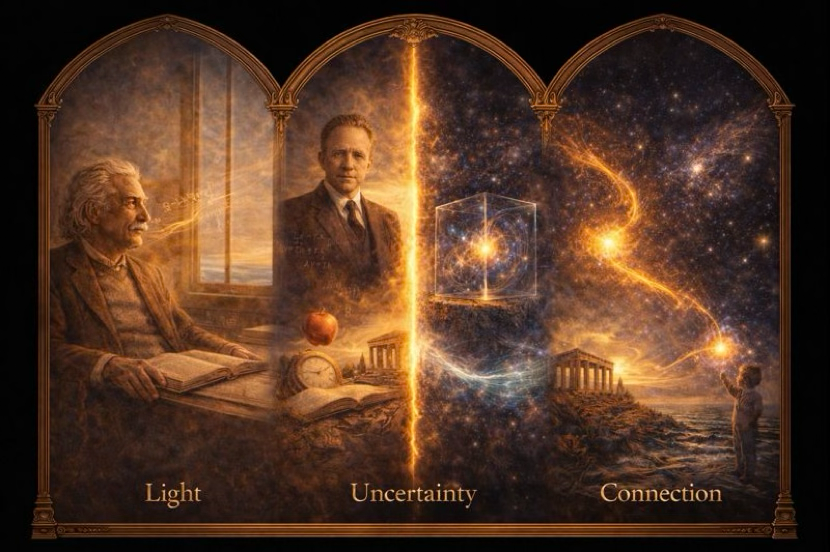
EN: Science often resembles a distant “glass tower,” filled with complex equations and locked secrets. However, the Nobel Prizes are not merely honorary distinctions; they are the milestones of humanity’s great journey toward the Light. In the section “Quantum Leaps of the Mind,” we embark on a bold endeavor: to bring knowledge down from university halls to the heart of everyday life. Because the hardworking person—who builds, cultivates, and dreams—deserves to know that the Universe is not a dead machine, but a living ocean of possibilities. Here, science meets etymology, and the mind takes its own quantum leap toward the truth.
GLOBAL KNOWLEDGE MAP: QUANTUM LEAPS OF THE MIND
CATEGORY: PHYSICS (Η ΦΥΣΙΚΗ)

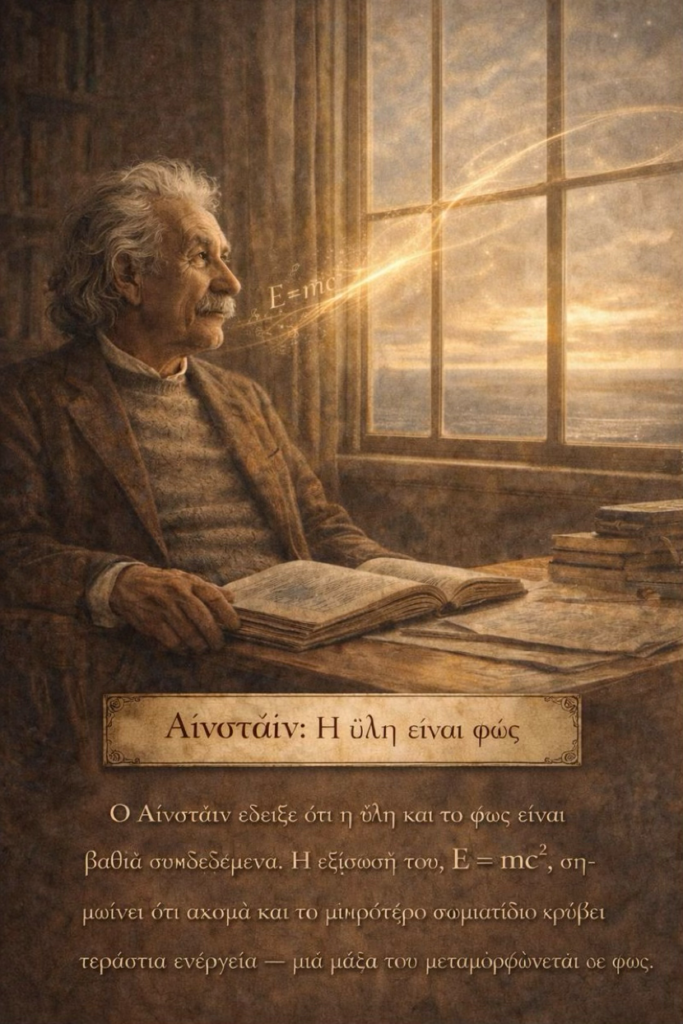
STATION 1: ALBERT EINSTEIN (Nobel 1921)
- The Achievement: Although awarded for explaining the “photoelectric effect” (proving that light behaves both as a wave and a particle), his greatest legacy is the Theory of Relativity ($E=mc^2$).
- In Plain Terms: Imagine that matter—a stone, a table, or even our own bodies—is simply “frozen energy.” Einstein showed us that if we could “melt” a single gram of matter, we would release enough energy to power the entire island of Corfu for years. We are, literally, fashioned from light and vibration.
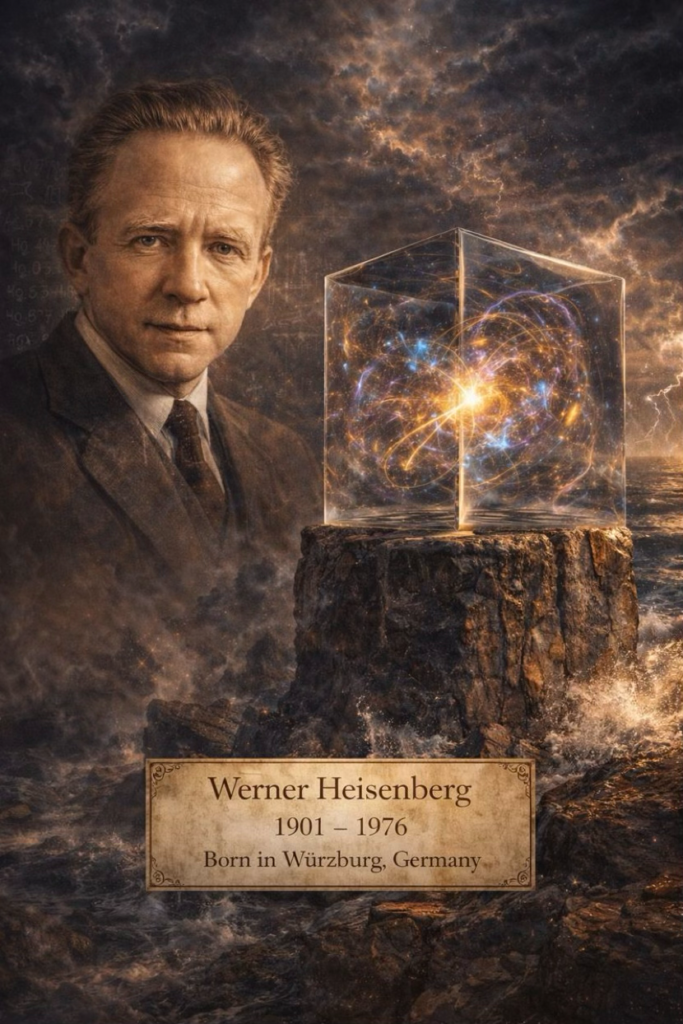
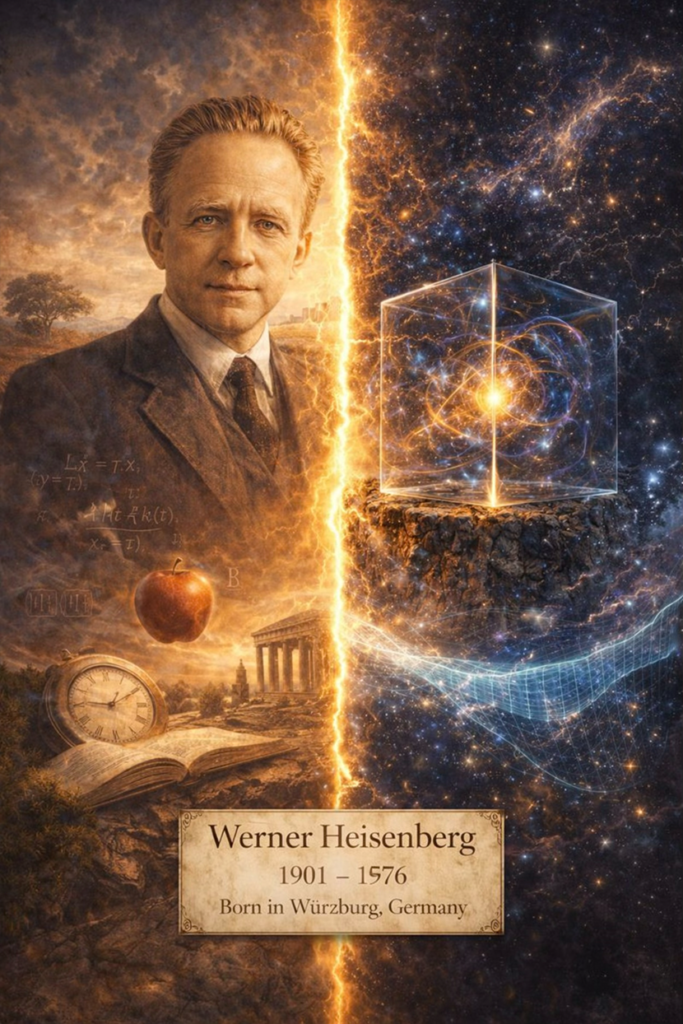
STATION 2: WERNER HEISENBERG (Nobel 1932)
- The Achievement: Formulated the “Uncertainty Principle,” the cornerstone of Quantum Mechanics. He proved that in the subatomic world, one cannot simultaneously know both the exact position and the exact velocity of a particle.
- In Plain Terms: Forget the world where everything is predictable. At the heart of matter, there is a “dancing uncertainty.” A particle can exist in two places at once until someone observes it. This means the Universe is not a static machine, but a dynamic field of potential.
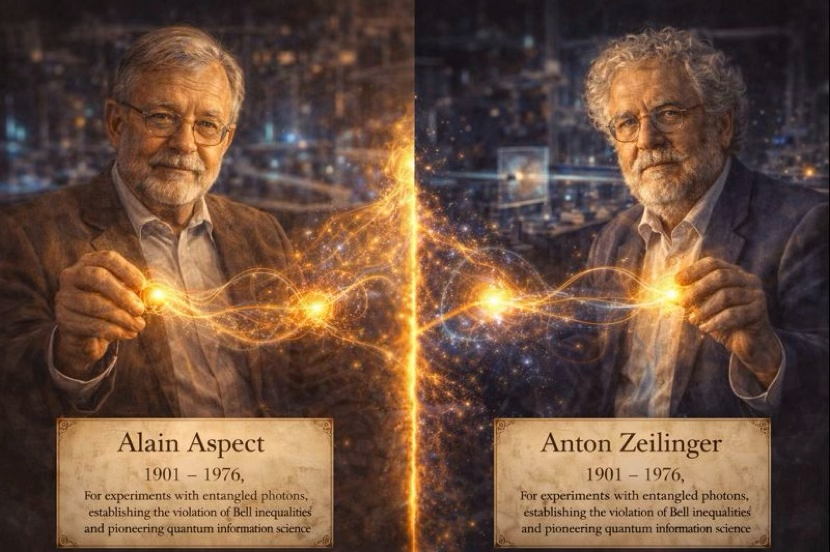
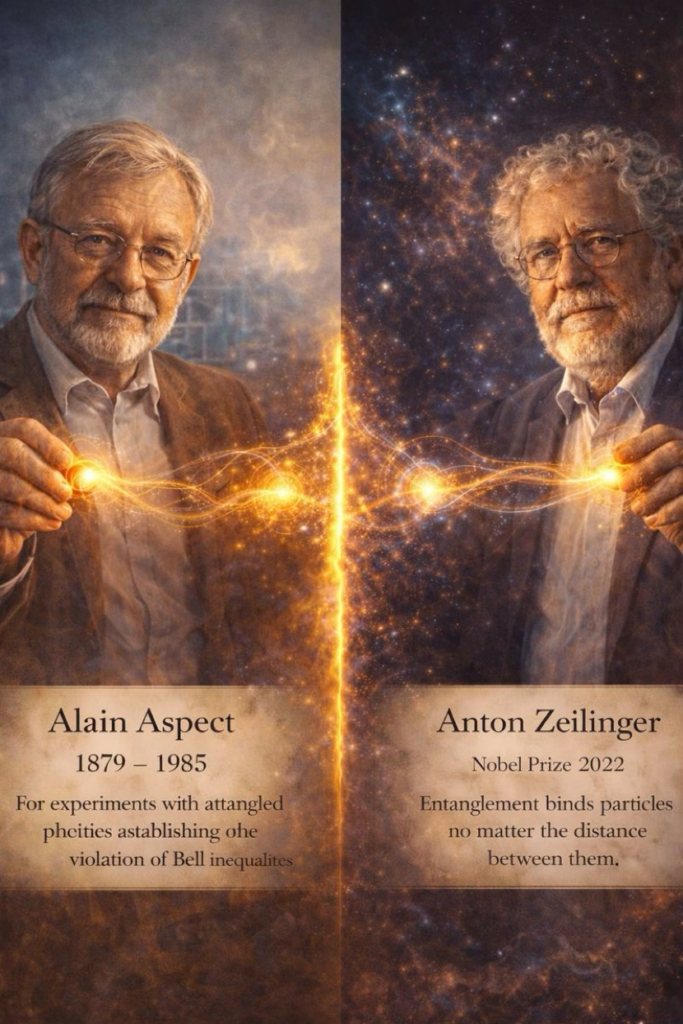
STATION 3: ANTON ZEILINGER & ALAIN ASPECT (Nobel 2022)
- The Achievement: Experimentally proved “Quantum Entanglement.”
- In Plain Terms: This is the ultimate “miracle” of science. Two particles that were once connected remain linked forever, regardless of the distance between them. If you change something in one, the other reacts instantaneously, even if it is on the other side of the galaxy.
- What this means for us: Separation is an illusion. On a deeper, fundamental level, we are all “entangled particles,” interconnected across space and time.