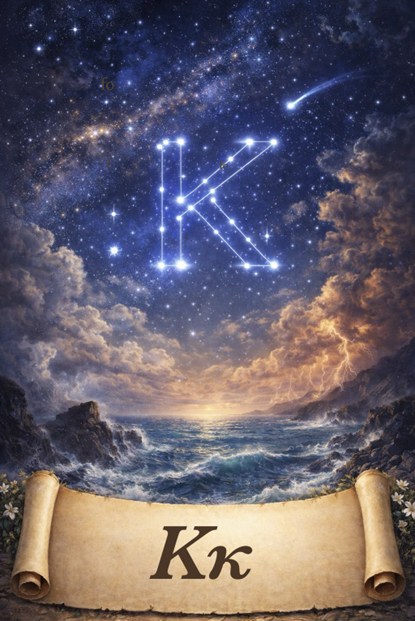
KAPPA (Κ, κ) — 20
- What sound Kappa represents
Kappa = /k/
A hard, sudden sound.
You cannot whisper it.
You must strike.
Try:
- k
- cut
- kick
👉 The sound is impact.
- The core idea of Kappa
In Greek, Κ is linked to actions of:
- cutting
- hitting
- striking
- breaking
- beginning motion through impact
It is the sound of contact.
- Greek root family of Kappa (the “action verbs”)
All these ancient Greek verbs begin with K and describe a blow or sharp action:
- κόπτω → to cut
- κτυπώ → to strike, to knock
- κροτώ → to make a sharp noise
- κρώζω → to croak, to cry sharply
Same idea every time:
a sudden action that starts something.
- Kappa is not soft — it starts cycles
In Greek thought, creation often begins with a blow, not with smoothness.
Think:
- stone struck → spark
- seed cracked → life
- silence broken → sound
Kappa marks the moment something happens.
- Kappa and the circle (life cycle)
Ancient explanations associate Κ with the cycle of life:
- impact → motion
- motion → change
- change → renewal
Kappa is the first push.
- Kappa in the sky (astronomy)
Ancient Greeks named stars with letters.
Kappa Canis Majoris
= a star in the Greater Dog constellation
Why this matters:
- stars were not decoration
- letters were cosmic markers
Kappa connects sound, action, and the heavens.
- K → CH before rough breathing (aspiration)
In Ancient Greek pronunciation:
- κ can become χ before a rough sound (h)
Example:
- οὐκ → οὐχ
Why?
Because the breath roughens the strike.
Same action, more air.
- Kappa → TS (dialects)
In some Greek dialects (Cretan, Tsakonian):
- K becomes TS
This is not “corruption”.
It is the same strike with a sharper edge.
Sound evolution, not loss.
- Kappa as number
In Greek numerals:
- Κ = 20
- ΚΑ = 21
- ΚΑΠ = 20,000 (in some systems)
Kappa marks countable force, not abstraction.
- What Kappa teaches
Kappa is the letter of decisive contact.
Not thought yet.
Not emotion yet.
But the moment something begins to happen.

