Mythology Is Not Fairy Tales · Cycle 1 · Episode 2 — The Metamorphosis
The Metamorphosis
Some oracles do not answer your question. They change it.
Begin the story ↓The Story
The oracle that became a blade
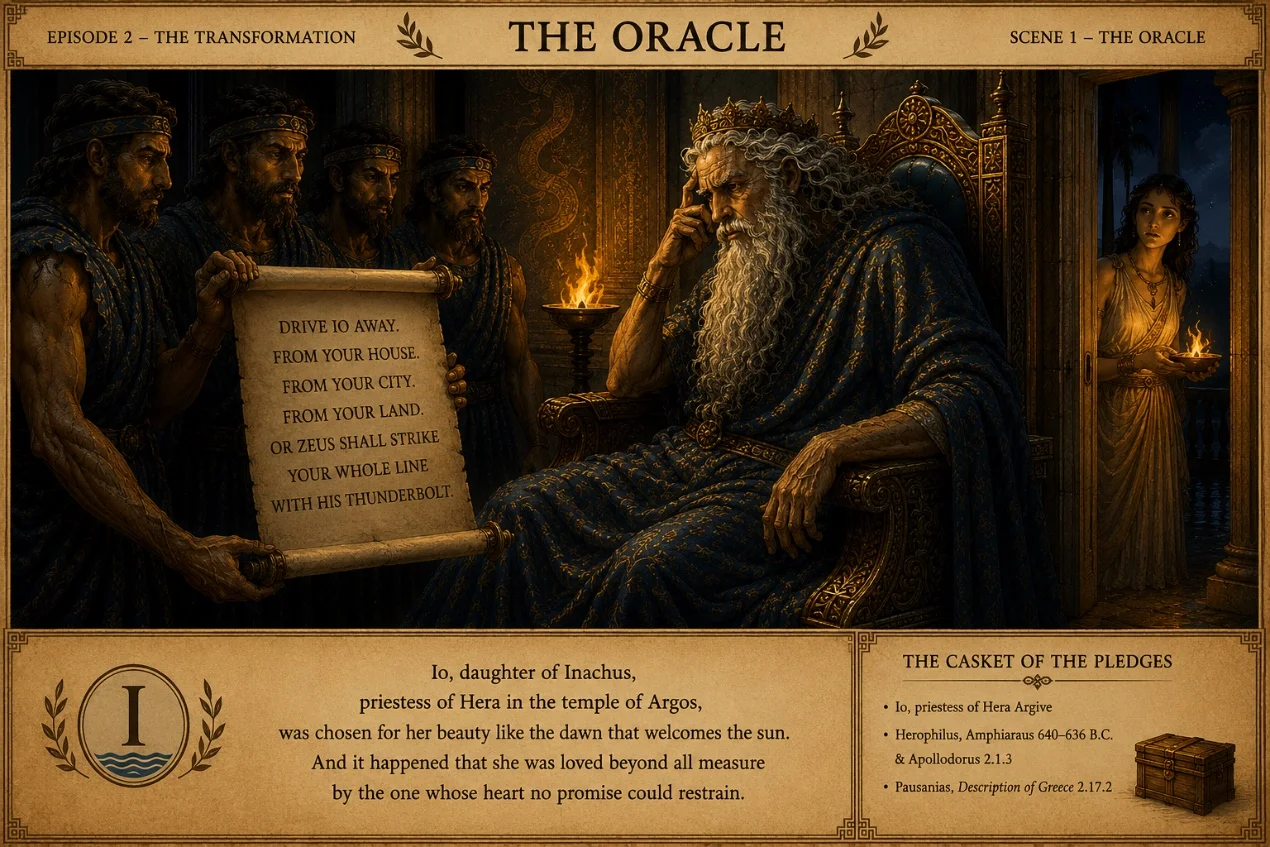
The envoys of Inachus came back from Delphi and Dodona with their hands full of words and empty of meaning. Twisting, shifting, riddling oracles — sentences that changed shape as you looked at them, like clouds.1 The old river sent them again, and again. Meanwhile his daughter’s dreams grew bolder every night: soft voices in the dark of her room, calling her out to the meadows of Lerna, where the grass grows thick and her father’s cattle graze down to the water.
Then came the oracle with nothing cloudy about it. It was clear as a blade: Inachus must cast Io out. Out of his house, out of the city, out of the land — turned loose, dishonoured, to wander to the ends of the earth. Otherwise, the thunderbolt of Zeus would erase his entire line.2
Picture the river-father that night. He whose waters fed the whole plain, whose name was the land’s first name, could not protect his own child — and not from any enemy: from the sky itself. Aeschylus, who centuries later let Io tell the story in her own voice, kept the phrase that bleeds: ἄκουσαν ἄκων — unwilling, he drove out the unwilling. It may be the shortest tragedy ever written.3
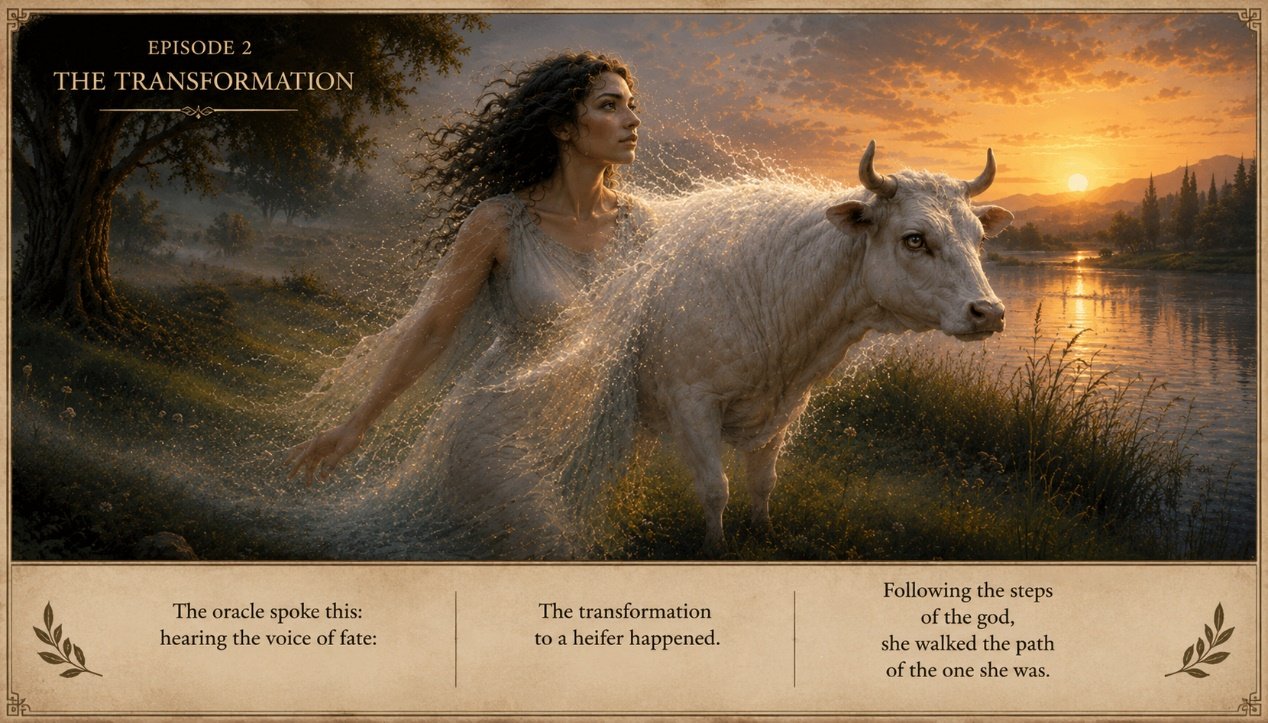
The Metamorphosis
Through the cow’s eyes, a human being is looking out
And the moment the girl crossed the threshold, her world changed — literally. Her outline blurred and was rewritten: her brow grew heavy with horns, her fingers fused into hooves, and where a girl of Argos had stood there now stood a heifer white as the moon — with the same, the very same, eyes.4
That is the truly chilling thing about metamorphosis, and the ancient vase-painters knew it when they painted Io: whatever the body becomes, the gaze remains.
Who changed her? Here our ancient sources — honest guests at our table, as always — do not all say the same thing. In one tradition the hand is Hera’s: the goddess who sees everything from her Heraion had long understood what the dreams and oracles meant, and she punished what she could not prevent. In the other, the hand is Zeus’s own: nearly caught in the act, he turned the girl into a heifer to hide her — and then swore to his wife that he knew nothing about this particular cow.5 A divine lie, clumsy, almost comical — if an innocent were not paying for it.
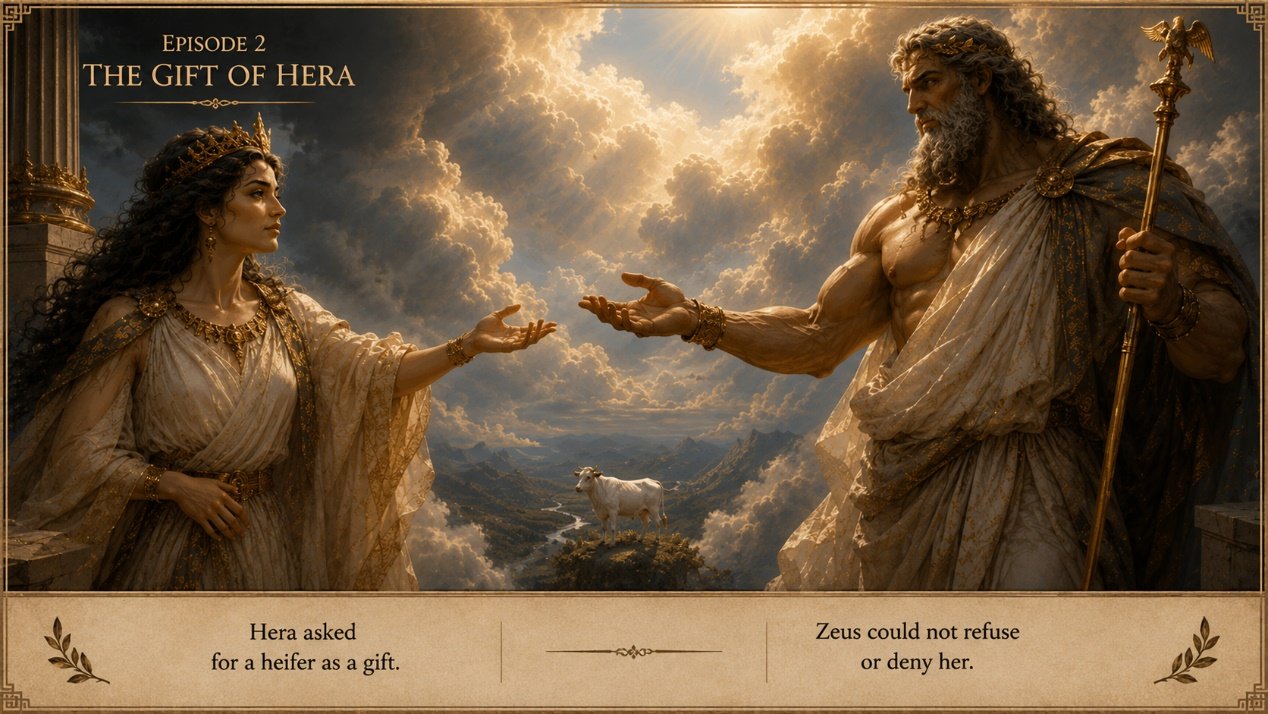
Hera’s Gift
The perfect crime
For Hera, queen and wife, then made the coldest move recorded in our mythology. She did not explode. She did not accuse. She smiled — and asked for a little present: “Give me the heifer.” What could Zeus say? Refuse his wife a cow, he who had just sworn the cow was nothing? He handed her over.6
The perfect crime: Hera took her rival as a gift — legally, with a thank-you.
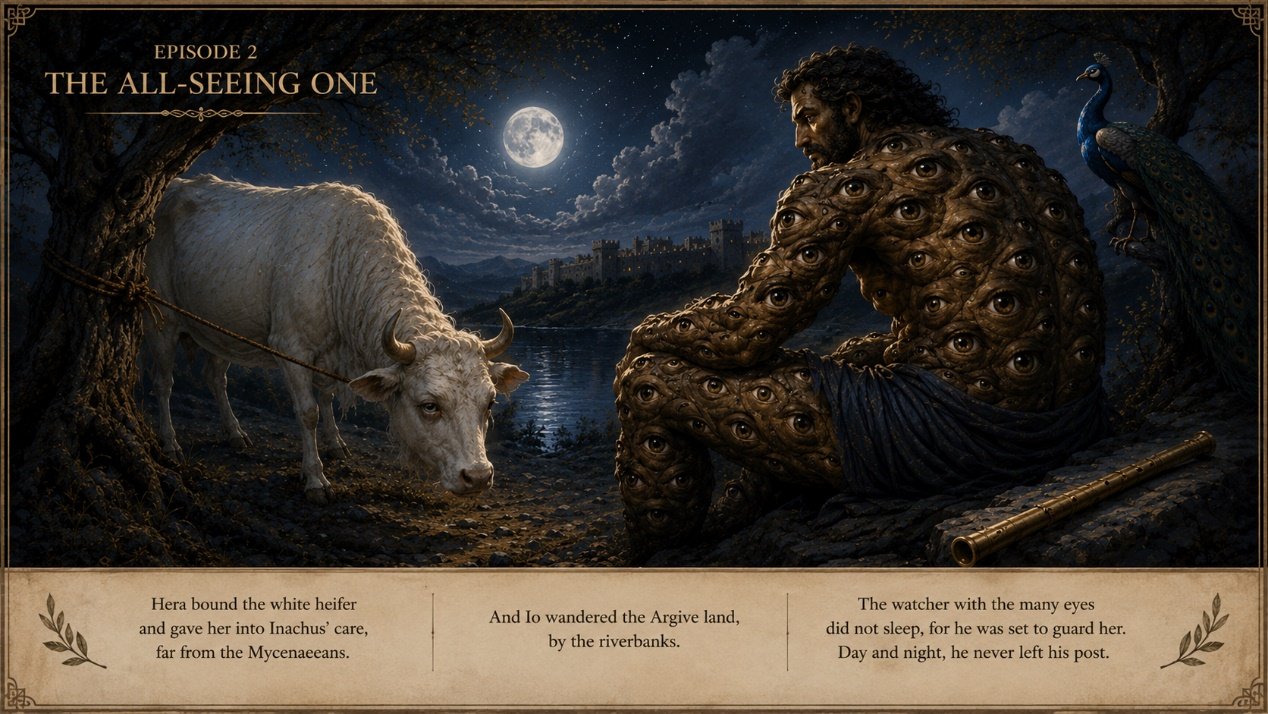
The All Seeing One
When fifty eyes close, fifty remain awake
And then she summoned her watchman. He comes from the soil of Argos itself, a distant kinsman of Io’s own line — a giant whose body, from neck to heel, is sown with eyes. A hundred eyes that never sleep all at once: when fifty close, the other fifty keep watch. His name is Argus. They call him Panoptes — “the one who sees everything.” Hera tied the white heifer to an olive tree in a grove outside Mycenae, and set Panoptes down across from her.7
In the next episode, someone will come for her. He will not bring a sword — he will bring a flute. And he will prove that a hundred eyes have one thing in common: they all close to the same lullaby.
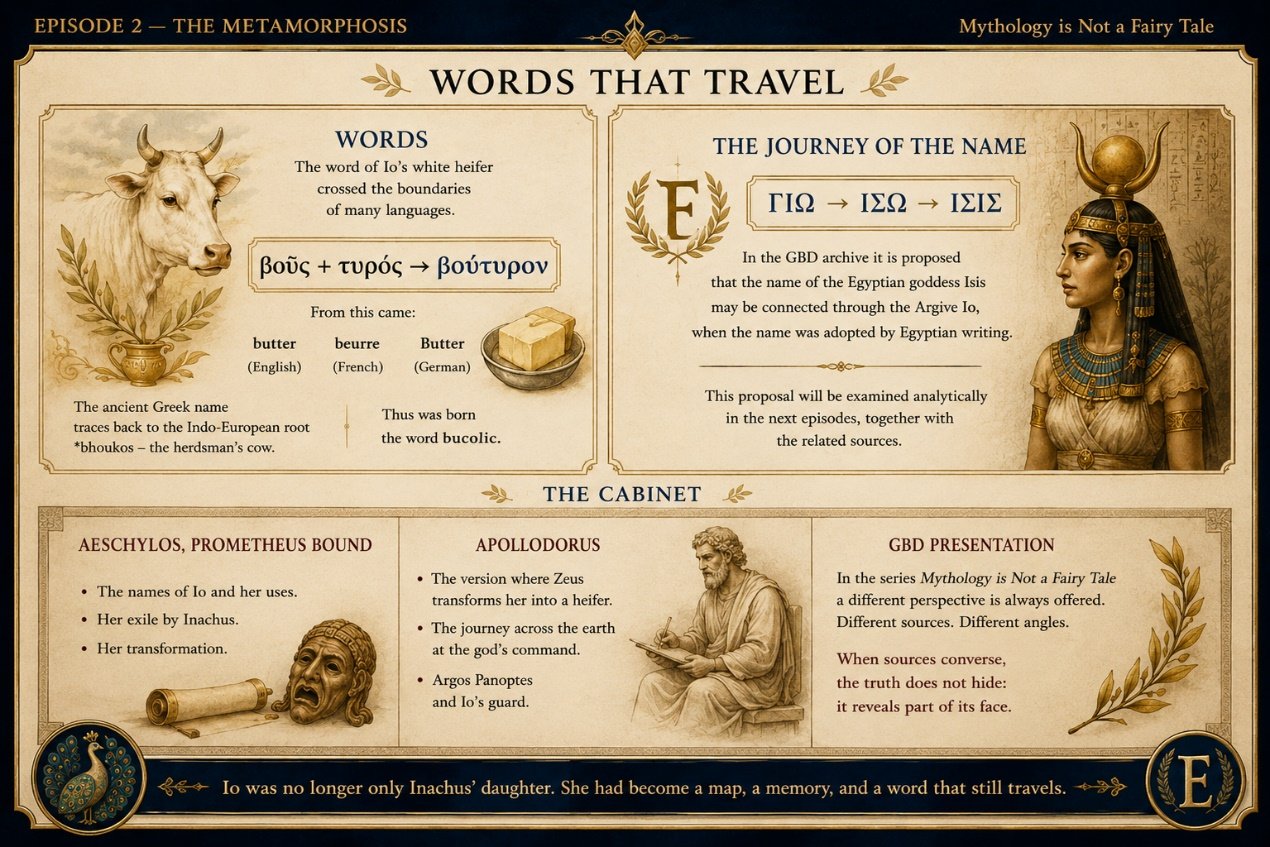
Words That Travel
A Greek cow at the breakfast table
BUTTER
The heifer of our episode has been hiding on your breakfast table all along. Boútyron = boûs + tyrós, “cow-cheese” — borrowed by the Romans as butyrum, and passed on as English butter, French beurre, German Butter. Every morning, the whole planet spreads a little Greek cow on its bread.
BUCOLIC
When Theocritus wrote his boukolika — songs of the boukólos, the cattle-drover — he gave Europe its word for all things charmingly rural: bucolic. From the same boûs, naturally, as our white heifer.
ϜIŌ → ISŌ → ISIS
With the restoration of the lost digamma, the name of Egypt’s great goddess preserves the memory of the Argive Io. We will meet her again in Episode 9, where Herodotus himself will hand us the master key.