MYTHOLOGY IS NOT FAIRY TALES Episode 8.Search for Epaphus
Mythology Is Not Fairy Tales
Cycle 1 · Io — the girl who became a map
Episode 8The Search for Epaphus
They had hunted her across three continents and she did not break. Then they took her child — and the world learned what a road really is.
Begin the story ↓The bitter symmetry
Hera had studied her rival well. She knew by now that the whip does not work on this creature: she had banished her by oracle, dressed her as a beast, dragged her by the sting from Argos to the Caucasus — and the creature, at the end of it, stood a queen in a foreign land with a baby in her arms.
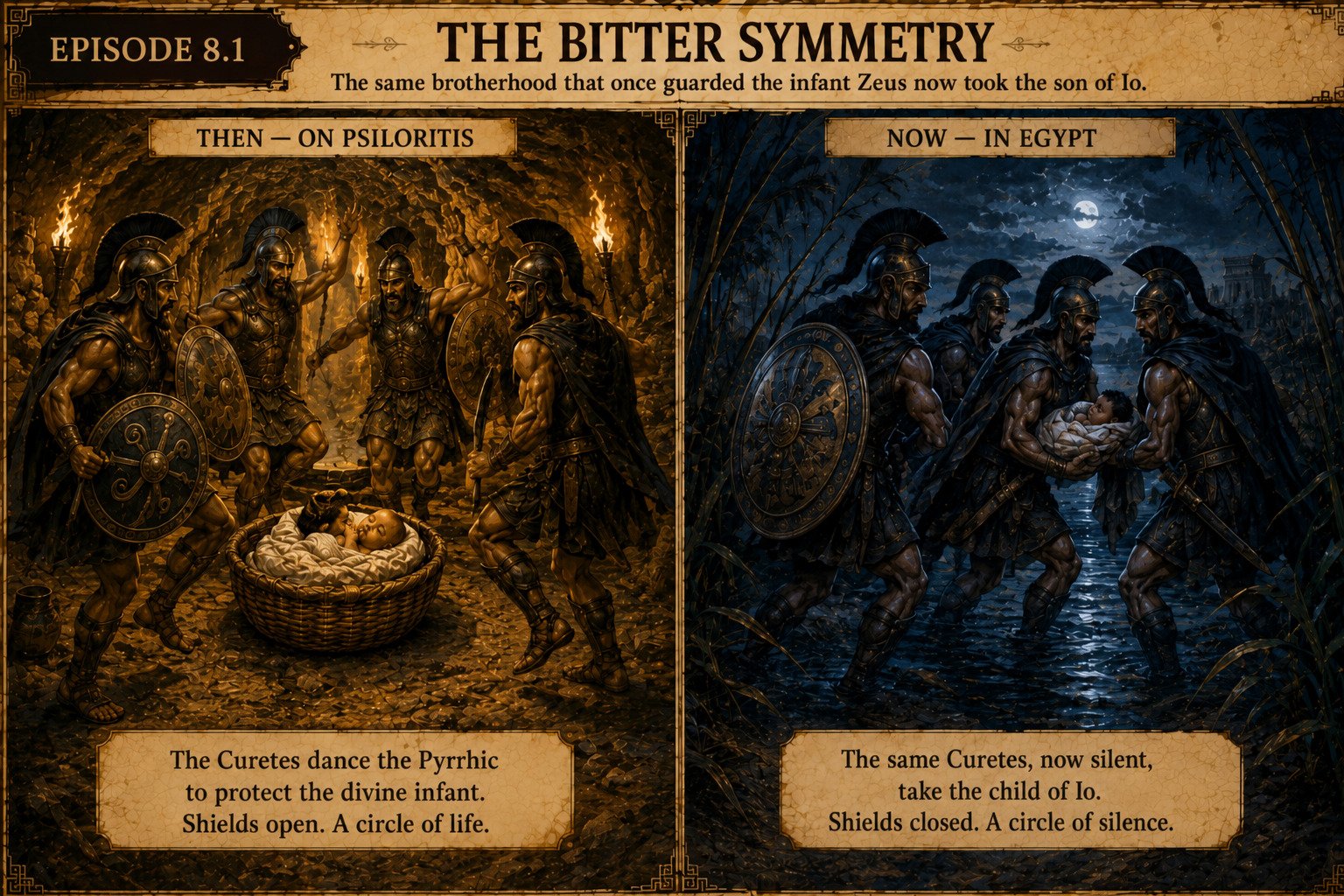
With the unbreakable, then, you do not strike the body. You strike the arms that hold. She sent the Curetes — yes, those same armed dancers of Cretan tradition who had once guarded a divine infant on Mount Ida with their Pyrrhic dance — and set them now to do the reverse: to make an infant disappear.1 The very guild that saved Zeus stole his son. Our mythology does not flinch from bitter symmetries; that is why we trust it with serious things.
“Zeus, when he learned of it, killed the Curetes.”
Zeus, when he learned of it, sent no heralds. Apollodorus records it in three words that fall like an axe: aisthomenos kteinei Kouretas — he perceived it, and killed the Curetes.2 But a father's wrath, however thunderous, did not answer the only question that mattered: the child was nowhere. The culprits dead, the trail erased. And here our real episode begins — for this is not an episode of gods. It is an episode of a mother.
The mother on the road
For the first time, she walked because she chose to
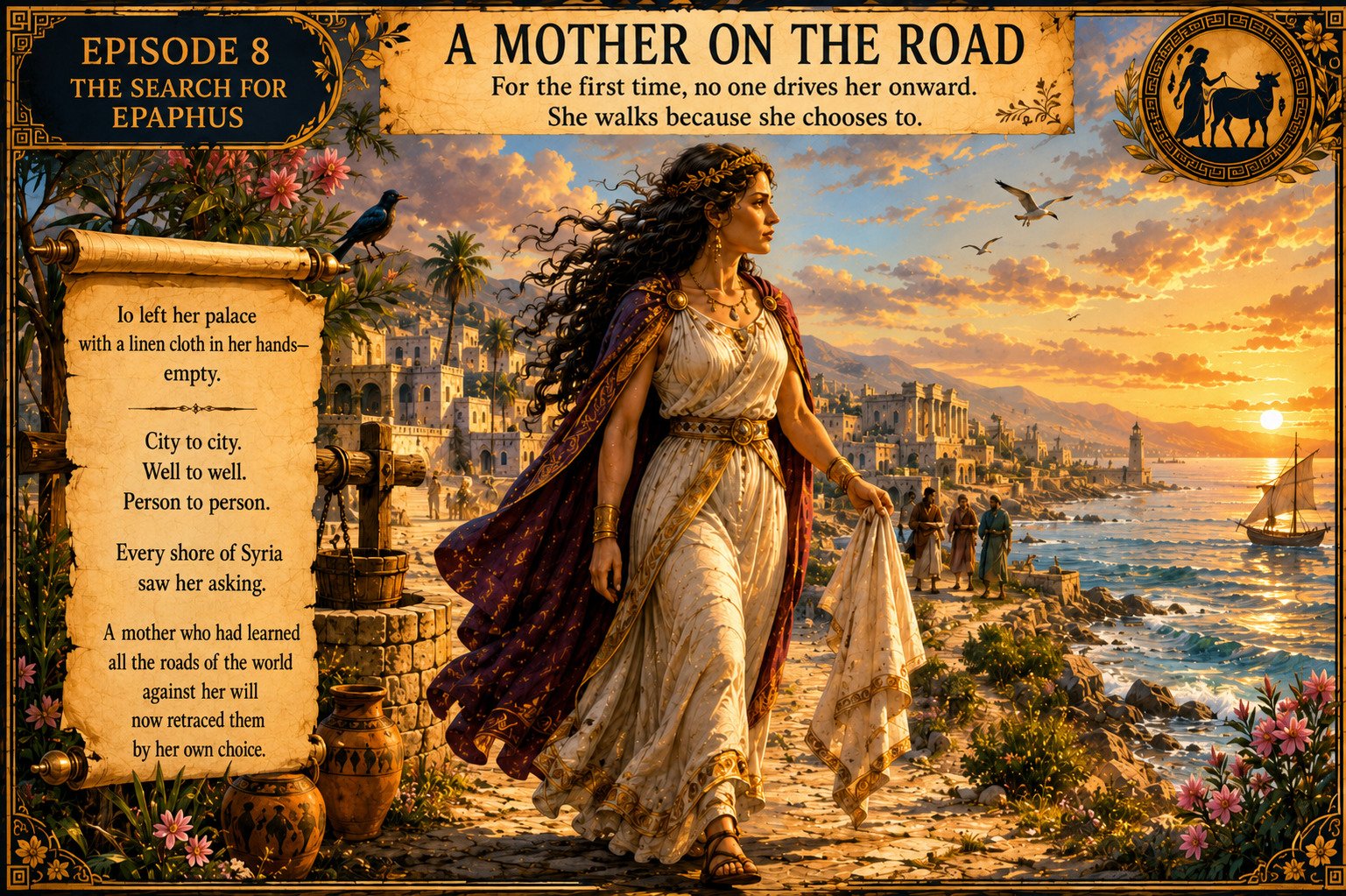
Io took to the road again. Mark the difference, for the whole cycle's meaning hides in it: every previous mile of hers had been travelled hunted — by oracles, by the gadfly, by divine designs.
Now, for the first time, she walked because she chose to. No sting at her flank; only a small linen sheet in her hands, empty. She left her palace — she was a queen; she could have sent armies, and did not — and took the coast of Syria town by town, well by well, asking. The woman who had learned all the world's roads against her will now walked them again by her own.3
The door of Byblos
And somewhere high on that coast, the road ended
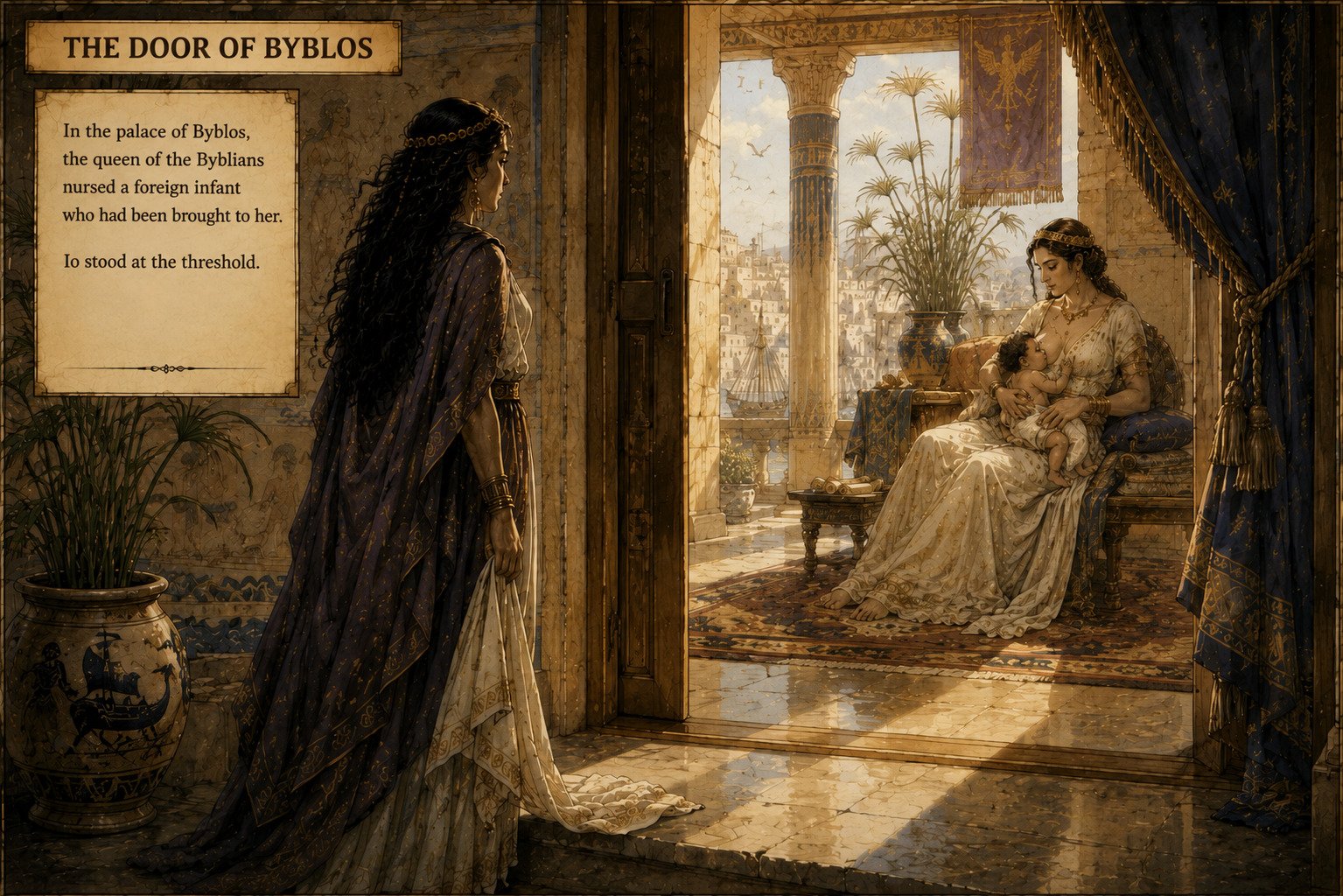
And somewhere high on that coast, in the city that keeps the oldest continuously inhabited harbour in the world, the road ended. They called it Byblos. In its palace, the queen of the Byblians was nursing a foreign infant that had been brought to her — a boy strangely serene, whom you looked at and found yourself smiling for no reason.4 I need not describe for you the moment the traveller stood at that door. Every mother on earth has lived it in a dream — the good one or the bad one, according to her luck.
The mirror
And here, before we close, our series owes its attentive reader one of its loveliest secrets, whispered. Centuries later, Plutarch would record Egypt's great myth: the goddess Isis, desperately searching for what had been taken from her, came — where else? — to Byblos; and there, in the palace, she became nurse to the queen's infant.5
Hold that beside our own scene: Io searches for her child at Byblos, where a queen is nursing him; Isis searches for her own loss at Byblos, where she nurses a queen's child. The two stories mirror each other like palms joining in prayer. In the next episode, when Herodotus hands us the master key, you will remember this mirror.6

The return
Mother and child together again
Io took her son and returned to Egypt. No source records what she said to the queen of the Byblians — perhaps a thank-you that only two mothers can exchange. The child grew, reigned, founded Memphis, and his name became the root of half the family tree of the Mediterranean.7
As for her — the land that had watched her search for her child like that decided that such a mother could not remain merely a queen. It was preparing her temples.
Words That Travel
BYBLOS → BIBLION → BIBLE
The harbour where Io found her son was the great hub of the papyrus trade; the Greeks named the writing material byblos after the city, the scroll a biblion — and “the books,” ta biblia, became on the lips of the whole world The Bible. Every Holy Bible on the planet, in every language, carries on its cover the name of this episode's city. So does every bibliothèque, every bibliography, every bibliophile. [A]
PAPYRUS → PAPER
And the second half of the same miracle: the papyrus of the Delta — Epaphus' homeland — travelled as Latin papyrus, French papier, English paper. Paper and Bible: the episode about searching for one child carries inside it the entire history of the written word. [A]
