Mythology Is Not Fairy Tales — Episode 9 — Isis: The Crown That Was a Curse
Mythology Is Not Fairy Tales
Cycle 1: “Io — the girl who became a map” · The climax
EPISODE 9ISIS: THE CROWN THAT WAS A CURSE
Mortals, when they wish to say thank you, raise a statue. Egypt raised a religion.
Begin the story ↓The Consecration
There are people you look at and know they have walked through fire — not because they say so, but because they no longer need to say anything. Such was the Io who returned from Byblos: a woman who had been priestess, exile, animal, swimmer of two continents, interlocutor of Titans, queen, and searching mother — all in one lifetime. Egypt looked at her. And Egypt — the land that weighed its people on a scale where the heart must be lighter than a feather — recognised what it saw.1
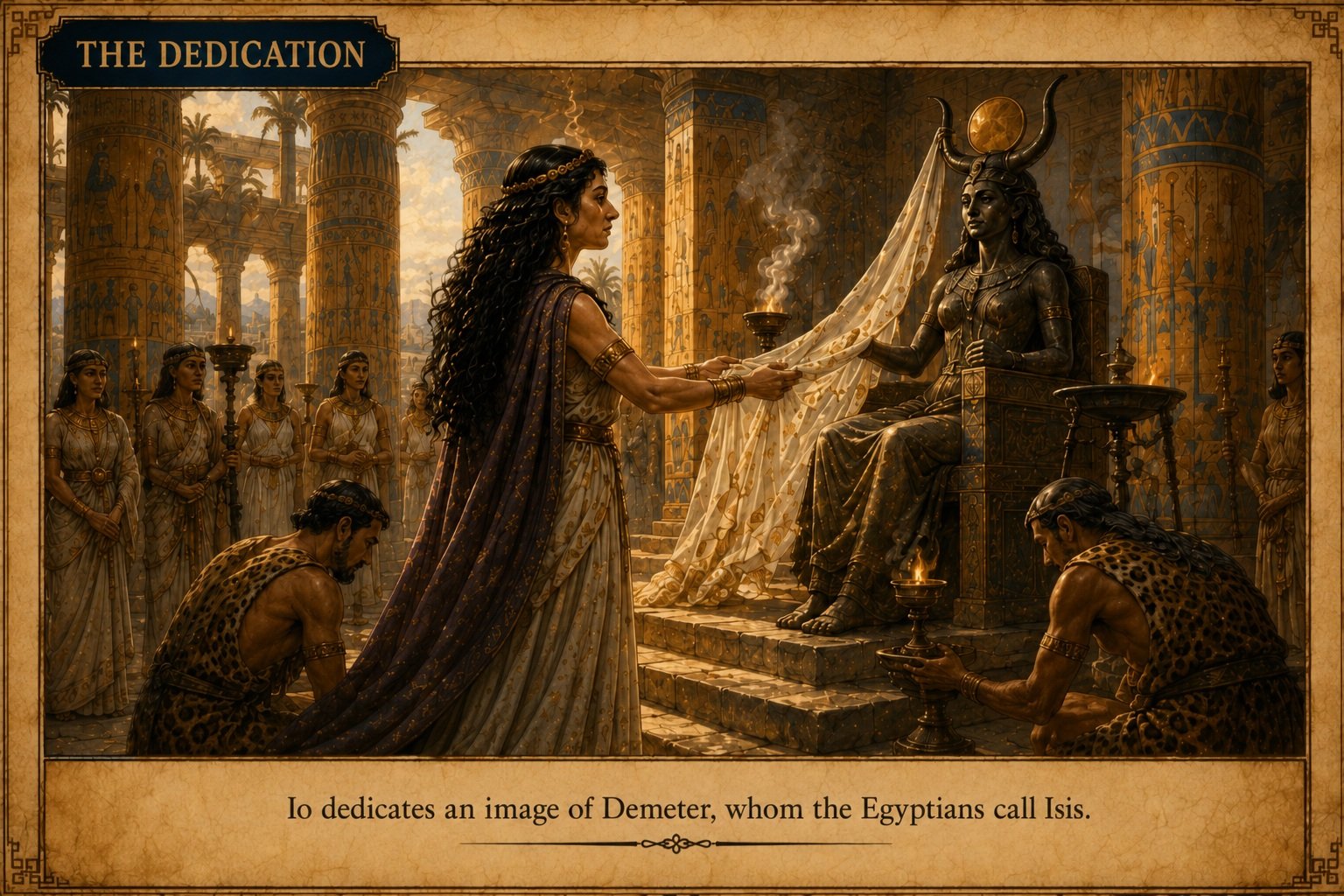
Apollodorus — the dry one, the measured one, who never gives away a word — records what happened next in a single sentence that is the key to our entire cycle. Io, he writes, set up a statue of Demeter, “whom the Egyptians called Isis” — and then the clause that stops the heart: “and Io likewise they addressed as Isis.”2 Read it again, slowly, for it is not our series saying it — it is the ancient genealogist, chisel on marble: the woman and the goddess received, on the lips of Egypt, the same name. The founder dissolved into the founded. The girl from Argos did not acquire a temple; she became the temple's face.
The Witness
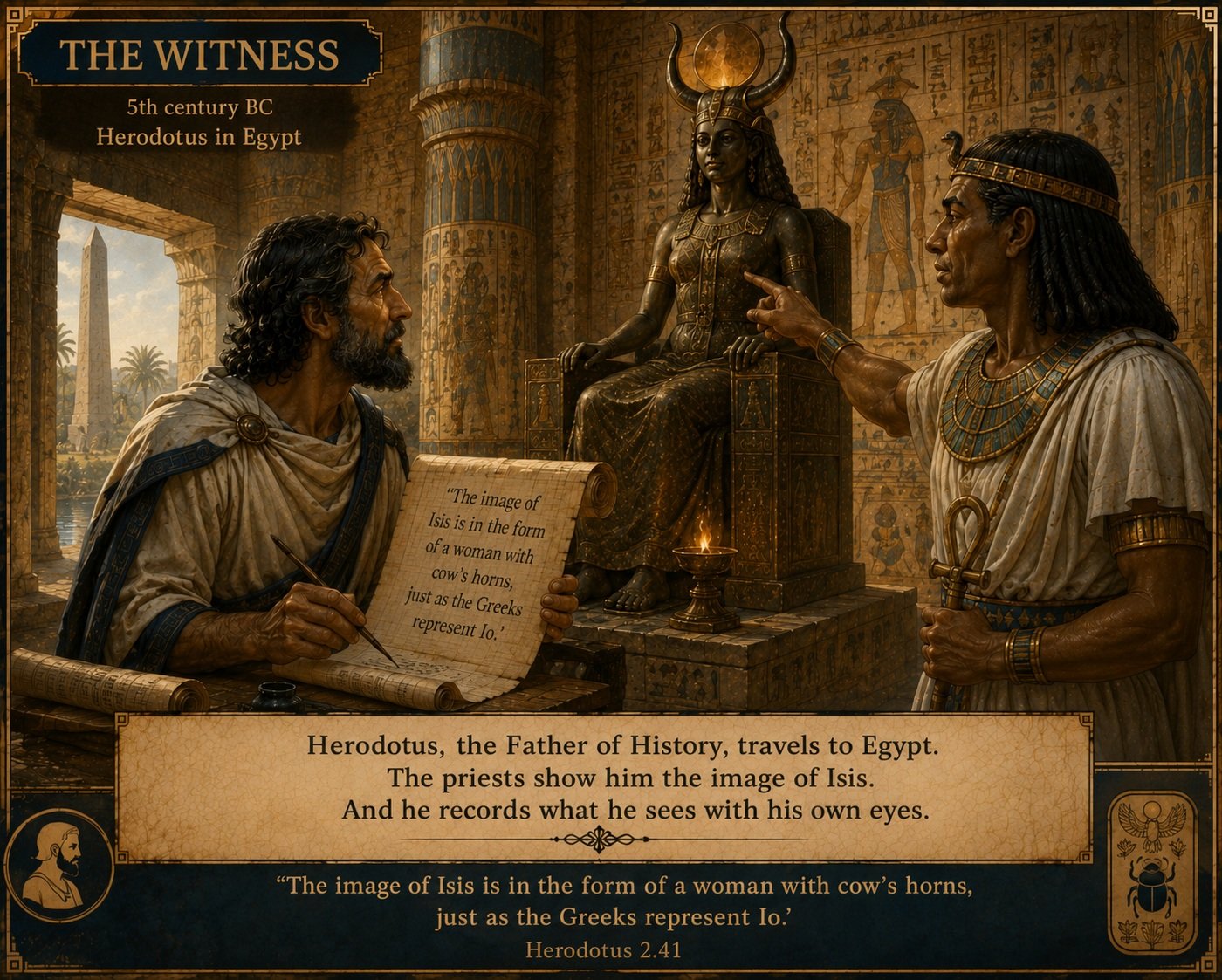
And here enters our second witness — the Father of History in person, his sandals dusty with Egypt itself. Herodotus walked the temples, questioned the priests, examined the statues with his own eyes — and noted, with the reporter's precision that made him immortal: “the statue of Isis is a woman with cow's horns, exactly as the Greeks paint Io.”3 Observe the mastery of our scale here: Herodotus does not rule “they are the same person” — he deposits something stronger, because it is an eyewitness report: that the two peoples, separately, were painting the same image. Two mirrors turned toward each other, at the two ends of the same sea.
The Crown
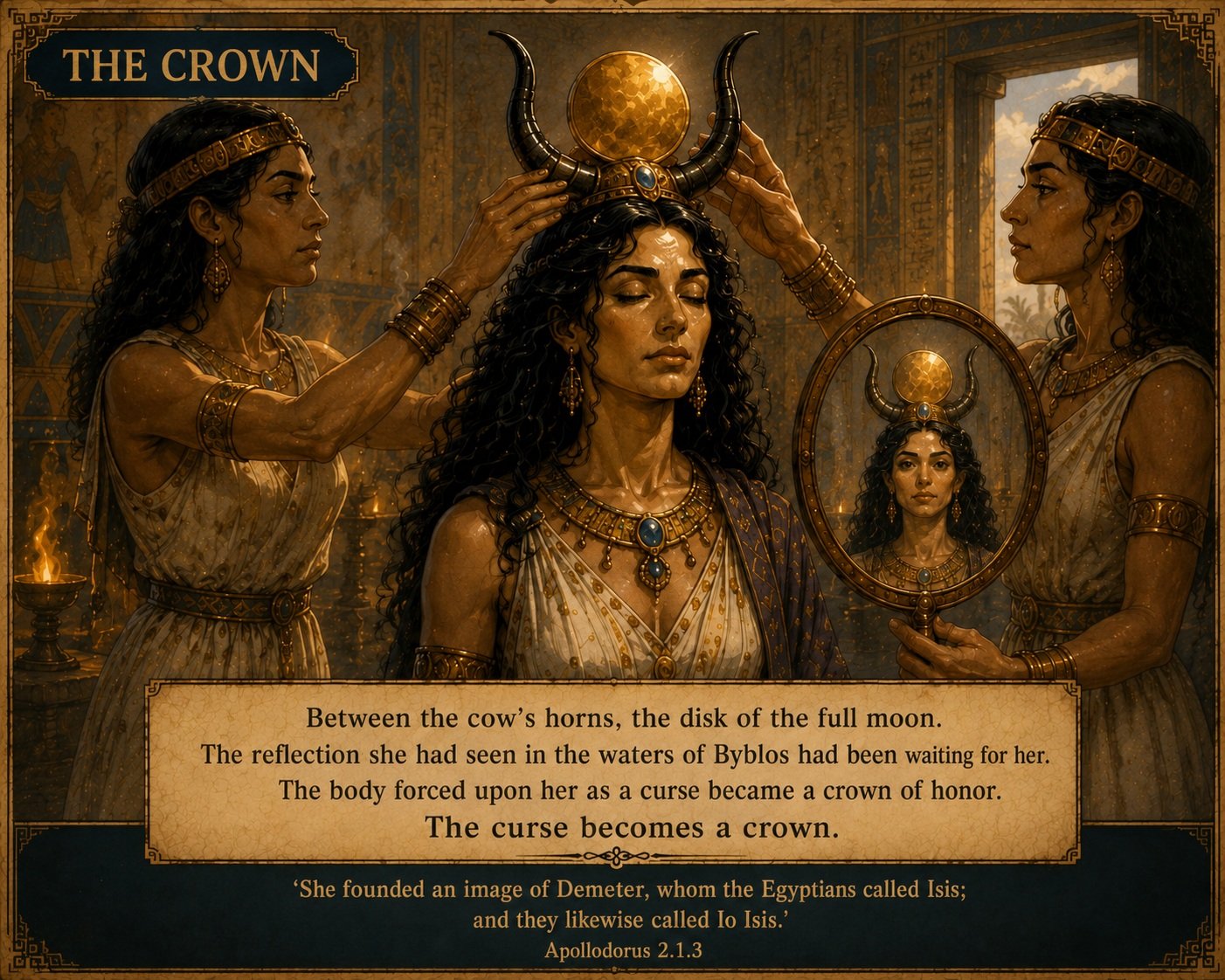
And the third piece of evidence is not a text — it is the landscape of the whole country. Herodotus records, in that very same passage, the one law of mercy that ran the length of Egypt: of all animals, the female cattle no one might sacrifice or harm — “sacred to Isis” they were, the most revered lives in the land.4 Stay with that, for here the arc that opened at Lerna closes: the body they forced upon her as humiliation — the body she howled to be free of across three continents — became the one body all Egypt swore never to wound. What had been her curse rose to her head as a crown: look at any image of Isis — between the cow's horns, the disc of the full moon. The reflection she saw in the water, sailing home from Byblos, had been waiting for her.
The Last Light
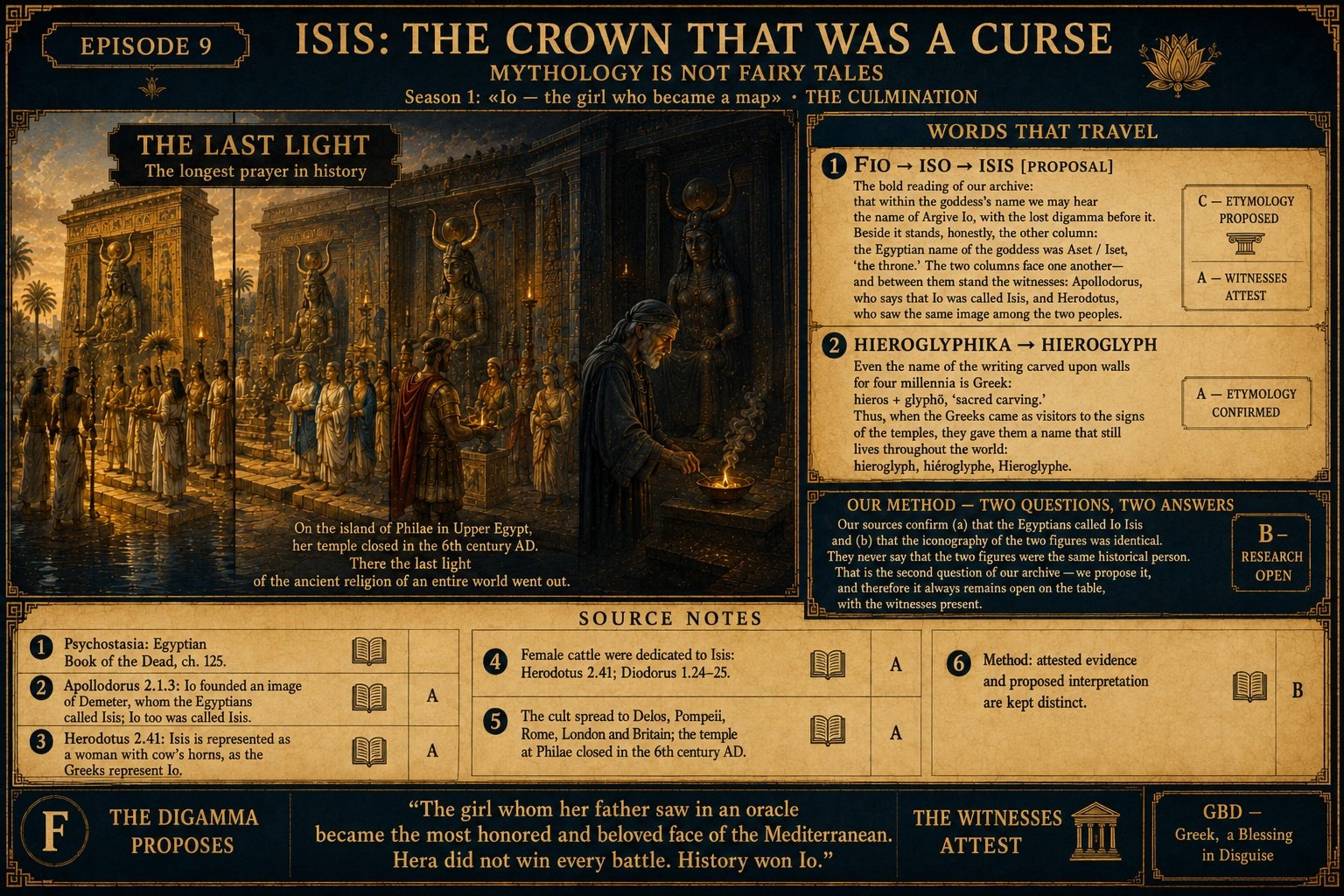
How long did that gratitude last? Here history — real, dated history — takes over from myth and shames it for scale. The worship of Isis did not stay in Egypt: it travelled with the ships to every harbour of the Mediterranean — a temple on Delos, a temple in Pompeii, temples to the Danube and to legionary Britain. And when the whole ancient world had gone dark, on the islet of Philae in the Upper Nile — directly across from our Eratosthenes' Syene — her temple still lit its lamps. It closed in the sixth century after Christ, under Justinian: the last light of the ancient religion of the entire world went out in a temple of hers.5 From Inachus to Justinian: no figure in human memory was prayed to, continuously, for so long, under one name.
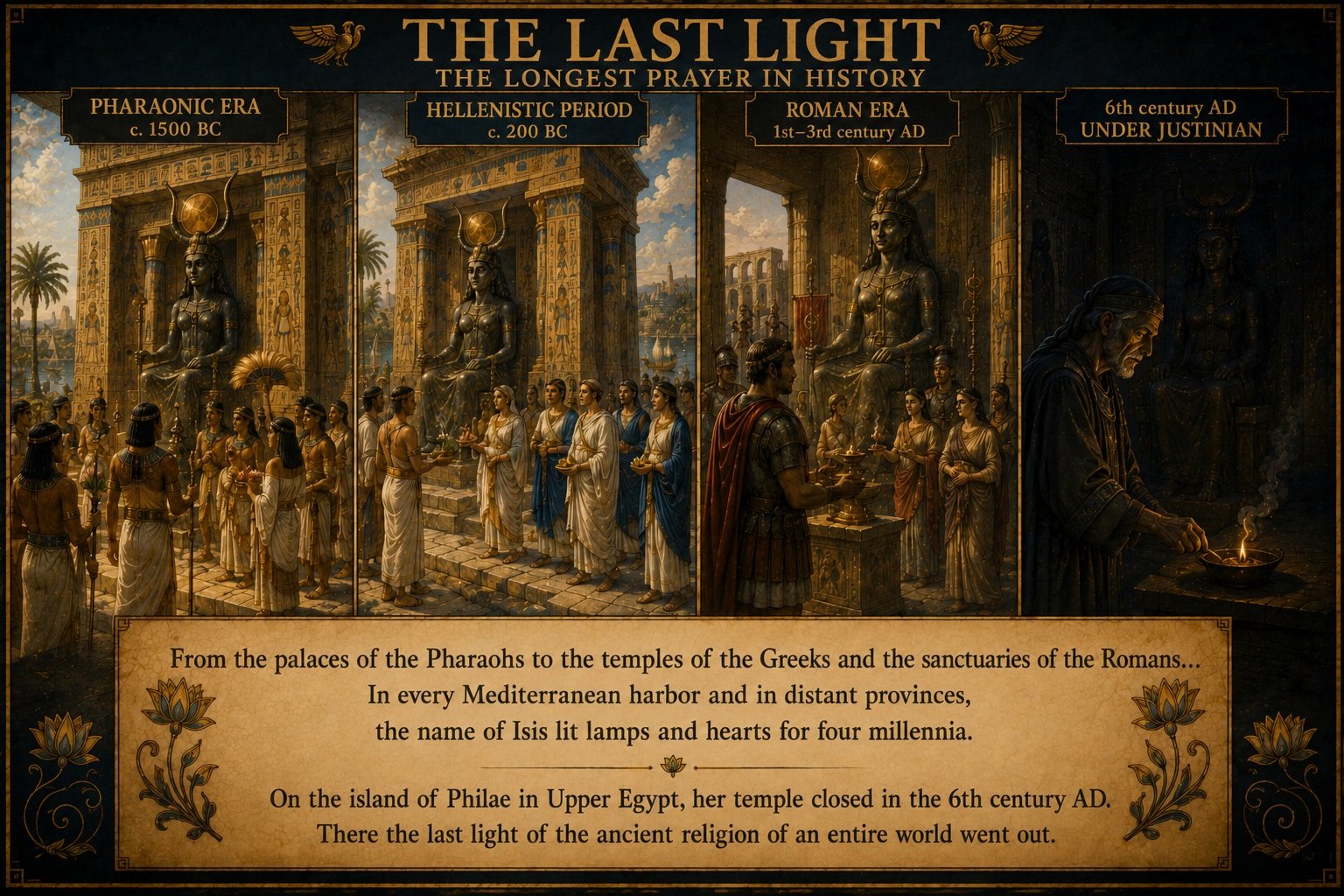
The girl her father banished by oracle, sworn against his will to wander “dishonoured to the ends of the earth” — became the most honoured and most permanent presence of the Mediterranean. Hera won every battle. Io won history.
One last gift remains for her to give — the greatest. For a goddess is forever; but a grandmother... a grandmother is everywhere. In the next episode, her grandchildren open the map.
Greek in Disguise
Our archive's bold reading, in its place of honour at last: that within the goddess's name sounds, with the lost digamma in front, the very name of the Argive girl. Beside it, honestly, the other column: the goddess's Egyptian name was Aset/Iset, “the throne.” The two columns face each other — and between them, unimpeachably A-grade, stand Apollodorus, who says Io was called Isis, and Herodotus, who saw the same image among both peoples. The digamma proposes; the witnesses testify; the reader judges. [C — the etymology, declared with head held high · A — the two testimonies]
Even the name of the script that wrote “Isis” on the walls for four millennia is Greek: hieros + glyphō, “the sacred carvings” — so the Greek visitors christened the temple signs, and so every language on earth calls them today: hieroglyph, hiéroglyphe, Hieroglyphe. Egypt wrote; Greece named the writing. [A]