
Quantum Nugget #11 — Complementarity: Two Aspects, One Phenomenon
Term of the Day
Bohr’s principle of complementarity
Greek: Η Αρχή της Συμπληρωματικότητας του Bohr
In everyday thought, if two descriptions appear to be opposed, we assume that one must be right and the other wrong.
Quantum Physics compels us to think differently.
A quantum object, such as a photon or an electron, is not a classical particle that occasionally transforms into a wave.
Depending on the experimental arrangement, it may display particle-like or wave-like properties.
In one experiment we record localised arrivals — a characteristic reminiscent of particles.
In another we observe interference — a characteristic reminiscent of waves.
Niels Bohr called these descriptions complementary.
What Does Complementarity Mean?
Different experimental arrangements may reveal different aspects of the same quantum phenomenon.
These aspects are not two complete pictures that we can simply place one on top of the other.
The conditions that allow one aspect to appear fully may prevent the other from appearing fully.
In the double-slit experiment, for example:
- An arrangement that keeps the two possible paths indistinguishable allows interference to appear.
- An arrangement that records which slit the quantum object passed through provides path information but reduces or eliminates the interference.
One picture does not arbitrarily “cancel” the other. Each is connected with a different, incompatible experimental question.
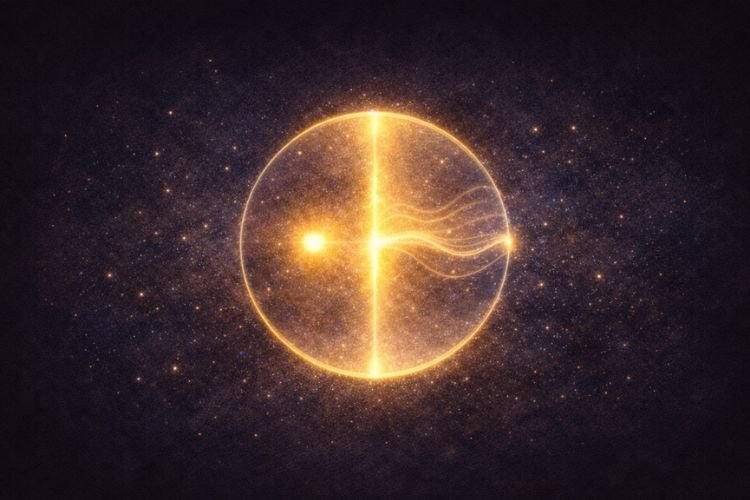
The image uses the point and the wave as classical symbols of two complementary descriptions. It does not suggest that a tiny particle and a material wave literally coexist within the circle.
Keep this in mind:
Neither classical picture can fully describe the quantum object on its own.
We do not choose which reality we prefer.
We choose which experiment to perform — and the experiment determines which aspect may be revealed.
Echo from the Ancients
Aristotle preserves a thought that he attributes to Heraclitus:
“What opposes brings together, and from things that differ comes the most beautiful harmony.”
Heraclitus was not speaking about quantum complementarity, and Bohr did not prove the philosophy of Heraclitus.
The two ideas meet only in a careful philosophical analogy:
Completeness does not always require us to eliminate difference.
It may require us to understand why we need more than one aspect.
Thought Exercise
Can you recognise within yourself two qualities that appear opposed but serve different circumstances?
You may be cautious and courageous.
Rational and emotional.
Independent and deeply connected to others.
This is a human metaphor — not an application of Quantum Physics to psychology.
Complementarity does not teach us who we ought to be.
It teaches us how careful we must be before dismissing as a contradiction two truths born from different questions.
The Poetic Bridge
Quantum complementarity is not a theory of human personality. Nor does it mean that two conflicting claims are always equally true.
It does, however, offer us a deeply human image:
A single aspect is not always enough to reveal the whole truth.
A person may be strong and vulnerable at the same time.
They may need solitude and still long for companionship.
They may think with rigorous logic and feel deeply.
One aspect does not necessarily cancel out the other. Each may appear under different circumstances, and together they may form a fuller picture.
So, before defining someone by a single moment, it may be worth remembering:
What we see may be true — without being the whole truth.
Some truths do not compete with one another.
Each illuminates the space that the other cannot reveal alone.

