
Quantum Nugget #13 — Chaos and Order in Quantum Behaviour
Term of the Day
Quantum chaos
Greek: Κβαντικό χάος
In everyday language, “chaos” means complete disorder: a world without rules, in which anything may happen.
In Physics, however, chaos is not the absence of laws.
A classical system may obey perfectly definite equations and still display chaotic behaviour.
An infinitesimal difference in its initial conditions may, as time passes, lead to an entirely different evolution.
This is called sensitive dependence on initial conditions.
The law remains.
What is lost is the possibility of long-term prediction with unlimited precision.
Does Chaos Exist in the Quantum World?
The question is not simple.
In classical physics, we can imagine a trajectory beginning at a particular point and evolving through time.
In Quantum Physics, however, a system is described by a quantum state whose evolution follows the Schrödinger equation.
For this reason, quantum chaos does not simply mean that a particle follows a disorderly and unpredictable trajectory.
It is the field that studies how the quantum description displays traces of systems that would exhibit chaotic behaviour in their classical form.
How Do We Recognise Its Traces?
Physicists look for characteristics such as:
- Distinctive statistical patterns in the spacings between energy levels.
- The rapid spreading of quantum information through complex systems.
- The loss of memory of certain details of the initial state.
- “Quantum scars” — striking structures that preserve traces of unstable classical trajectories.
Quantum chaos is not identical to the randomness of an individual measurement.
Quantum probability and dynamical chaos are different concepts, although they may meet in the study of complex systems.
The Hidden Order
Strangely, chaos is often revealed through statistical regularities.
A single result may appear irregular. When, however, we study many energy levels or many evolutions of the system, recognisable mathematical patterns emerge.
Chaos, therefore, is not the end of order.
It is a form of behaviour in which order is not always found in an individual path, but in the relationships and statistics of the whole.
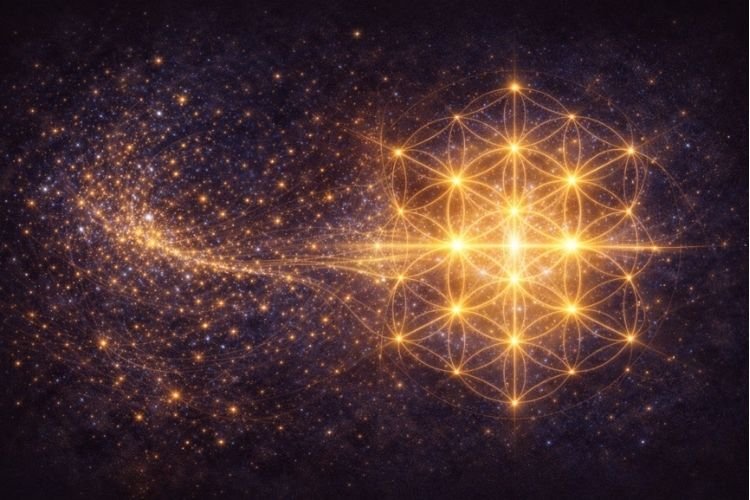
The image is symbolic: the luminous geometric structure is not a literal shape of quantum chaos. It expresses the emergence of mathematical patterns within an apparently disorderly multiplicity.
Keep this in mind:
Chaos does not mean “without laws.”
It means that simple or definite laws may produce extremely complex and, in the long term, unpredictable behaviour.
Nor does order always mean that we can predict every event.
Sometimes order reveals itself only when we stop looking at the one and begin to read the many.
Echo from Language and the Ancients
The ancient word chaos did not originally mean modern confusion. It denoted a chasm, an opening, an immeasurable expanse.
The word cosmos, by contrast, came to be associated with order, arrangement and adornment.
Modern Physics does not repeat an ancient cosmogony. It does, however, allow us to hear once more the profound tension between these two words:
The opening that appears impossible to arrange
and the order waiting to be recognised.
Perhaps knowledge does not conquer chaos by making it disappear.
Perhaps it learns to discover the form concealed within its complexity.
The Poetic Bridge
The study of quantum chaos does not prove that a higher order lies behind every upheaval in life.
Nor does it mean that every pain serves a hidden plan.
It does, however, offer us a careful reminder:
The unpredictable is not always the same as the formless.
A single event may appear disconnected. Yet when we change scale and examine many behaviours together, relationships and regularities may emerge that we could not see before.
Sometimes we stand in the same way before a difficult period in our lives.
We need not impose a meaning that is not there, nor pretend to control what cannot be controlled.
But within the confusion, we can search for the small part that still belongs to us:
One steady habit,
one clear decision,
the next possible step.
Order does not always appear as a perfect design.
Sometimes it begins as a small rhythm we choose to protect within the noise.
Scientific reference: The modern meaning of quantum chaos, the statistics of energy levels and their relationship with classically chaotic systems are presented in research published by the American Physical Society .

