
Quantum Nugget #18 — The Double-Slit Experiment
Term of the Day
Double-slit experiment
Greek: Πείραμα της διπλής σχισμής
Richard Feynman regarded the double-slit experiment as lying at the heart of the mystery of Quantum Mechanics.
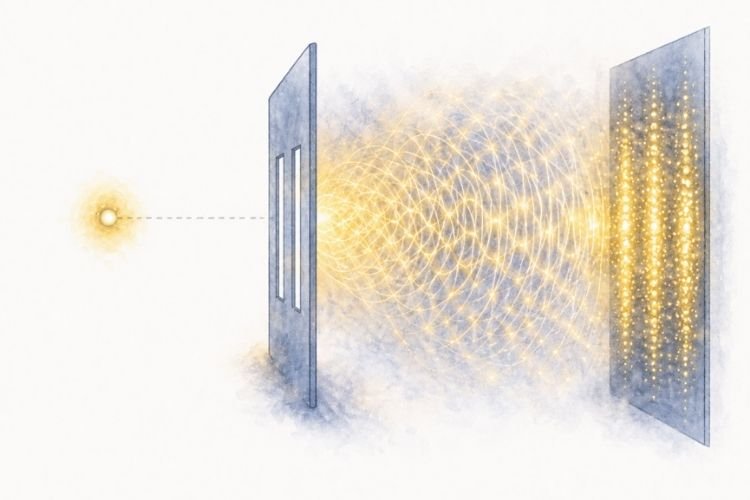
The apparatus appears simple:
- A source emits photons, electrons or other quantum objects.
- Before them stands a barrier containing two very narrow, parallel slits.
- Behind the barrier is a screen that records their arrivals.
The result, however, overturns our familiar pictures of particles and waves.
What Would We Expect Classically?
If we fired tiny pellets towards the two slits, each pellet would pass through one opening or the other.
Two principal bands, aligned with the openings, would form on the screen.
If we sent a classical wave, the two slits would act as new wave sources. The waves would meet:
- Where they arrived in phase, they would reinforce one another.
- Where they arrived out of phase, they would weaken or cancel one another.
An interference pattern of alternating bright and dark bands would appear on the screen.
One Quantum Object at a Time
We reduce the intensity until only one electron or photon is present within the apparatus at a time.
Each arrival is recorded at one particular point on the screen.
It does not appear as a spread-out stain; it leaves a localised trace.
At first, the points appear random.
As we repeat the experiment many times, however, the individual points gradually form an interference pattern.
Each event is localised.
The multitude of events reveals wave-like interference.
What Interferes with What?
Quantum Physics does not simply add the probability of the first route to the probability of the second.
When the two routes cannot be distinguished, it first adds the probability amplitudes:
ψ = ψ₁ + ψ₂
and then calculates the probability:
P = |ψ₁ + ψ₂|²
The square contains interference terms.
The probability with both slits open is therefore not merely the sum of the probabilities obtained by opening each slit separately.
Which Slit Did It Pass Through?
If we add a detector that reliably records which slit the quantum object passed through, we acquire path information — but the interference pattern disappears.
This is not because a human being has learned the answer. Neither consciousness nor a human gaze is required.
The physical interaction that makes the routes distinguishable changes the quantum state and destroys the coherence required for interference.
If no path measurement is performed, we are not entitled to imagine that the particle secretly possessed one ordinary, definite classical trajectory.
The theory includes the amplitudes of both indistinguishable alternatives.
Different interpretations of Quantum Mechanics offer different accounts of what this means for underlying reality.
The experimental result, however, remains unchanged.
The image is schematic and poetic. The curved lines represent probability amplitudes; they are not a photograph of material waves or predetermined trajectories.
Keep this in mind:
The double-slit experiment does not demonstrate that human consciousness creates reality.
It demonstrates something more rigorous and more strange:
When alternative paths are indistinguishable, their probability amplitudes interfere.
When reliable path information exists, the interference is lost.
The quantum object arrives as a single point.
The law, however, reveals itself only through many points.
The Philosophical Bridge: The One and the Many
A single trace does not reveal the pattern.
Many traces are required for a form to appear that none of them contains alone.
Ancient philosophers asked in different ways how the One and the Many are related.
They did not anticipate the double-slit experiment, and Quantum Physics does not confirm any particular ancient doctrine.
The experiment does, however, allow us to hear the question again:
How does one unified form arise from a multitude of individual events?
Each point appears alone.
The whole remembers the interference.
The Poetic Bridge
The double-slit experiment does not prove that human life follows a hidden quantum design, nor that our thoughts create reality.
It does, however, offer us a fascinating image:
A single dot on the screen does not reveal the overall pattern.
It appears isolated, random, perhaps even insignificant.
Yet as the dots accumulate, something begins to emerge that none of them could reveal alone.
This is worth remembering when we judge an effort by a single moment.
One mistake does not reveal the full extent of a child’s ability.
One failure does not describe the whole course of a person’s journey.
Nor is one success enough to explain everything that prepared the way for it.
The individual event is real — but it is not always the whole pattern.
Sometimes time, repetition and careful observation are needed before we can see the form emerging from many small arrivals.
Scientific references: The addition of probability amplitudes, the appearance of interference and the effect of path information are developed in the Feynman Lectures at Caltech . The experimental build-up of an interference pattern from individual electrons was recorded by Tonomura and colleagues, as summarised in the Harvard ADS bibliographic record .

