Quantum Nugget #21 — THE PRINCIPLE OF LEAST ACTION
More Precisely: The Principle of Stationary Action
Term of the Day:
Action
Of all the possible ways in which a physical system might move, which one corresponds to its motion in the real world?
Physics offers an answer of remarkable elegance:
The physical path is one for which a quantity called action is stationary under very small variations of that path.
Historically, this became known as the Principle of Least Action.
The more precise name is the Principle of Stationary Action, because the action is not always an absolute minimum; it may correspond to a minimum, a maximum, or another stationary point.
What Is Action?
In the simplest form of classical mechanics, action is represented by S and defined as:
S = ∫t₁t₂ L dt
where L is the system’s Lagrangian.
For a simple particle:
L = T − V
that is, kinetic energy T minus potential energy V.
Action is therefore neither merely the length of a path nor the energy “consumed.”
It is a quantity combining motion, energy, and the duration of the system’s entire evolution.
What Does “Stationary” Mean?
Imagine many slightly different paths connecting the same initial and final points.
We calculate the action for each one.
The physical path has a special property: if we alter it by a very small amount, its action does not change to first order:
δS = 0
This condition produces the Euler–Lagrange equations and, in appropriate cases, the familiar Newtonian laws of motion.
It is not a different kind of physics. It is a deeper and extraordinarily powerful way of expressing the same laws of motion.
Does Nature “Choose”?
The language of choice is enchanting, but it can also mislead us.
A particle does not inspect possible paths and decide which one is most economical.
The principle does not attribute intention or wisdom to nature. It is a mathematical formulation of the laws governing motion.
Feynman’s Quantum Revelation
In the path-integral formulation of quantum mechanics, we do not calculate only one classical trajectory.
Every possible path between the initial and final states contributes to the calculation.
Each contributes a quantum amplitude with a phase determined by its action:
eiS/ℏ
The phases of paths with widely differing actions tend to cancel one another.
Near a path of stationary action, however, neighbouring phases vary only slightly and reinforce one another.
Thus, on the scale at which classical behaviour emerges, the familiar classical trajectory becomes dominant.
The classical path is not arbitrarily imposed upon quantum mechanics. It emerges from the interference of quantum amplitudes.
The Subtle Irony of the Name
“Least action” does not necessarily mean:
- the shortest distance,
- the shortest time,
- the least energy,
- or the easiest route.
It means that the total action is stationary under small variations of the path.
Nature does not necessarily follow the shortest road.
It follows motion consistent with its laws.
A Philosophical Bridge
The principle allows us to regard an entire motion as a unified whole: beginning, path, and end are connected within a single mathematical relation.
This may inspire philosophical reflections on order and economy in nature.
It is not, however, evidence that the Universe possesses intention, purpose, or foreknowledge.
The bridge is poetic and philosophical.
The law remains mathematical.
Keep This in Mind:
Nature does not “search” for the correct path.
Its laws can be written so that the physical path makes the action stationary.
And in the quantum description, the single classical path emerges from the interference of many possible paths.
The Poetic Bridge
The Principle of Least Action does not say that nature consciously chooses the easiest path.
“Action” is a precisely defined physical quantity, and the principle concerns the complete evolution of a system—not intention, economy of effort, or advice for living.
It does, however, offer us a fruitful image:
A journey cannot always be judged by a single step.
The path that seems easiest at this moment may prove more difficult when we consider the entire course.
A hasty avoidance may bring relief today, only to return us to the same obstacle tomorrow.
By contrast, a demanding decision may organise many steps that follow and spare us unnecessary wandering.
This does not mean that every person has one unique, predetermined path.
It means only that, when choosing, it is worth asking not merely:
“What is the easiest step right now?”
but also:
“Which path best serves the whole of what I am trying to create?”
Wisdom does not always lie in the least effort.
It may lie in the clearest direction.
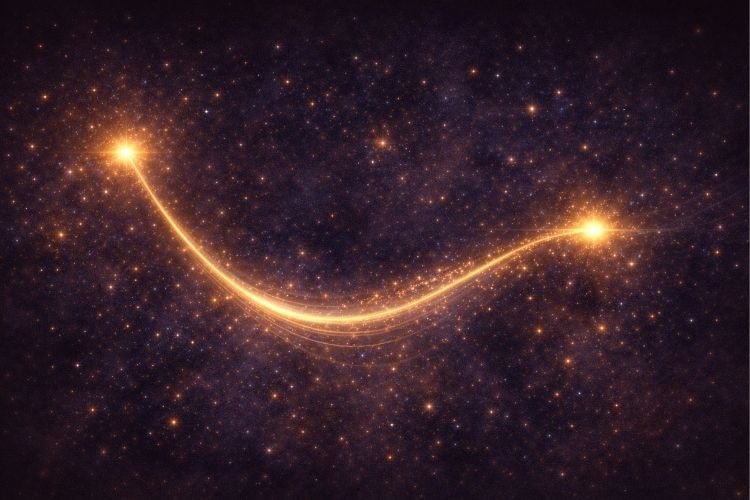
Visual note: The luminous curve symbolises a trajectory between two events. It does not imply that the physical path is always the shortest one or that a particle consciously selects its route.
Scientific reference: MIT presents the principle using the more precise term “Principle of Stationary Action.” In Feynman’s formulation, every possible path contributes an amplitude with phase S/ℏ, while the classical trajectory emerges around stationary action. MIT OpenCourseWare — Stationary Action · The Feynman Lectures — The Principle of Least Action

