
Quantum Nugget #16 — The Quantum Probability Distribution
Term of the Day
Probability distribution — Born rule
Greek: Κατανομή πιθανότητας — Κανόνας του Born
In classical physics, we imagine a particle as a tiny grain following a particular trajectory.
If we knew its initial state and all the laws affecting it with perfect precision, we would expect to calculate where it would be found.
In Quantum Physics, the theory does not always give us one certain prediction for the outcome of an individual measurement.
It gives us a probability distribution.
The wavefunction
The quantum state of a system may be described by a wavefunction, usually represented by the Greek letter:
ψ
The wavefunction is not a material wave that we can watch spreading through space.
It is a mathematical entity — a probability amplitude — from which we calculate the probabilities of the possible outcomes.
Max Born formulated the rule according to which probability is related to the square of the wavefunction’s absolute magnitude:
P(x) = |ψ(x)|²
More precisely, the probability of detecting a particle within a small region around position x is proportional to |ψ(x)|² in that region.
The total probability of finding the particle somewhere must equal 1 — that is, 100%.
One measurement — many experiments
In a single measurement, the detector records one particular outcome: a luminous point, a position or a definite value.
If, however, we prepare the same quantum system in the same way and repeat the measurement many times, the results gradually form the distribution predicted by the Born rule.
The theory does not tell us with certainty where the next individual point will appear.
It does, however, predict with extraordinary accuracy the pattern formed by many results.
Amplitudes come before probabilities
In Quantum Physics, we do not always add probabilities directly.
When an event can occur through different indistinguishable alternatives, we first add the probability amplitudes and then take the square of their absolute magnitude.
This is why interference appears.
Quantum probability is not simply an ordinary die on a microscopic scale.
Amplitudes possess phase and may reinforce or weaken one another.
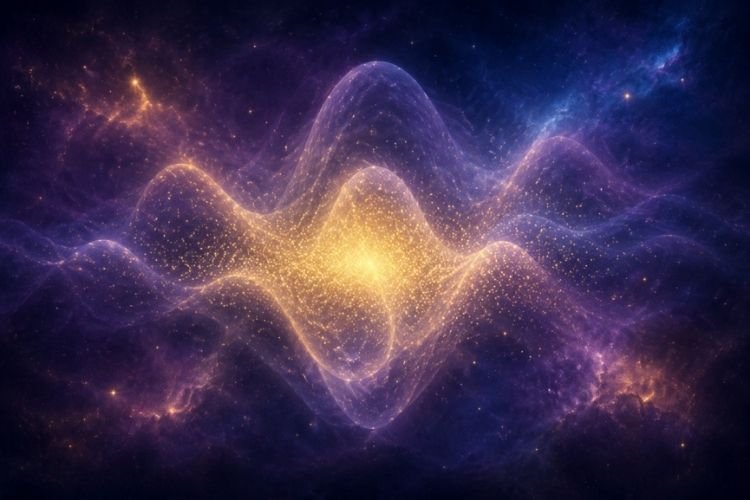
The luminous rings in the image are symbolic regions of probability. They are not circular paths along which an electron travels like a tiny planet.
Keep this in mind: Quantum Physics may not predict every individual result. It does, however, predict the distribution of many results with mathematical precision.
The single event may surprise us.
The multitude reveals the law.
A linguistic and philosophical echo
The ancient word moira originally denoted a share or portion allotted to someone. It later acquired the meaning of the fate assigned to that person.
Quantum probability is not the Moira of the ancients, and the Born distribution does not determine our destiny.
The linguistic kinship of the image is beautiful, however:
the whole is divided among possible outcomes,
and each is assigned a mathematical weight.
Physics does not know in advance which individual outcome we shall encounter. It does know, however, how the possibilities are distributed.
The random event and the rigorous law are not always opposed.
Sometimes the law is precisely the way in which the unpredictable is distributed.
The Poetic Bridge
A quantum probability distribution does not describe the probabilities of human life. It cannot tell us which decision to make or what is going to happen to us.
It does, however, teach us a valuable distinction:
What is more probable is not certain, and what is less probable is not impossible.
We often confuse expectation with prediction.
Because something has happened many times, we assume that it must happen again.
Because something appears difficult, we dismiss it before examining whether it remains possible.
Mature thought neither ignores probabilities nor submits to them.
It examines them.
It weighs the evidence.
It recognises risk without turning it into certainty and sees possibility without calling it a promise.
We cannot demand that life provide absolute certainty before we make a decision.
But we can choose with clear eyes, knowing the difference between what may happen, what is likely to happen, and what we truly know.
Scientific reference: The statistical interpretation of the wavefunction, for which Max Born was honoured, is presented by the Nobel Prize . The relationship P = |ψ|² and the addition of probability amplitudes are developed in the Feynman Lectures at Caltech .

