
Quantum Nugget #24 — Is Information Never Lost?
Preservation, Scrambling and the Mystery of Black Holes
Terms of the Day:
Quantum Information — Unitary Evolution
In everyday life, information seems to disappear constantly.
A letter burns.
A file is deleted.
A memory fades.
A fragrance disperses into the air.
Quantum mechanics, however, introduces a deeper meaning of information.
It does not refer to the meaning of a message or to our personal memories. It refers to everything required for a complete description of the quantum state of a physical system.
Unitary Evolution
In standard quantum mechanics, the state of an ideally isolated system evolves unitarily.
This means that its evolution is reversible in principle: if we knew the final quantum state with perfect accuracy, together with every law governing its evolution, we could mathematically reconstruct the initial state.
Information is not erased by this evolution. It is transformed.
Lost or Dispersed?
Imagine a drop of ink placed in a glass of water.
After a while, the ink has spread throughout the glass. The original drop is no longer visible, and restoring it to its earlier form would be extraordinarily difficult.
Its molecules have not vanished.
The information about its evolution has become dispersed among countless microscopic positions, motions and correlations.
Something similar can occur in a complex quantum system.
Information may become so deeply distributed among correlations between the system and its environment that recovering it is practically impossible.
This is often described as the scrambling of information.
The Part and the Whole
A small quantum system is rarely isolated. It interacts and becomes entangled with its environment.
If we examine only the small system, some of its information appears to have been lost.
If we could describe the system together with its entire environment, however, that information might still be present in the correlations between them.
This is the crucial distinction:
Information may be lost to our access without disappearing from the complete physical description.
Measurement and Irreversibility
When we perform a quantum measurement, we obtain a particular result.
In practice, that result alone does not allow us to reconstruct the complete earlier quantum state.
Interaction with the measuring instrument and the environment distributes information among an enormous number of degrees of freedom.
How this process should ultimately be understood depends partly upon the interpretation of quantum mechanics.
We must not, therefore, turn the phrase “information is never lost” into an unlimited metaphysical law.
Black Holes and the Information Paradox
Black holes created one of the deepest conflicts in modern theoretical physics.
According to Hawking, a black hole can emit thermal radiation and eventually evaporate.
If that radiation contains no information about the matter that entered the black hole, the original information appears to have been destroyed.
This conflicts with unitary quantum evolution and creates the Black Hole Information Paradox.
Many physicists expect a complete theory of quantum gravity ultimately to preserve the information, perhaps in an extraordinarily scrambled form within the radiation.
We do not yet possess a complete, experimentally confirmed solution.
What It Does Not Mean
The preservation of quantum information does not prove that:
- Every human memory remains recoverable.
- A destroyed photograph continues to exist somewhere intact.
- Personality survives bodily death.
- The Universe is conscious and remembers everything.
These are different philosophical or religious questions. They do not follow from the mathematical concept of quantum information.
A Poetic Bridge
Physics offers us an image subtler than “nothing is ever lost.”
Whatever occurs may leave traces, alter correlations and influence what follows.
Yet those traces may become so widely dispersed that no observer could reconstruct their history.
Poetry may say:
Nothing departs without touching the world.
Physics would add:
The touch may remain within correlations — even when we can no longer read it.
Keep This in Mind:
In ideal unitary quantum evolution, information
is not destroyed.
It may, however, become so thoroughly scrambled
that it is practically inaccessible.
Fundamental preservation is one thing.
Human recoverability is another.
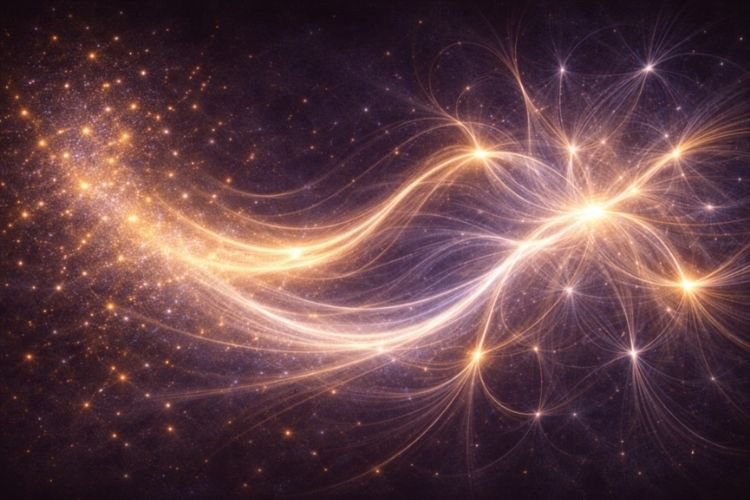
Visual note: The transition from the luminous cloud to the network symbolises the dispersal of information across many correlations. It is not a literal representation of quantum data.
Scientific references: The state of an isolated quantum system evolves unitarily, preserving quantum information. In open systems, information may pass into correlations with the environment and become inaccessible. Whether and how information is preserved during the complete evaporation of a black hole constitutes the Information Paradox and is connected with the still-unfinished search for a theory of quantum gravity. MIT OpenCourseWare — Unitary Quantum Evolution · Stanford Encyclopedia of Philosophy — Black Holes and Information Loss

