
Quantum Nugget #15 — The Pauli Exclusion Principle
Term of the Day
Pauli exclusion principle
Greek: Αρχή Απαγόρευσης του Pauli
In 1925, Wolfgang Pauli discovered a rule that explains a great part of the structure of matter:
No two identical fermions can simultaneously occupy exactly the same quantum state.
What Are Fermions?
Fundamental particles are divided into two broad categories:
- Fermions, which include electrons and quarks.
- Bosons, such as photons.
Composite particles such as protons and neutrons also behave as fermions.
Many bosons may gather in the same quantum state. Identical fermions cannot.
What Happens Inside an Atom?
The state of an electron in an atom is described by four quantum numbers.
Two electrons may occupy the same atomic orbital only if they differ in their spin quantum number.
Each orbital can therefore contain no more than two electrons, with opposite spin projections.
As further electrons are added, they are compelled to occupy different allowed states.
This is how electron shells are constructed and how the structure of the Periodic Table arises.
This structure determines:
- The chemical properties of the elements,
- the bonds between atoms,
- the diversity of materials,
- and much of the stability of ordinary matter.
The Pauli principle also contributes to degeneracy pressure, which supports dense stellar objects such as white dwarfs against gravitational collapse.
An Important Correction
The principle does not say that every electron possesses its own personality, private space or unique energy signature.
On the contrary, all electrons are fundamentally identical, and we cannot assign them individual identities as we assign names to human beings.
Order does not arise because the electrons are different.
It arises because, precisely as identical fermions, they obey a common rule forbidding them from occupying the same quantum state.
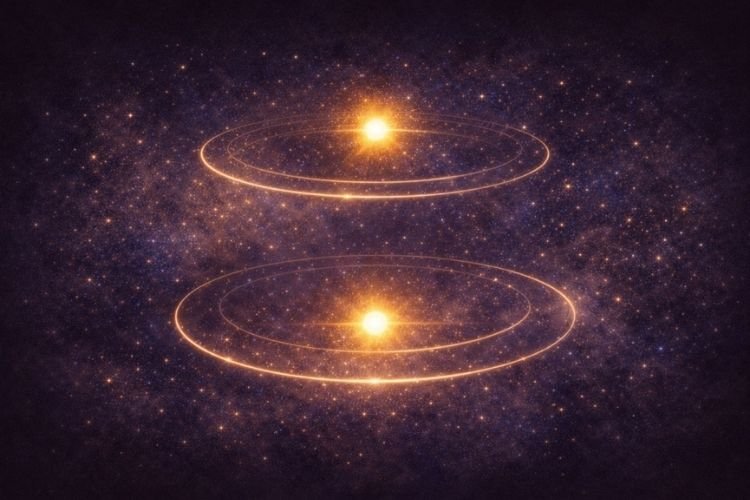
The image is symbolic. The luminous rings are not planetary electron orbits; they represent different allowed quantum states.
Keep this in mind:
Without the Pauli Exclusion Principle, electrons could accumulate in the same lowest state.
The electronic structure of atoms, the Periodic Table and the chemistry of the world would not possess the form we know.
A rule of exclusion becomes an architect of diversity.
The Poetic Bridge
The Pauli Principle is not a law of human uniqueness.
Human beings are not fermions in atomic orbitals, our personalities are not described by quantum numbers, and our worth requires no proof from Quantum Physics.
We may, however, carefully borrow an image:
Order is not always created when everything is crowded into the same position or compelled to become alike.
It may emerge when there is room for more possibilities, more functions and more ways of participating in a whole.
This does not mean that every person has a predetermined place they are obliged to accept.
It means that a community is not made poorer because its members do not all think, create and contribute in the same way.
Physics explains how fermions are organised.
Our humanity teaches us not to demand that one person become a copy of another in order to be considered valuable.
And so we preserve the beauty of the metaphor without presenting it as proof.
Scientific reference: The formulation of the Exclusion Principle in 1925 and its fundamental role in the electronic structure of atoms are presented by the Nobel Prize — Wolfgang Pauli .

