
Quantum Nugget #17 — Quantum Coherence
Term of the Day
Quantum coherence
Greek: Κβαντική συνοχή
A quantum superposition is not merely a list of possible states.
The states composing it maintain a precise mathematical relationship with one another, known as relative phase.
This stable and controllable phase relationship lies at the heart of quantum coherence.
What Is Phase?
Imagine two waves.
If their crests arrive together, they may reinforce one another.
If the crest of one meets the trough of the other, they may weaken or even cancel each other.
This depends on their relative phase.
A superposition of two quantum states may be written symbolically as:
|ψ⟩ = a|0⟩ + b eiφ|1⟩
The angle φ expresses the relative phase. As long as this relationship is preserved, the probability amplitudes can interfere in a predictable way.
Coherence, therefore, does not simply mean that several possibilities exist.
It means that the possibilities preserve the delicate relationship that allows interference to appear.
How Is Coherence Lost?
A quantum system is not usually alone.
It interacts with light, heat, air molecules, vibrations and countless degrees of freedom in its environment.
Through these uncontrolled interactions, information about the relative phase becomes dispersed into the environment.
For the system we are studying, the ability to observe interference diminishes or disappears.
This process is called decoherence.
Decoherence does not mean that quantum theory has suddenly ceased to apply.
It means that the delicate quantum relationship has become practically inaccessible because the system has become connected with too many elements of its environment.
Why Does It Matter?
Quantum coherence is essential for:
- The appearance of interference,
- the precise control of quantum states,
- the operation of qubits,
- quantum computation,
- and many applications of quantum measurement and communication.
A qubit must preserve its coherence long enough for the required quantum operations to be completed.
Researchers therefore isolate quantum systems carefully, reduce noise and develop methods of error correction.
The length of time for which this precious relationship is preserved is called the coherence time.
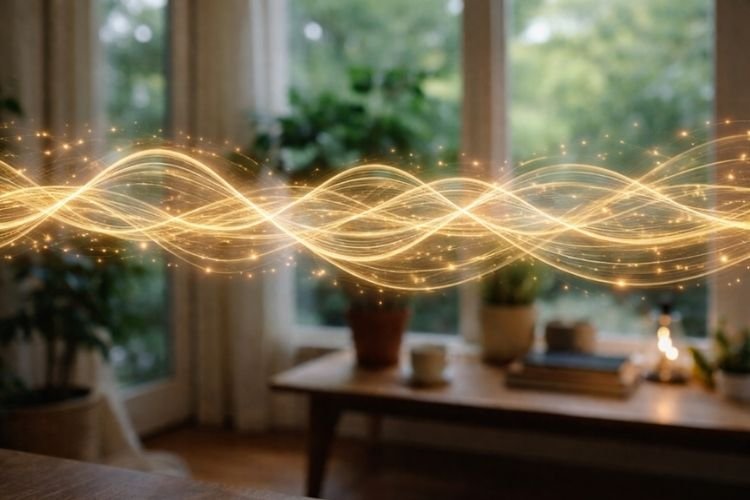
The golden waves in the image are a poetic symbol of a stable phase relationship. They are not visible quantum waves travelling through the room.
Keep this in mind:
Quantum coherence is not the mere coexistence of several states.
It is the preservation of the relationship between them.
When the relationship remains, the possibilities can interfere.
When phase information disperses into the environment, interference is lost.
The Musical Bridge
Two musicians may play the correct notes and still fail to create a unified sound.
They must preserve rhythm, timing and relationship.
Musical coherence is not quantum coherence. The parallel is only poetic.
It does, however, help us feel something essential:
It is not enough for the parts to exist.
The relationship that allows them to create a phenomenon greater than their simple juxtaposition must also be preserved.
Quantum coherence is the memory of that relationship.
And decoherence begins when the relationship is not necessarily destroyed, but scattered so widely into the world that we can no longer hear it.
The Poetic Bridge
Quantum coherence is not a theory of human harmony, nor does it prove that we can protect our lives from every external influence.
It does, however, offer us a delicate image:
It is not enough for all the necessary parts to be present. The relationship they maintain with one another also matters.
A melody is not born merely because we have gathered the right notes.
It emerges when those notes meet in the proper rhythm and duration, within a relationship that allows them to become music.
In a similar way, a human endeavour may possess knowledge, inspiration, time and effort, yet lose its form when these pull in different directions.
Coherence does not mean that everything becomes the same.
It means that different parts cease to cancel one another out and begin to serve a shared purpose.
And when noise threatens to dissolve that relationship, perhaps we need to return to the simplest question:
Do what I think, what I say and what I do still lead in the same direction?
Scientific reference: Quantum information relies upon superpositions with definite phase relationships, which are vulnerable to environmental interactions. The relationship between coherence and decoherence is presented by the American Physical Society .

