
QUANTUM NUGGET #19 QUANTUM FIELDS
The Fundamental Description of Matter
Term of the Day: Quantum Field
In our everyday picture of the world, matter consists of tiny particles: small, solid units moving through otherwise empty space.
Quantum Field Theory offers a deeper description.
According to this theory, space does not merely contain particles. It is permeated by different quantum fields: the electron field, the quark fields, the electromagnetic field, the Higgs field, and others.
A particle is not a tiny bead placed upon a field.
It is a quantized excitation of the field itself.
A photon is an excitation of the electromagnetic field.
An electron is an excitation of the electron field.
A Higgs boson is an excitation of the Higgs field.
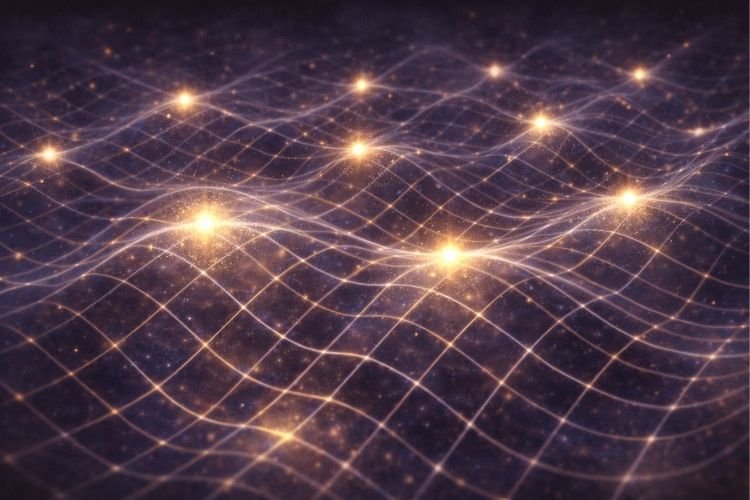
Just as a ripple is not separate from the sea, a particle is not independent of its corresponding field. This analogy helps us form an image, but a quantum field is neither a physical ocean nor a visible material grid. It is a precise mathematical description of nature whose predictions have been extensively tested.
The vacuum does not mean the absence of fields
Even when no particles are detected, quantum fields remain present in their lowest-energy state.
The quantum vacuum, therefore, is not absolute “nothingness.” It is the lowest-energy state of the fields—an idea we encountered in the lesson on quantum vacuum fluctuations.
What the theory describes—and what remains unexplained
The Standard Model of particle physics is a quantum field theory. It describes the known elementary particles and three fundamental interactions with extraordinary success:
- the electromagnetic interaction,
- the weak interaction,
- the strong interaction.
It does not, however, contain a confirmed quantum description of gravity, nor does it answer every question concerning dark matter, dark energy, or the complete nature of the Universe.
We therefore do not claim that physics has discovered a single “source of all reality.” We can make a more precise—and equally astonishing—statement:
In modern particle physics, quantum fields provide the fundamental description of matter and its interactions.
An Echo from the First Philosophers
The early Greek philosophers searched for the archē: the underlying principle behind the multiplicity of appearances.
Modern physics does not confirm any particular ancient cosmology. The kinship lies in the question, not in the scientific answer.
They asked:
What remains beneath everything that changes?
Quantum Field Theory replies in its own mathematical language: behind what we recognize as particles lie fields whose excitations appear as the elementary constituents of matter.
Keep This in Mind
A particle does not merely exist inside a field.
It is a quantized pulse of that field.
Matter did not disappear.
Our understanding of it deepened.
The Poetic Bridge
Quantum fields do not prove that human beings are surrounded by mysterious energies, nor that our thoughts emit forces capable of altering reality.
They do, however, offer us a remarkable shift in perspective:
What appears to be an isolated object may be the visible manifestation of a deeper reality.
A particle is no longer described merely as a microscopic grain of matter. It may be understood as an excitation of a field—like a ripple appearing within something more extensive than itself.
In human life, without suggesting any quantum equivalence, a visible achievement is rarely born only at the moment when we see it.
Behind it may lie years of learning, failures, encounters, care, words offered by another person, and efforts that no one noticed.
What emerges into view is not always the whole story.
So, when we admire a result, it is worth remembering the unseen background that made it possible.
Every flower has a moment when it becomes visible.
But its blossoming began much earlier.
Visual note: The luminous mesh in the image is a symbolic representation. Quantum fields have not been shown to form a visible cosmic web, nor are particles literally glowing nodes resting upon such a fabric.
Scientific reference: CERN explains that, in Quantum Field Theory, every particle can be represented as a wave or excitation of a corresponding field. The Standard Model describes the electromagnetic, weak, and strong interactions, but it does not include gravity and is not a complete theory of all reality. CERN — Quantum fields · CERN — The Standard Model

