
Quantum Nugget #4 — The Quantum Leap
Term of the Day
Quantum leap
Greek: Κβαντικό άλμα or κβαντική μετάβαση
In everyday language, a “quantum leap” means an enormous advance. In Physics, however, the leap is not necessarily large.
It is discrete: a transition between two allowed quantum states.
In an atom, an electron does not orbit the nucleus like a tiny planet. It is described by a quantum state and may possess only certain allowed values of energy.
When the atom absorbs the appropriate amount of energy, it may make a transition to a higher energy state.
When it moves to a lower one, it may emit a photon. The photon’s energy corresponds exactly to the difference between the two energy levels.
The electron, therefore, does not disappear from one circular orbit and magically reappear in another.
Nor does the “leap” mean that nature steps outside time. It means that the initial and final energy states are discrete: there is no allowed stationary state at just any intermediate energy.
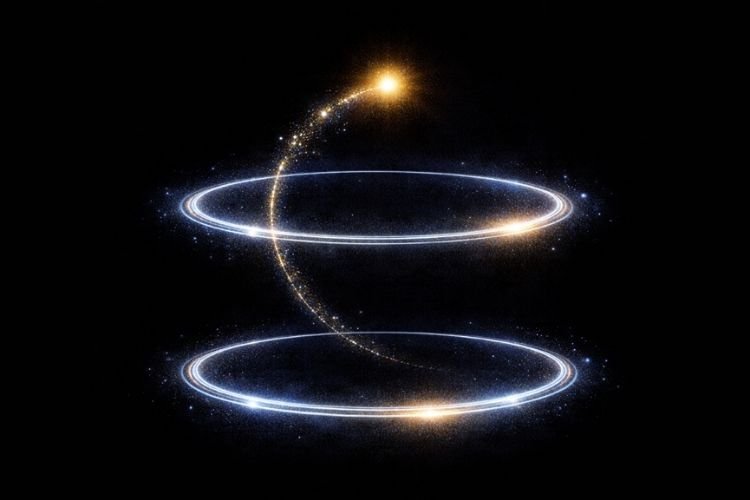
The image is a symbolic rather than a literal representation of a quantum transition.
For the Teenagers of the World — and of the Soul
Some changes appear sudden: a decision, a discovery, the moment when you realise that you are no longer the person you once were.
That does not mean they required no time. They were often being prepared silently within you, like a system receiving energy until a new state becomes possible.
Physics does not promise that we can change our lives through a magical quantum leap.
It does, however, offer us a powerful image: change does not always have to leave a visible trace on every intermediate step.
Keep this in mind:
A quantum leap is not remarkable because it crosses a great distance.
It is remarkable because it connects two allowed states without inhabiting an intermediate stationary state.
Echo from the Ancients
The Pythagorean tradition searched for number, proportion and harmony behind the visible world.
Quantum Physics is not a fulfilment of Pythagorean thought. It does, however, show us that nature does not always permit every conceivable value: the possible states are determined by precise mathematical relationships.
For the Pythagoreans, harmony arose from definite proportions.
In Quantum Physics, energy transitions obey definite differences.
They are not the same knowledge. They are two different paths inviting us to seek the order behind appearances.
Change may appear as a leap.
Its possibility, however, has its own unseen preparation.
The Poetic Bridge
A quantum leap does not explain how a human being changes. Human development does not obey the energy levels of an electron.
We may, however, borrow a powerful image from a quantum transition:
Not every preparation leaves a visible trace.
A decision may appear sudden.
Understanding may arrive in a single moment.
One day, a person may say, “I am no longer who I used to be.”
Yet that moment was rarely born on its own. It may have been preceded by questions, failures, small actions and quiet inner work that no one could yet see.
That is why we should not dismiss the periods during which nothing appears to be changing.
Not all gradual progress is visible.
And not every sudden change is unprepared.

