
Quantum Nugget #27 — The Vacuum
Not Matter — but Not Absolute Nothingness
Terms of the Day:
Physical Vacuum — Quantum Vacuum State
What remains when we remove all air, dust, light and every detectable particle from a region of space?
The everyday answer might be:
Nothing.
Physics, however, requires a more careful word:
Vacuum.
The vacuum of physics is not identical to philosophical Nothingness.
It is a particular physical state whose meaning depends upon the theory being used.
The Laboratory Vacuum
In a laboratory, a “vacuum” is a region from which as much matter as possible has been removed.
No laboratory vacuum is absolutely empty.
A few gas molecules, radiation and interactions with the walls of the container remain.
The quality of a vacuum is measured through its pressure and the density of the particles still present.
This is a technological vacuum: extremely sparse matter, not absolute non-existence.
Vacuum in Classical Physics
In the classical picture, we can imagine a region containing neither matter nor radiation.
Even then, space does not cease to possess geometry.
In General Relativity, spacetime can be curved and gravitational waves can travel through regions containing no ordinary matter.
“Vacuum” does not mean that the laws of nature have ceased to operate.
The Quantum Vacuum
In Quantum Field Theory, every fundamental field possesses a lowest-energy state.
This is called its vacuum state.
It is not a region from which the quantum fields themselves have been removed.
The fields remain part of the description; they are simply in their lowest-energy state.
The quantum vacuum is therefore not:
- A storehouse of hidden ordinary particles.
- An unlimited source of free energy.
- A conscious field.
- A secret substance from which we may create anything we desire.
It is the lowest-energy state of the quantum fields.
Why Can It Not Be Perfectly Still?
Quantum fields obey uncertainty relations.
In general, they cannot simultaneously possess an exactly defined value and an exactly defined rate of change.
Thus, even in their ground state, certain measurable quantities may display quantum fluctuations.
This does not mean that tiny particles literally appear from nothing and disappear before we can “catch” them.
The popular image of “virtual particles popping in and out of the vacuum” is a convenient but often misleading manner of speaking.
Virtual particles are primarily elements of particular mathematical calculations and are not detected like real particles.
The Higgs Field and the Vacuum
The Higgs field has a special property: its value in the vacuum state is not zero.
This does not mean that space is filled with ordinary Higgs bosons.
A Higgs boson is an excitation of the field, just as a ripple is an excitation of a surface.
The non-zero vacuum value of the Higgs field forms part of the mechanism through which elementary particles acquire mass.
Vacuum and Energy
In Quantum Field Theory, the vacuum state is associated with a reference energy.
When we attempt to connect quantum vacuum energy with gravity and the observed cosmological constant, however, we encounter one of the deepest unsolved problems in modern physics.
We still do not fully understand the relationship among:
- The quantum vacuum,
- gravity,
- and the accelerating expansion of the Universe.
The vacuum is not a completed story. It is one of the great frontiers of knowledge.
The Vacuum Does Not Create “Something” from Absolute Nothing
When physics describes particles being created from a quantum state or from powerful fields, it is not describing creation from philosophical Nothingness.
There are already:
- Quantum fields,
- physical laws,
- energy,
- and particular initial conditions.
The phrase “something arises from nothing” may therefore be poetic, but it is not a precise account of Quantum Physics.
A Philosophical Bridge
Philosophy may ask:
Why is there something rather than nothing?
Physics asks a different question:
What is the lowest-energy state of the fields, and what measurable properties does it possess?
The first question seeks the meaning of existence.
The second seeks a testable description.
Neither invalidates the other. They must not, however, be confused.
Keep This in Mind:
The quantum vacuum is not absolute Nothingness.
It is the lowest-energy state of the quantum fields.
It is not filled with tiny hidden balls of matter.
It is empty of real particles — not of physical structure.
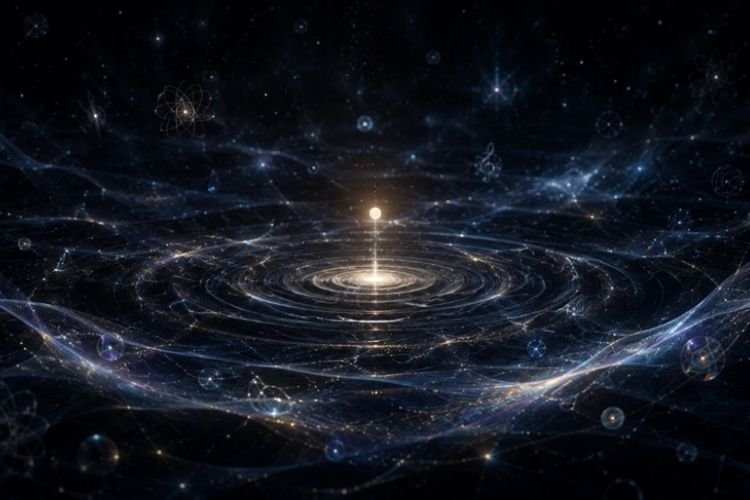
Visual note: The luminous ripples and atomic forms symbolise the presence of fields and possible excitations. They are not an image of the actual quantum vacuum or particles literally appearing from nothing.
Scientific references: Quantum Field Theory describes fundamental particles as excitations of fields present throughout space. The vacuum state is the lowest-energy state of these fields. The Higgs field has a non-zero vacuum value, while the Higgs boson is an excitation of that field. The relationship between quantum vacuum energy and gravity remains an open fundamental problem. CERN — Quantum Fields and the Higgs · CERN — The Higgs Boson · Einstein Online — Empty Universes and Vacuum

