Mythology Is Not a Fairy Tales
PYRRHICHIOS DANCE – ATHENS 2004 OLYMPIC GAMES
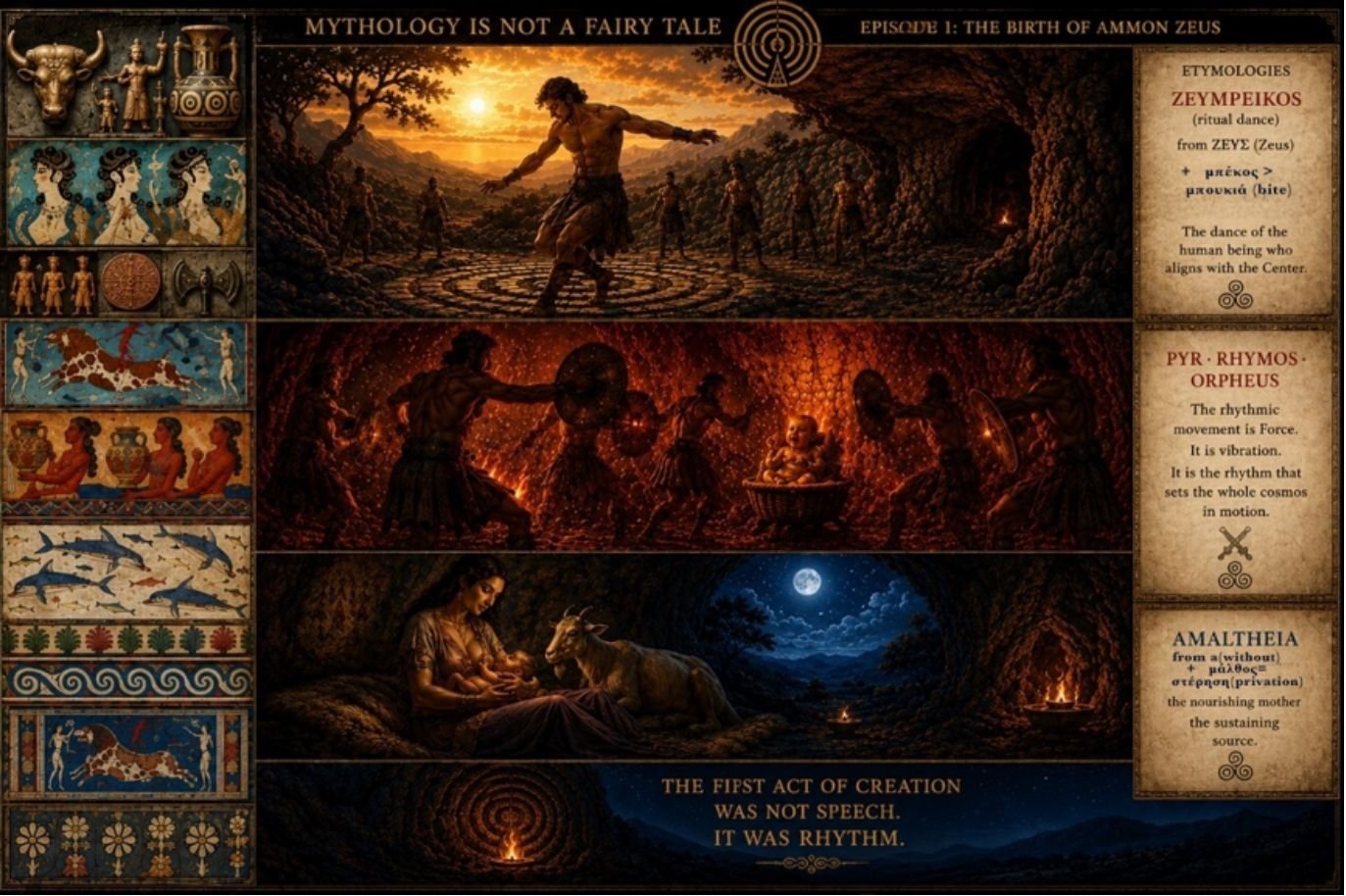
“Everything began here, in the geometry of Crete, beneath the shadow of Mount Psiloritis and the light of a primordial full moon.
When the Kouretes clashed their shields to drown out the crying of the divine infant, they did not merely create a noise; they delivered to humanity the Pyrrhichios*, the rhythm of guardianship, the sacred shield that protects the Seed of Life from the darkness.
From this very same pulse, centuries later, the Zeibekiko emerged. The dance of the solitary human being who does not pretend, who does not bend, but rotates around their own Center, conversing directly with the Universe.
For the first sound of creation was not a word. It was Rhythm.
From the cosmic milk of Amaltheia to the ends of the East, our Mythology is not a fairytale of the past. It is the hidden code of Nature itself, an eternal dance of energy, motion, and balance. We are the heirs of this Rhythm. And as long as our shields resound and our steps carve the earth, the ship of our truth will travel into the infinite, its sails full of Light.”
*Πλάτων – Νόμοι (7-815α)
ὄρχησιν λέγοι. τὴν πολεμικὴν δὴ τούτων, ἄλλην οὖσαν τῆς εἰρηνικῆς, πυρρίχην ἄν τις ὀρθῶς προσαγορεύοι, τάς τε εὐλαβείας πασῶν πληγῶν καὶ βολῶν ἐκνεύσεσι καὶ ὑπείξει πάσῃ καὶ ἐκπηδήσεσιν ἐν ὕψει καὶ σὺν ταπεινώσει μιμουμένην, καὶ τὰς ταύταις ἐναντίας, τὰς ἐπὶ τὰ δραστικὰ φερομένας αὖ σχήματα, ἔν τε ταῖς τῶν τόξων βολαῖς καὶ ἀκοντίων καὶ πασῶν πληγῶν μιμήματα ἐπιχειρούσας μιμεῖσθαι· τό τε ὀρθὸν ἐν τούτοις καὶ τὸ εὔτονον, τῶν ἀγαθῶν σωμάτων (815β) καὶ ψυχῶν ὁπόταν γίγνηται μίμημα, εὐθυφερὲς ὡς τὸ πολὺ τῶν τοῦ σώματος μελῶν γιγνόμενον, ὀρθὸν..
Pyrrhichios*(815a)…. the war dance, which differs from the dance of peace, could rightly be called the pyrrhichios. This dance imitates, on one hand, the movements a person makes to avoid all incoming blows, whether from close range or from afar—dodging to the side, retreating, leaping high, and crouching low; and on the other hand, it imitates the opposite movements, those that attempt to replicate offensive stances, namely the shooting of bows, the hurling of javelins, and gestures that mimic every kind of strike. The correctness and coordination found in these dances, when imitating beautiful bodies and beautiful souls, is achieved when all the limbs of the body maintain the straightness of their lines.
Note: In this episode, the name Ammon Zeus refers to the Cretan-born Zeus, who was later identified in cultic practice with the Egyptian Ammon. He should not be confused with Ammon—a king of a region of Libya—who appears in the distinct Libyan account recounted by Diodorus in Book III, chapters 68–74.

